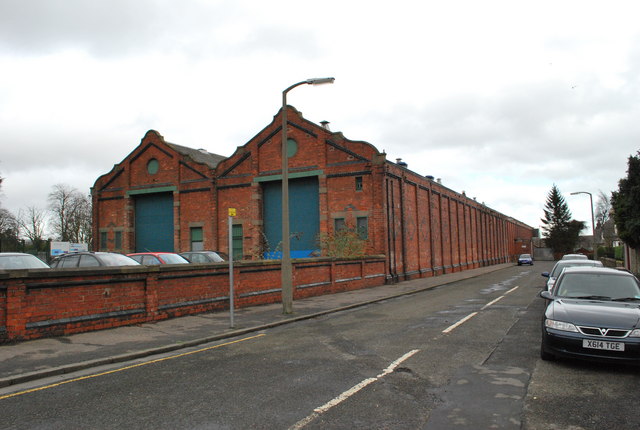
Behind the paired brick gables on Forfar Road, Dundee Corporation housed its electric tramcars in two long sheds. As the fleet grew, the sheds were extended backwards while their entrances stayed in the same place.
Quick facts
- Date
- Opened in 1901, extended in the 1910s and in 1920
- Type
- Former electric tram depot
- Designation
- Listed building, Category B (LB25307)
- OS grid reference
- NO 41432 32009
Architecture and history
The electric route to Maryfield opened on 6 March 1901. The first depot was about 60 metres long. Two extensions, the second in 1920, doubled its length and brought its capacity to around 70 cars.
Inside, a single line of cast-iron columns supported the two timber roofs. This left a long space on either side for tramcars. North-facing rooflights brought daylight into a building whose long side walls were divided into rows of shallow brick recesses.
When Dundee’s tram service ended in 1956, the corporation used Maryfield for buses. The depot housed a maintenance area and a paint shop. Dundee Museum of Transport acquired the site in 2015.
What to notice
- Look above the tram doors for the round openings in the gables. The curves are picked out in contrasting red and blue brick.
- The scale of the small side doors gives a measure of the width the tram entrances had to accommodate.
Location and Photos
The depot stands back from Forfar Road near the junction with Walrond Street. In November 2026 the museum was preparing the site for its move, following the closure of its Market Mews premises on 31 October.

Sources & further reading
- Historic Environment Scotland, LB25307 — Lists the brick sheds at Category B and describes their doors, cast-iron columns, roofs and forecourt rails.
- Dundee Museum of Transport, the Maryfield project — Gives the depot’s dimensions, capacity, extensions, bus workshops and acquisition in 2015.
- Dundee Museum of Transport — Records the closure of Market Mews and the museum’s preparations for its move to Maryfield.