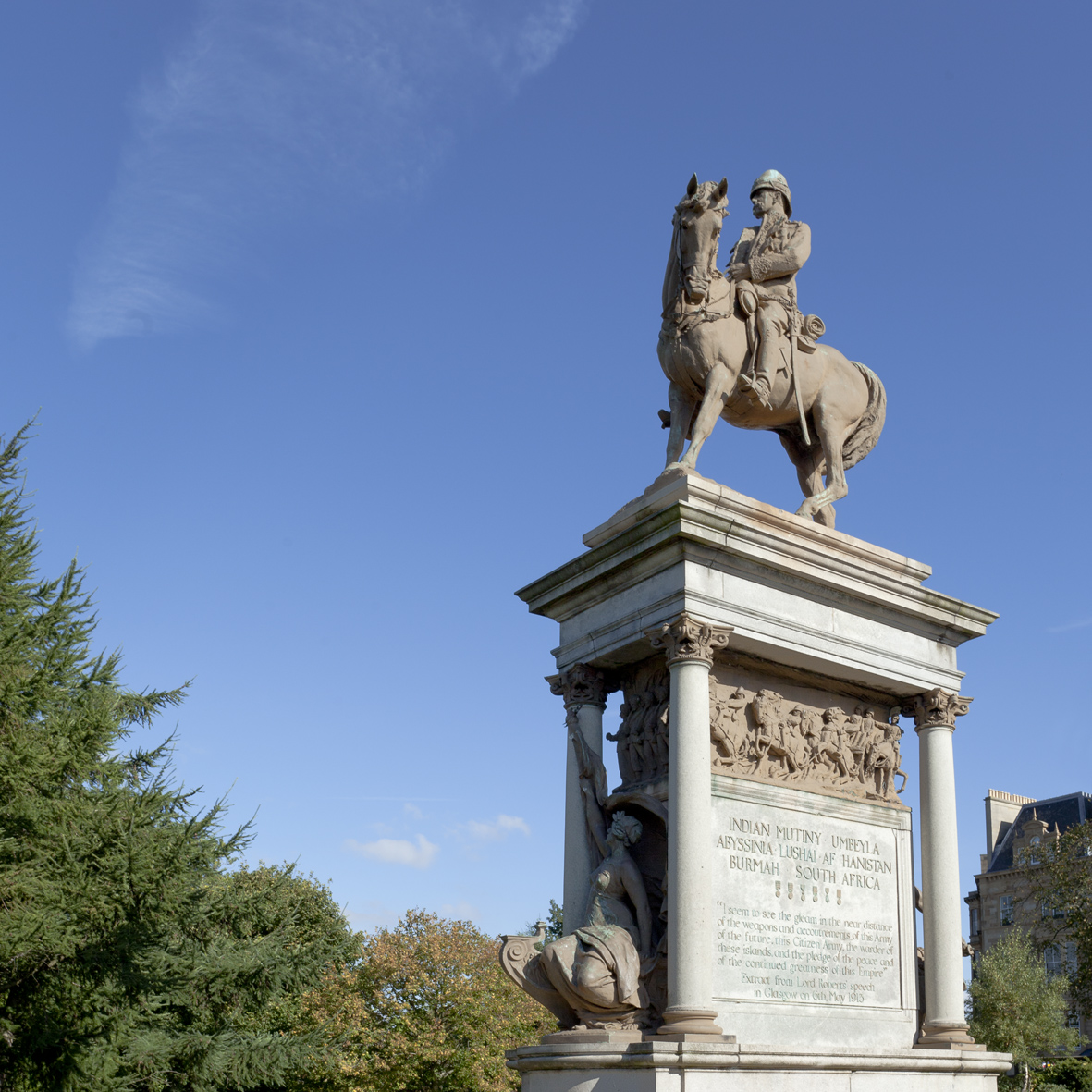
Image: Lord Roberts Memorial by Loustalotphotography, sourced from Wikimedia Commons and licensed under CC BY-SA 3.0.

The Lord Roberts Memorial is an unusually elaborate union of equestrian sculpture and classical architecture. Its bronze figures and martial reliefs preserve a powerful example of early twentieth-century imperial commemoration, while the campaigns they celebrate require critical historical reading.
Quick facts
- Date
- Unveiled 1916
- Architect / designer
- Replica of Harry Bates’s Calcutta memorial; Imperial War Museums also credits sculptor Henry Poole
- Type
- Equestrian bronze, allegorical figures and martial reliefs on a granite Corinthian aedicule
- Designation
- Listed building, Category A (LB32211)
- OS grid reference
- NS 57317 66481
An architectural monument, not only a statue
The mounted figure of Field Marshal Frederick Sleigh Roberts is raised above a substantial pink-granite structure in three principal stages. A tall moulded plinth supports four Corinthian columns and a canopy, which in turn carries the base of the life-size equestrian bronze. The arrangement turns the figure into a landmark visible through the park rather than placing it on an ordinary pedestal.
Within the columned frame is an oblong granite slab bearing dedicatory inscriptions. Bronze relief panels form a frieze of soldiers, horses, wagons and campaigning scenes. Seated life-size figures personifying War and Victory occupy the two sides. These layers require the visitor to move around the monument: the equestrian silhouette dominates at a distance, while inscriptions, decorations, reliefs and allegory become legible only at closer range.
Origin and replication
The Glasgow monument was unveiled in 1916. Historic Environment Scotland identifies it as a replica of the memorial to Roberts erected in Calcutta in 1915 and designed by Harry Bates. Imperial War Museums credits both Bates and Henry Poole in its record for the Glasgow memorial. Because Bates died in 1899, the monument belongs to the posthumous reproduction and completion of an established sculptural design rather than to a new portrait modelled from life for Glasgow.
Replication was part of the work’s meaning. Roberts’s reputation was constructed across the British Empire, and related monuments placed an almost identical heroic image in different imperial settings. In Glasgow, the granite canopy and bronzes were inserted into Kelvingrove Park, already a civic landscape of museums, bridges, fountains and memorials.
Who is commemorated
Roberts was born in India in 1832, entered the Bengal Artillery in 1851 and served through a succession of British imperial campaigns. He became widely known after the Second Afghan War, particularly for the march from Kabul to Kandahar in 1880, and later served as Commander-in-Chief in India. During the South African War he took command of British forces after early reverses. The National Army Museum notes that the strategy used by Roberts and his senior command included the burning of Boer farms and the internment of civilians in concentration camps, where more than 26,000 people died before conditions improved.
He was the last Commander-in-Chief of the British Army before that office was abolished in 1904. Roberts died of pneumonia in France in November 1914 while visiting Indian troops. The Glasgow inscription includes an extract from a speech he had delivered in the city on 6 May 1913, advocating a future “Citizen Army”. Installed during the First World War, the memorial therefore links retrospective celebration of colonial campaigns with contemporary arguments about military preparedness and imperial identity.
Reading the imagery critically
The monument presents Roberts through the visual language of command, victory and honour. The elevated horse and rider, Corinthian order, personifications and campaign reliefs convert complex wars into a coherent heroic narrative. The inscriptions list campaigns in India, Abyssinia, Afghanistan, Burma and South Africa and display Roberts’s decorations.
That is the viewpoint of the memorial, not a neutral account of the events. Many of the campaigns were wars of conquest or enforcement of British colonial rule. The South African campaign in particular involved policies with devastating civilian consequences. Architectural and sculptural quality can be studied without accepting the political message uncritically. The monument is valuable evidence for how military leadership and empire were represented in public space in 1916, and for how those representations are reassessed today.
Setting and public access
The memorial stands in publicly accessible Kelvingrove Park, close to the formal gateways and the Prince of Wales Bridge. Glasgow City Council states that the park is open at all times, although particular areas or routes may close temporarily for works or events. The monument can normally be approached from public park paths and viewed on all sides without any interior-access issue.
The surrounding park includes slopes, steps and changing path conditions. Visitors who need a particular step-free route should check current park information rather than assume that the shortest approach is accessible. Do not climb the granite structure or bronze work, and respect any temporary maintenance barriers.
What to notice
- The way four Corinthian columns and the canopy frame the equestrian figure.
- The change of scale from the distant horse-and-rider silhouette to the close-worked reliefs.
- The seated figures of War and Victory, which turn abstract ideas into human bodies.
- The campaign names, decorations and 1913 Glasgow speech used to construct a public biography.
- The relationship between pink granite, dark bronze and the planted park setting.
Timeline
- 1832 Frederick Sleigh Roberts is born in India.
- 1851–1904 His military career extends from the Bengal Artillery through campaigns across the British Empire to command of the British Army.
- 6 May 1913 Roberts speaks in Glasgow; an extract later forms part of the memorial inscription.
- 14 November 1914 Roberts dies in France while visiting Indian troops.
- 1915 The Calcutta memorial on which Glasgow’s version is based is erected.
- 1916 The Glasgow memorial is unveiled in Kelvingrove Park.
- 1970 The monument is added to the statutory list at Category A.
Evidence and uncertainty
The designation record securely establishes the date, form and relationship to the Calcutta monument. Imperial War Museums supplies the transcription and credits Harry Bates and Henry Poole, but the available records do not fully explain how responsibility for reproducing and completing the Glasgow version was divided. The HES statement gives Roberts’s birth year as 1852; biographical and memorial sources consistently give 1832, which is used here.
Sources & further reading
- Historic Environment Scotland: Roberts Memorial, LB32211 — Category A designation, mapped location, date, architectural and sculptural description, Calcutta precedent and Glasgow speech.
- Imperial War Museums: Field Marshal Earl Roberts VC, WMR-54682 — Location, inscription, campaign associations, maker credits and conservation record.
- National Army Museum: Frederick Roberts — Biographical chronology and critical account of his imperial military career and South African War command.
- Glasgow City Council: Kelvingrove Park — Current public-park status and general access information.
- Historic Environment Scotland: Kelvingrove Park, GDL00235 — Designed-landscape context and the memorial’s relationship to the park’s architectural features.
Location
OS grid reference NS 57317 66481 · Location confidence: High: the statutory designation supplies an official mapped National Grid Reference and the current source confirms the Place relationship or present identity. · Select the marker to open its satellite view in Google Maps. On desktop, drag Pegman (the yellow figure) onto a blue road. On mobile, turn on the Street View layer and tap a blue road. Other photo markers may be user-contributed.
Suggest a marker correction
Suggest a more accurate position
The teal marker is the current published position. The orange marker starts slightly to its right so both remain visible; this is only a visual starting position. Tap the correct place on the map or drag the orange marker. Sending this form creates a private review entry only; it does not move the published marker.
Check this area in Google Maps Choose the Satellite layer there if useful.
Map: © OpenStreetMap contributors. You can also enter checked coordinates below.