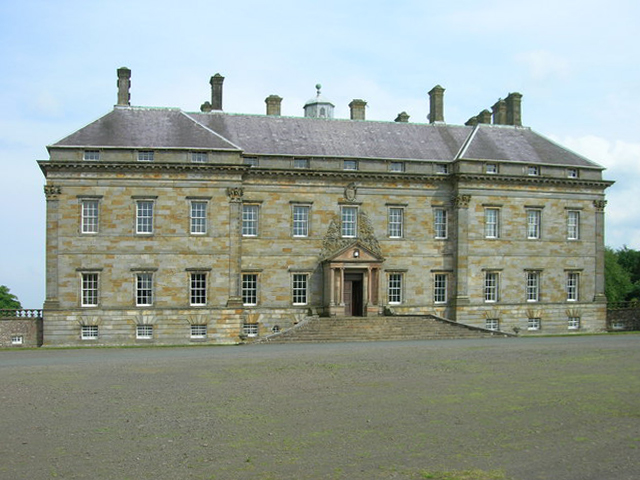


Sir William Bruce placed a rigorously classical mansion, courts, gates and gardens on an axis with Lochleven Castle across the water.
Quick facts
- Date
- 1684–95; later restoration completed 2013
- Architect / designer
- Sir William Bruce, architect and owner
- Type
- Classical country house and axial designed landscape
- Designation
- Listed building, Category A (LB11200)
- OS grid reference
- NO 12637 02044
Architecture, archaeology and continuing use
The eleven-bay ashlar house rises above a rusticated basement, with projecting end bays framed by giant Corinthian pilasters. Porticoes address the principal fronts, while quadrant links, garden houses, gates, walls and formal garden structures extend the architecture into the estate.
Its story
Bruce bought the Lochleven barony around 1680 and designed the house for himself. Built between 1684 and 1695, it became an early landmark of fully classical country-house design in Scotland. After long periods of changing ownership and disuse, a major modern restoration was completed in 2013.
Why it is included
Category A listing recognises an exceptionally influential house in which building, approach, garden and loch-side view were conceived as one ordered composition.
What to notice
- Giant Corinthian pilasters marking the projecting end bays.
- Long visual axis between the house and Lochleven Castle.
- Quadrant corridors linking the mansion to garden houses and enclosing walls.
Reading the surroundings
The estate is private and normally operates on an exclusive-use basis. Use its official booking information, do not enter drives or gardens without permission, and view distant elements only from lawful public routes.
Timeline
- Circa 1680 Sir William Bruce acquired the Lochleven estate and began planning a new seat.
- 1684–95 Mansion, courts and garden structures were assembled into a single axial scheme.
- 1819–91 The principal house stood unoccupied for much of the nineteenth century.
- 2013 A substantial private restoration returned the estate to active use.
What we know — and what remains uncertain
Current access depends on private bookings and events; no claim is made that the wider policies or interiors are normally open to non-guests.
Sources & further reading
- Historic Environment Scotland: Kinross House, LB11200 — Current designation status, mapped location, date, fabric and architectural or archaeological interest.
- Trove designation: LB11200 — Parallel national record identity and archival context.
- Kinross House: official website — Current estate use, accommodation, events and booking context.
- Kinross House: visitor FAQs — Current exclusive-use model, privacy and restoration information.
Location
OS grid reference NO 12637 02044 · Location confidence: High: the current national designation supplies an exact mapped National Grid Reference; public text separately states access and current-use uncertainty. · Select the marker to open its satellite view in Google Maps. On desktop, drag Pegman (the yellow figure) onto a blue road. On mobile, turn on the Street View layer and tap a blue road. Other photo markers may be user-contributed.
Suggest a marker correction
Suggest a more accurate position
The teal marker is the current published position. The orange marker starts slightly to its right so both remain visible; this is only a visual starting position. Tap the correct place on the map or drag the orange marker. Sending this form creates a private review entry only; it does not move the published marker.
Check this area in Google Maps Choose the Satellite layer there if useful.
Map: © OpenStreetMap contributors. You can also enter checked coordinates below.