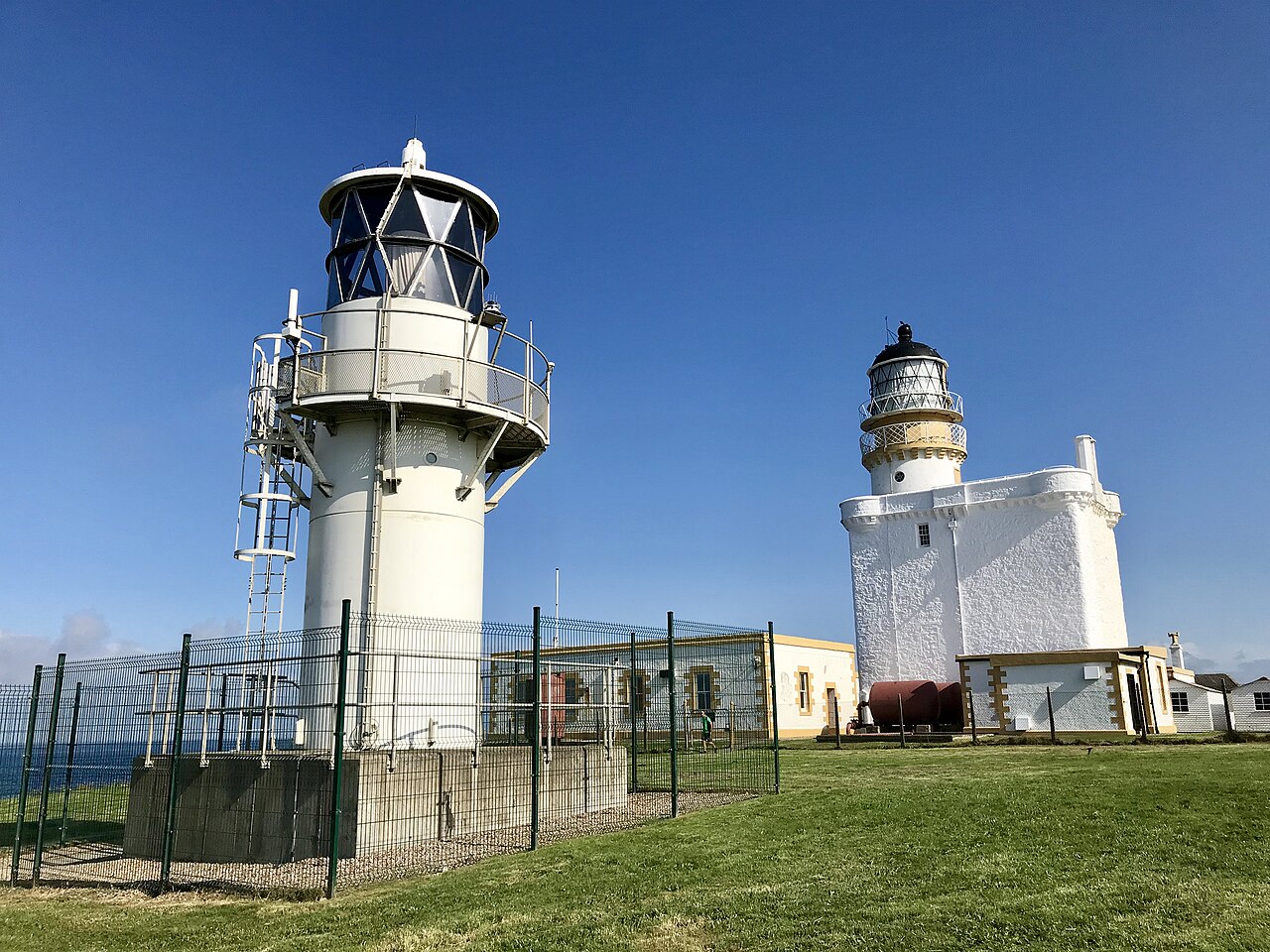
Kinnaird Head Castle Lighthouse. Photograph: Ellievking1 / Wikimedia Commons, CC BY-SA 4.0.

A sixteenth-century castle containing Scotland’s first mainland lighthouse now anchors a museum devoted to the nation’s lighthouse story.
Quick facts
- Date
- Castle built about 1570; lighthouse established 1787; remodelled 1824; decommissioned 1991
- Architect / designer
- Sir Alexander Fraser of Philorth; Thomas Smith; Robert Stevenson; later lighthouse work by Alan and David Stevenson
- Type
- Tower house converted into a lighthouse complex, with keepers’ cottages, engine house and foghorn
- Designation
- Listed building, Category A (LB31888)
- OS grid reference
- NJ 99864 67528
Architecture and continuing use
A harled tower house with corbelled parapet encloses the lighthouse stair and lantern. Flat-roofed keepers’ cottages, an engine house and the great concrete foghorn form a remarkably complete operational group on the headland.
Its story
The Frasers built the tower house around 1570. The Northern Lighthouse Board acquired it in 1786; Thomas Smith installed the first light in 1787 and Robert Stevenson rebuilt the lantern and stair in 1824. The old light was decommissioned in 1991 and retained as a museum.
A lighthouse built inside a castle
The lighthouse is more than a lantern placed on an old roof. A circular granite tower was constructed within the north-eastern part of the earlier tower house, with a stone spiral stair rising towards the optical apparatus. The castle’s irregular windows, vaulted basement and projecting bartizans remain legible around that inserted system. Other rooms were adapted as keepers’ accommodation in the nineteenth century.
Navigation depended on a group of buildings as well as the elevated light. The flat-roofed cottages housed keepers and families, while the engine house served the foghorn installed in 1902. The horn’s concrete enclosure faces the sea at the cliff edge. Reading these parts together explains the domestic labour, power and audible warning that supported the lantern, rather than treating the castle as an isolated picturesque tower.
What to notice
- Castle bartizans surrounding the projecting lantern.
- Relationship between tower, keepers’ cottages and engine house.
- The 1902 foghorn facing the sea.
- The circular lighthouse stair inserted within the older tower house.
Reading the surroundings
Museum entry and lighthouse access follow current opening, ticket and guided-tour arrangements. The cliff edge and operational museum areas require care.
Timeline
- About 1570 The Frasers of Philorth build the tower house at Kinnaird Head.
- 1787 Thomas Smith installs the first lighthouse within the castle.
- 1824 Robert Stevenson rebuilds the lantern and internal stair.
- 1991 The original light is decommissioned and retained as part of the museum.
- Present Museum of Scottish Lighthouses visitor attraction and preserved historic lighthouse complex.
What we know — and what remains uncertain
Tour frequency, weather access and individual room availability can change; the museum’s current visitor information takes precedence.
Sources & further reading
- Historic Environment Scotland: Kinnaird Head Castle Lighthouse, LB31888 — Designation status, mapped location, construction phases, fabric, authorship and architectural or historical interest.
- Museum of Scottish Lighthouses: Kinnaird Head Lighthouse — Current museum use, guided tours, opening information and visitor access.
- Northern Lighthouse Board: Kinnaird Head — Official lighthouse history and confirmation that the original light now houses the museum.
Location
OS grid reference NJ 99864 67528 · Location confidence: High: the statutory designation supplies an official mapped National Grid Reference and the current source confirms the Place relationship or present identity. · Select the marker to open its satellite view in Google Maps. On desktop, drag Pegman (the yellow figure) onto a blue road. On mobile, turn on the Street View layer and tap a blue road. Other photo markers may be user-contributed.
Suggest a marker correction
Suggest a more accurate position
The teal marker is the current published position. The orange marker starts slightly to its right so both remain visible; this is only a visual starting position. Tap the correct place on the map or drag the orange marker. Sending this form creates a private review entry only; it does not move the published marker.
Check this area in Google Maps Choose the Satellite layer there if useful.
Map: © OpenStreetMap contributors. You can also enter checked coordinates below.