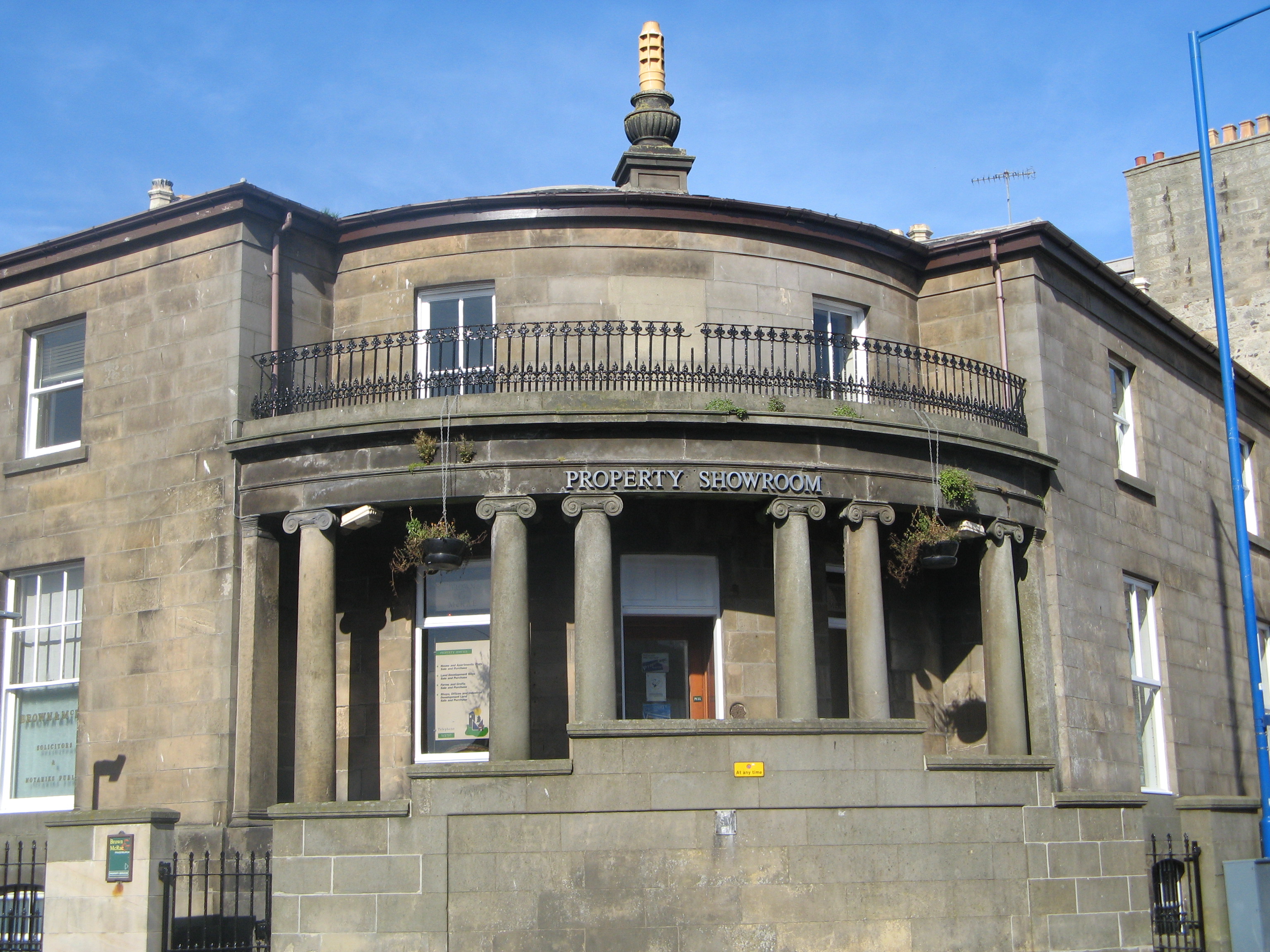
Image: Curving classical frontage of Fraserburgh Custom House, with a columned entrance beneath a balustraded parapet by Sagaciousphil, licensed under CC BY-SA 3.0.

A sweeping Ionic corner turns a former custom house and bank into one of Fraserburgh’s most assured classical commercial buildings.
Quick facts
- Date
- Built about 1820–1835
- Architect / designer
- Designed in the style of Archibald Simpson; exact authorship not established
- Type
- Classical former custom house and bank with a curved corner portico
- Designation
- Listed building, Category A (LB31873)
- OS grid reference
- NJ 99791 66932
Architecture and continuing use
Two ashlar storeys rise above a basement, with two-window street fronts joined by a curved three-window corner. Coupled Ionic columns support the entrance portico and a broad eaves line unifies the composition.
Its story
Built in the early nineteenth century as a custom house, the building was later occupied by the Bank of Scotland and became Anderson House. Its continuing office use reflects the commercial importance of the Broad Street approach to the harbour.
Why it is included
It is one of Fraserburgh’s three Category A listed structures and a refined architectural marker of maritime revenue, banking and professional life.
What to notice
- Coupled Ionic columns at the rounded corner.
- Segmental basement windows below the principal floor.
- Low roof line and distinctive urn chimney.
Reading the surroundings
This is a working professional office. View the exterior from public pavements and enter only for legitimate business or by arrangement.
Timeline
- Built about 1820–1835 Built in the early nineteenth century as a custom house, the building was later occupied by the Bank of Scotland and became Anderson House. Its continuing office use reflects the commercial importance of the Broad Street approach to the harbour.
- Present Professional offices of Brown & McRae solicitors and estate agents, known as Anderson House.
What we know — and what remains uncertain
HES describes the design as “style of Archibald Simpson”; this record does not convert that stylistic attribution into a confirmed commission.
Sources & further reading
- Historic Environment Scotland: Fraserburgh Custom House, LB31873 — Designation status, mapped location, construction phases, fabric, authorship and architectural or historical interest.
- Brown & McRae — Current professional-office use and Fraserburgh practice identity.
- Visit Fraserburgh: Brown & McRae — Current Anderson House address and local business-directory confirmation.
Location
OS grid reference NJ 99791 66932 · Location confidence: High: the statutory designation supplies an official mapped National Grid Reference and the current source confirms the Place relationship or present identity. · Select the marker to open its satellite view in Google Maps. On desktop, drag Pegman (the yellow figure) onto a blue road. On mobile, turn on the Street View layer and tap a blue road. Other photo markers may be user-contributed.
Suggest a marker correction
Suggest a more accurate position
The teal marker is the current published position. The orange marker starts slightly to its right so both remain visible; this is only a visual starting position. Tap the correct place on the map or drag the orange marker. Sending this form creates a private review entry only; it does not move the published marker.
Check this area in Google Maps Choose the Satellite layer there if useful.
Map: © OpenStreetMap contributors. You can also enter checked coordinates below.