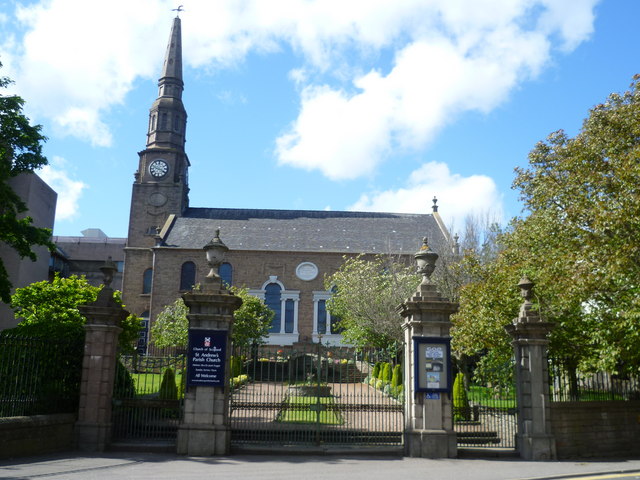


Dundee’s 1770s Trades Kirk combines a restrained Palladian body with an elaborate five-stage steeple, while craft associations remain visible in its glass, banners and continuing worship.
Quick facts
- Date
- Dated 1772; completed 1774; later alterations and 1939 restoration
- Architect / designer
- Built by Samuel Bell from plans prepared by James Craig
- Type
- Rectangular Palladian church with gallery, graveyard and staged Classical steeple
- Designation
- Listed building, Category A (LB25279)
- OS grid reference
- NO 40453 30694
- Current use
- Kingsgait Kirk worship base; sanctuary refurbishment under way in 2026
Architecture
The former St Andrew’s Church is a rectangular rubble-built kirk, probably intended to be harled, with ashlar dressings and a symmetrical principal elevation. Round-headed doors and windows are arranged around two Venetian windows articulated by Ionic pilasters and swags. A dentilled cornice binds the wall top, while urn finials mark the eastern gable and the surrounding boundary.
The west tower rises in five diminishing stages. Square lower stages contain round-headed openings and a Diocletian window; a plaque records the 1939 restoration. Above, clock faces sit between corner urns, then an octagonal belfry with attached columns supports a stone spire punctured by three tiers of small circular openings. A dragon weather vane gives the skyline a particularly Dundee character.
Interior and the Trades
The interior centres on a semi-octagonal gallery carried by six Doric columns and a panelled pulpit with an Ionic, pedimented backboard. Later emblems of Dundee’s Trades appear on the gallery. The Venetian windows contain glass presented by the Three and Nine Trades in 1892, while other windows include work by Mayer and Company, William Wilson, Gordon Webster and Douglas Hogg. Trades banners and chairs reinforce the long association between the church and the city’s craft corporations.
Kingsgait Kirk states that individual Trades hold services through the year, its minister acts as Worthy Chaplain, and the annual Kirkin’ o the Trades is hosted by the congregation.
Origins and congregational change
The church is dated 1772 and was completed in 1774, built by Samuel Bell from plans James Craig had prepared in 1769. It provided additional accommodation beyond Dundee’s crowded burgh churches and became closely identified with the Incorporated Trades. The graveyard retains eighteenth- and nineteenth-century monuments; part was reshaped as a garden of remembrance in 1953. Rusticated gatepiers date from 1810 and were altered in 1828.
The historic name St Andrew’s remains important, but the present congregation is Kingsgait Kirk, created in 2022 by the union of Meadowside St Paul’s and St Andrew’s. The King Street church is the worship base, while the former Meadowside St Paul’s buildings on Nethergate form the mission base.
Why it matters
The building is a notable survival of later eighteenth-century Scottish church design. Its simple rectangular preaching space is paired with an unusually elaborate civic steeple, and the interior records a continuing institutional relationship between worship and Dundee’s organised trades. Church, graveyard, gates and boundary ironwork form one historic ensemble.
What to notice
- The shift from square to octagonal stages as the steeple rises.
- The clocks, corner urns, louvred belfry and dragon weather vane.
- The Venetian windows, swags and Ionic detail on the south elevation.
- When the sanctuary reopens, the Doric gallery, Trades emblems, banners, chairs and several generations of stained glass.
- The surviving graveyard monuments and early-nineteenth-century gatepiers.
Access during the 2026 refurbishment
Kingsgait Kirk’s current notice says Sunday worship remains at 11am but has moved into the adjacent Glasite Hall while the sanctuary is refurbished. The congregation’s project brief seeks a more accessible, adaptable and comfortable worship space while preserving historic character, but it does not make the sanctuary a general building site visit. Until the works are complete, visitors should not expect routine interior access to the listed church. Attend an advertised service in the stated venue or contact the congregation before a specialist visit; the exterior, steeple, graveyard boundary and setting can be appreciated from public streets.
Timeline
- 1769 James Craig prepares plans for the church.
- 1772–1774 Samuel Bell builds the kirk, dated 1772 and completed in 1774.
- 1810 and 1828 Gatepiers are erected and later altered.
- 1892 The Three and Nine Trades present stained glass for the Venetian windows.
- 1939 A major restoration is recorded on the tower.
- 1953 Part of the graveyard becomes a garden of remembrance.
- 2022 Meadowside St Paul’s and St Andrew’s unite as Kingsgait Kirk.
- 2026 Worship moves temporarily to the Glasite Hall during sanctuary refurbishment.
What we know — and what remains uncertain
The designation securely records the historic fabric and fittings. Kingsgait Kirk’s dated notices establish the 2026 refurbishment and temporary worship arrangement, but construction programmes can change. Visitors should therefore check the congregation’s current notice rather than assume that the sanctuary has reopened.
Sources & further reading
- Historic Environment Scotland: 2 King Street, St Andrew’s Church, LB25279 — Category A designation, architecture, interior, graveyard, gates, Trades furnishings and dates.
- Kingsgait Kirk: current notice — Current 11am worship time and temporary move to the Glasite Hall during refurbishment.
- Kingsgait Kirk: about the congregation — The 2022 union, worship base and mission base.
- Kingsgait Kirk: sanctuary refurbishment — Project objectives, architect and dated progress notices.
- Kingsgait Kirk: the Trades — Continuing services and relationship with Dundee’s incorporated trades.
Explore further
Location
OS grid reference NO 40453 30694 · Location confidence: High: the statutory designation supplies a mapped National Grid Reference and a current official operator, responsible public body or institutional source confirms the Place relationship and present identity. · Select the marker to open its satellite view in Google Maps. On desktop, drag Pegman (the yellow figure) onto a blue road. On mobile, turn on the Street View layer and tap a blue road. Other photo markers may be user-contributed.
Suggest a marker correction
Suggest a more accurate position
The teal marker is the current published position. The orange marker starts slightly to its right so both remain visible; this is only a visual starting position. Tap the correct place on the map or drag the orange marker. Sending this form creates a private review entry only; it does not move the published marker.
Check this area in Google Maps Choose the Satellite layer there if useful.
Map: © OpenStreetMap contributors. You can also enter checked coordinates below.