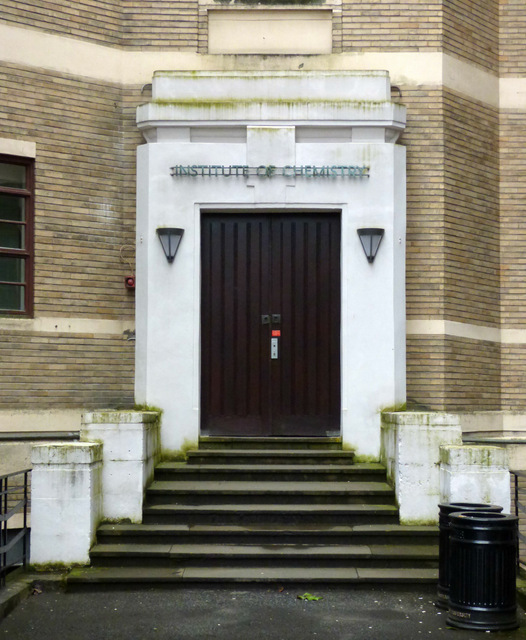
Image: Joseph Black Building by Thomas Nugent, sourced from Wikimedia Commons and licensed under CC BY-SA 2.0.

Radiating yellow-brick wings and glazed stair towers gave Glasgow chemistry an unusually bold, functional campus building before and after the Second World War.
Quick facts
- Date
- Designed 1936–1939; completed 1950–1954; later extensions and refurbishments
- Architect / designer
- T Harold Hughes with D S R Waugh; later work by Alexander Waugh & Kay
- Type
- Art Deco chemistry teaching and research complex with radiating wings
- Designation
- Listed building, Category A (LB32918)
- OS grid reference
- NS 56614 66700
Architecture and continuing use
Three-storey wings spread in a butterfly plan from a central body, linked by curving, fully glazed stairs. Narrow yellow Roman brick, concrete bands, carved stairwells and a sweeping entrance drive produce a distinctive Art Deco composition.
Its story
The University approved a dedicated chemistry building in 1936, but wartime interruption delayed full completion. Later additions and repeated laboratory refurbishment allowed the School of Chemistry to remain in the building.
Why it is included
Innovative planning, unusual materials and long-lived scientific use make the Category A complex a major Scottish higher-education building.
What to notice
- Butterfly plan best understood from the spaces between wings.
- Curved vertical glazing to the stair towers.
- Brick-and-concrete contrast and carved entrance details.
Reading the surroundings
This is an active teaching and research building. Visitors should use authorised entrances and university arrangements; laboratories and staff areas are restricted.
Timeline
- 1936 The University approved plans for a purpose-built Institute of Chemistry.
- 1939 The first construction campaign reached interruption at the outbreak of war.
- 1950–1954 Post-war work completed the principal building.
- 2026 The School of Chemistry remains based in the Joseph Black Building.
What we know — and what remains uncertain
Several later additions and refurbishments belong to the working complex, but this overview centres on the listed 1930s and post-war design.
Sources & further reading
- Historic Environment Scotland: Joseph Black Building, LB32918 — Designation category, mapped location, construction phases, fabric, authorship and architectural or historical interest.
- University of Glasgow: School of Chemistry contact — Current School of Chemistry occupation, address and campus access information.
- University of Glasgow: history of chemistry buildings — Official design, construction and continuing-use history.
Location
OS grid reference NS 56614 66700 · Location confidence: High: the HES designation provides an official mapped National Grid Reference and the current source confirms the Place relationship or present identity. · Select the marker to open its satellite view in Google Maps. On desktop, drag Pegman (the yellow figure) onto a blue road. On mobile, turn on the Street View layer and tap a blue road. Other photo markers may be user-contributed.
Suggest a marker correction
Suggest a more accurate position
The teal marker is the current published position. The orange marker starts slightly to its right so both remain visible; this is only a visual starting position. Tap the correct place on the map or drag the orange marker. Sending this form creates a private review entry only; it does not move the published marker.
Check this area in Google Maps Choose the Satellite layer there if useful.
Map: © OpenStreetMap contributors. You can also enter checked coordinates below.