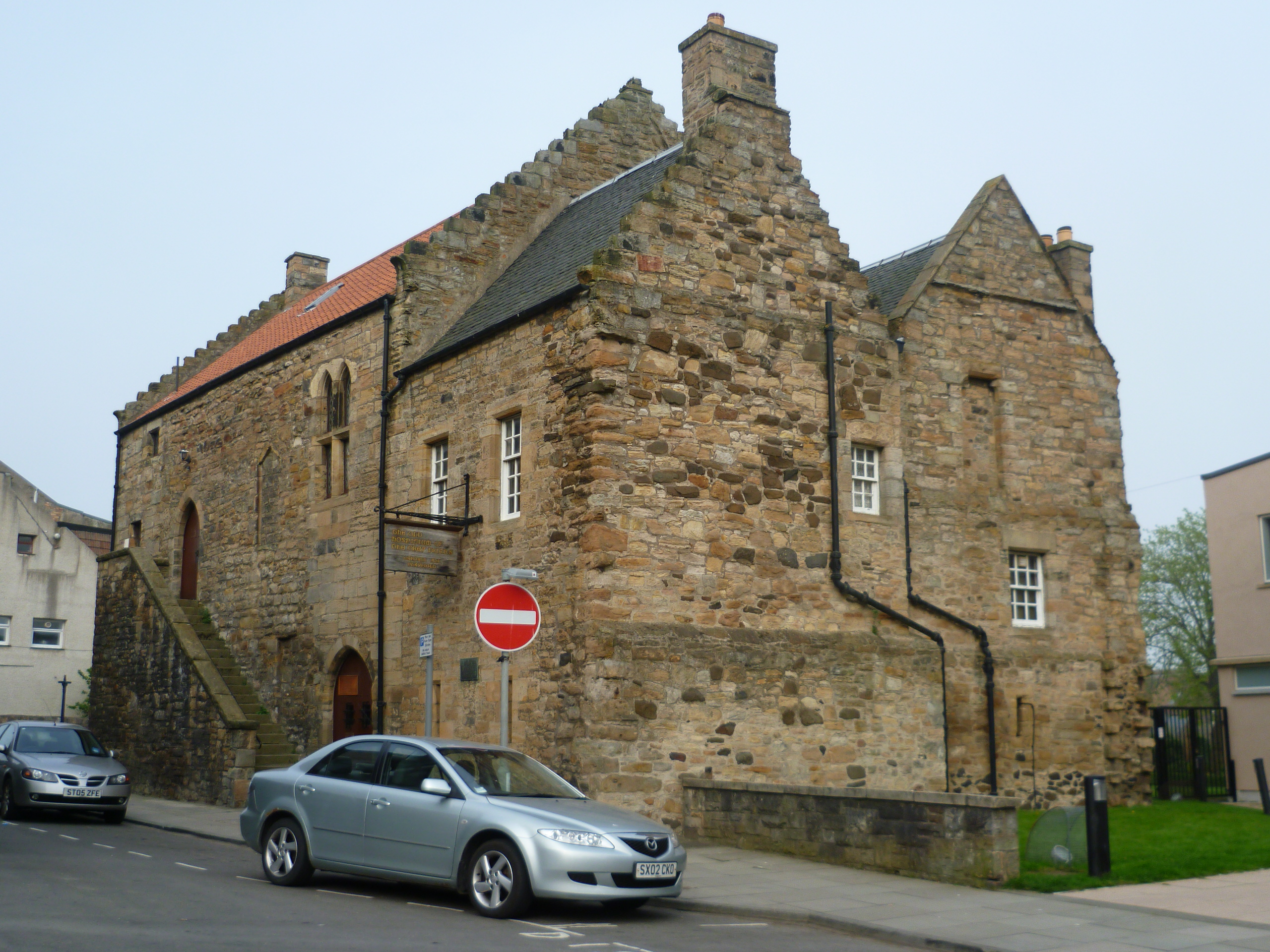
Image: Hospitium of the Grey Friars in Inverkeithing by Kim Traynor, 20 April 2011, sourced from Wikimedia Commons and licensed under CC BY 3.0.

A rare urban Franciscan guest range survives with vaulted cellars and a well, preserving both medieval hospitality and later burgh adaptation.
Quick facts
- Date
- Mid fourteenth century; remodelled in the seventeenth century; museum conversion 1934–37
- Architect / designer
- Franciscan community and successive burgh owners; later conversion designer unrecorded
- Type
- Medieval friary guest range with vaulted cellars, well and later domestic fabric
- Designation
- Listed building, Category A (LB35100)
- OS grid reference
- NT 12949 82757
Architecture and continuing use
Random rubble walls, pointed openings, crowsteps and a forestair define the surviving west range. Below and beside it, ruined vaults preserve parts of the friary undercroft, while a historic well marks the former cloister area. Seventeenth-century remodelling and twentieth-century museum work remain readable within the medieval envelope.
Its story
A Franciscan house was established after 1346 and fully endowed by 1384. Its hospitium served guests and carried royal associations, including Annabella Drummond. John Swynton purchased the friary in 1559, and later owners adapted the range as housing. Public acquisition supported museum conversion in the 1930s, but the museum subsequently closed and long-term reuse remains under consideration.
Why it is included
Category A listing recognises a nationally important late medieval urban religious survival with unusual archaeological depth and a long record of secular reuse.
What to notice
- Pointed doorways and lancets within later altered walling.
- Vaulted cellar remains defining a lost friary range.
- Relationship between hospitium, well and terraced garden.
Reading the surroundings
Enjoy the public Friary Gardens within posted hours and restrictions, but treat fenced or unsafe areas as closed. Do not enter the hospitium, cellars or well unless a managed visit is advertised, and never climb or move masonry.
Timeline
- After 1346 Franciscan friars established a conventual complex beside the burgh centre.
- 1559 Purchase by John Swynton began the site’s long transition to secular ownership.
- 1934–37 Conversion created a local museum within the surviving guest range.
- 2020s Closure and condition concerns prompted study of a safer sustainable future use.
What we know — and what remains uncertain
Some ranges survive only archaeologically, and proposals for future reuse do not establish a current opening date or access arrangement.
Sources & further reading
- Historic Environment Scotland: Inverkeithing Friary Hospitium, LB35100 — Current designation status, mapped location, date, fabric and architectural interest.
- Trove designation: LB35100 — Parallel national record identity and archival context.
- Fife Historic Buildings Trust: Inverkeithing heritage regeneration — Current conservation, reuse and restricted-interior context for the Friary.
- Fife Council: Friary Gardens — Current public-garden identity, facilities and historical setting.
Location
OS grid reference NT 12949 82757 · Location confidence: High: the current national designation supplies an exact mapped National Grid Reference; public text separately states access and current-use uncertainty. · Select the marker to open its satellite view in Google Maps. On desktop, drag Pegman (the yellow figure) onto a blue road. On mobile, turn on the Street View layer and tap a blue road. Other photo markers may be user-contributed.
Suggest a marker correction
Suggest a more accurate position
The teal marker is the current published position. The orange marker starts slightly to its right so both remain visible; this is only a visual starting position. Tap the correct place on the map or drag the orange marker. Sending this form creates a private review entry only; it does not move the published marker.
Check this area in Google Maps Choose the Satellite layer there if useful.
Map: © OpenStreetMap contributors. You can also enter checked coordinates below.