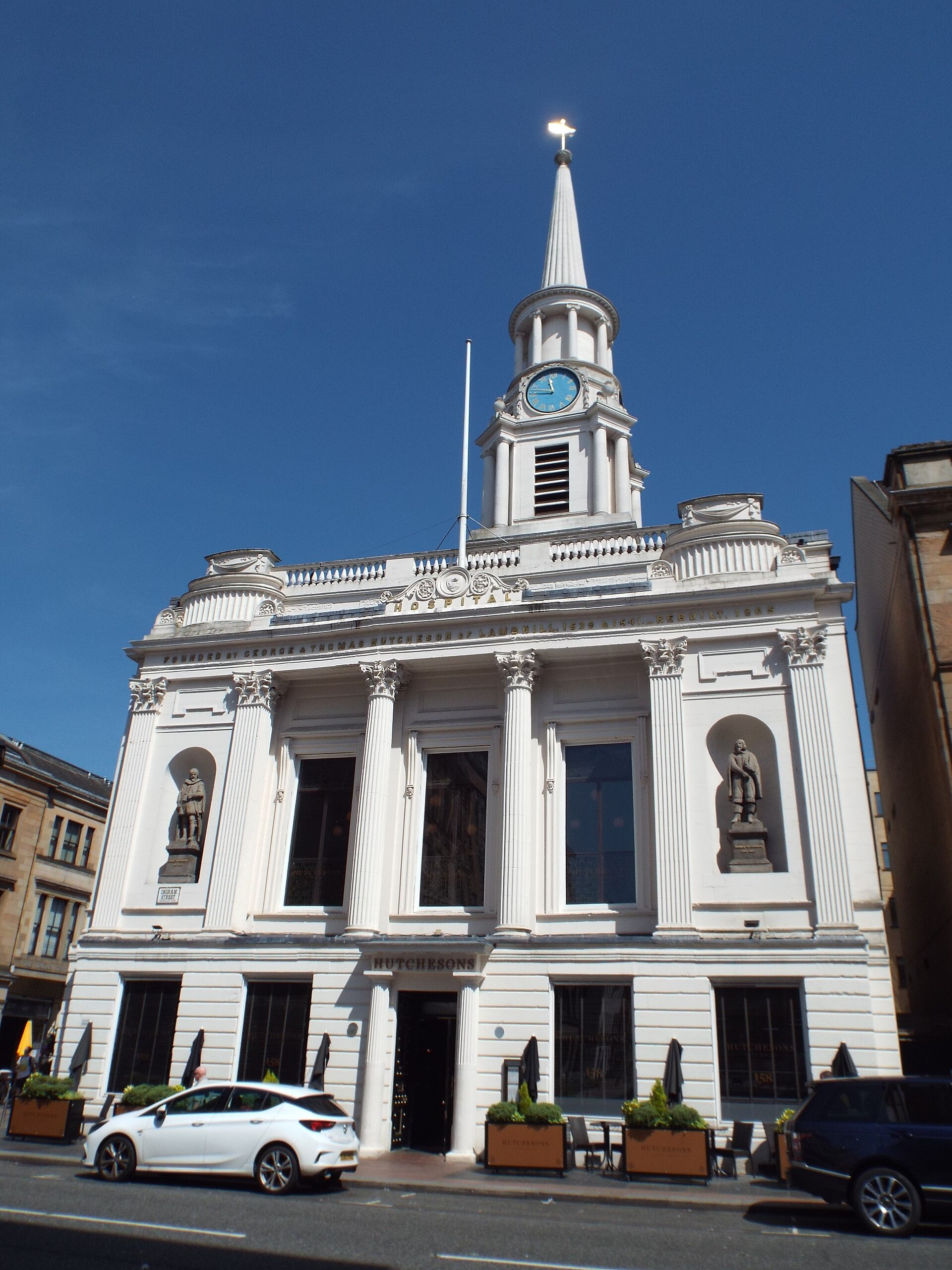
David Hamilton’s classical hall turns a charitable institution into a Merchant City landmark, carrying seventeenth-century founder statues beneath a remarkably slender tower and spire.
Quick facts
- Date
- Built 1802–1805; founder-statue niches added 1824; interior recast 1876
- Architect / designer
- David Hamilton; interior recast by John Baird II; statues by James Colquhoun
- Type
- Classical former hospital and hall, now a restaurant and events venue
- Designation
- Listed building, Category A (LB32744)
- OS grid reference
- NS 59422 65250
Architecture
The five-bay Ingram Street front is symmetrical and carefully hierarchical. A channelled ground floor supports a double-height first-floor composition, where Corinthian columns in antis frame the three recessed central bays. A Roman Doric porch marks the entrance, while niches in the end bays contain the statues of George and Thomas Hutcheson. An inscribed frieze, cornice, central scroll pediment and balustraded parapet complete the main front.
The John Street elevation is simpler, with broad bays, pilasters, pedimented tripartite windows and an attic. Above the corner rises the building’s most distinctive feature: a four-stage square tower. Tuscan columns frame its louvred openings, a clock occupies the next stage, and an Ionic tempietto narrows into a needle spire crowned by a gilded orb and cross.
The hall within
The principal interior is not simply Hamilton’s work of 1802–1805. John Baird II completely recast it in 1876 in a heavy classical manner. The first-floor hall has deeply modelled architraves and pediments, painted glass, wainscot panelling, elaborate chimneypieces with Ionic columns, a richly divided ceiling and a scale-and-platt stair with carved timber balusters. This later Victorian campaign is an important part of the listed building’s character.
Charity, continuity and the founder statues
George and Thomas Hutcheson left endowments in 1639 and 1641 for a hospital and school serving poor and elderly people in Glasgow. The present building replaced the earlier seventeenth-century hospital and was conceived as a home for aged men. The two statues, carved by James Colquhoun in 1649, were transferred from the old hospital and placed in new façade niches in 1824.
The statues are therefore more than decoration: they carry the memory of the earlier institution into Hamilton’s nineteenth-century building. The charitable foundation also survives beyond the hall through institutions that developed from the Hutcheson bequests; the hall itself has passed through changing uses.
Why it matters
Hutchesons’ Hall is one of the clearest architectural terminations in central Glasgow, closing the view along Hutcheson Street. Its significance combines Hamilton’s assured urban classicism, Baird’s lavish interior, unusually early surviving public sculpture and the long civic history of the Hutcheson foundation. Continued use for gathering preserves something of the building’s social purpose even though hospitality has replaced institutional charity.
What to notice
- The Roman Doric entrance porch against the channelled ground floor.
- The recessed Corinthian colonnade across the double-height first floor.
- George and Thomas Hutcheson’s 1649 statues, older than the present building.
- The tower’s progression from square stages to Ionic tempietto and needle spire.
- The first-floor hall’s 1876 panelling, chimneypieces, painted glass and divided ceiling.
- The building’s role as the formal end of the view north along Hutcheson Street.
Visiting and accessibility
Saints of Ingram currently operates the ground floor as a restaurant and bar. Its official homepage lists opening Tuesday–Thursday 12 noon–10pm, Friday–Saturday 12 noon–midnight, Sunday 1pm–10pm, and closure on Monday. These commercial hours can change, so booking information should be checked before travel.
The first-floor Grand Hall is used for weddings, receptions and private events, and the second-floor Experience Room for pre-arranged tastings and masterclasses. Access to these upper-floor spaces is by arrangement. The operator states that a lift serves all three floors; visitors with specific access requirements should confirm the route and facilities when booking.
Timeline
- 1639 and 1641 George and Thomas Hutcheson left charitable endowments for a hospital and school.
- 1649 James Colquhoun carved the founder statues for the earlier hospital.
- 1802–1805 David Hamilton designed and completed the present Hutchesons’ Hospital.
- 1824 Niches were created for the older founder statues.
- 1876 John Baird II completely recast the interior in a heavy classical style.
- Present Saints of Ingram operates a restaurant, bar, events hall and booked experience room across the three floors.
What we know — and what remains changeable
The statutory record securely establishes the fabric, authorship, dates, statue history and 1876 interior. The operator confirms the current uses, address, lift and published trading hours. Restaurant hours, event access and room availability are operational and may change; the details here were checked on 26 September 2026.
Sources & further reading
- Historic Environment Scotland: Hutchesons’ Hall, LB32744 — designation, grid reference, architecture, interior, statue history and streetscape significance.
- Saints of Ingram — current restaurant and events operation, room uses, lift, hours, booking and contact information.
- Saints of Ingram: building history — operator account of the charitable foundation, present use and surviving architectural features.
Hutchesons’ Hall. Photograph: BrainiacBlink, 27 June 2018. CC BY-SA 4.0.
