Sir Robert Rowand Anderson’s richly considered late-Victorian church now houses the Govan Stones, bringing a major work of ecclesiastical architecture together with evidence for Govan’s early medieval religious and political importance.
Quick facts
- Date
- Built 1883–1888; chancel lengthened in 1906 and dedicated in 1908
- Architect / designer
- Sir Robert Rowand Anderson
- Type
- Early Pointed cruciform church, now a seasonal heritage attraction and home of an exceptional early medieval sculpture collection
- Designation
- Listed building, Category A (LB33353)
- OS grid reference
- NS 55349 65917
Architecture
Anderson designed a cruciform church in an Early Pointed Gothic manner, using red brick internally and grey ashlar bands to create a deliberately polychromatic effect. Tall lancets, rose windows, buttresses and steep slate roofs give the exterior its disciplined medieval character. A projected steeple at the west end was never built: its foundations and the abrupt brick wall where a porch was meant to connect with it make the incompleteness legible.
The wide nave has a timber roof carried on clustered wall shafts, narrow aisles and small galleries. The chancel extension of 1906 adds an elaborate blind arcade, carved foliage, encaustic tiles and wrought-iron gates. Stained glass includes work by C. E. Kempe, Clayton and Bell, and Shrigley and Hunt. Historic Environment Scotland notes that the design drew on Italian Franciscan churches and Pluscarden Priory rather than simply copying one Scottish medieval model.
An ancient site in a nineteenth-century building
The present building is the sixth known church on the site. Its north–south orientation reflects the foundations of the previous church of 1826, itself built over a much earlier religious centre. Anderson’s church therefore belongs to a long sequence rather than marking the beginning of worship at Govan.
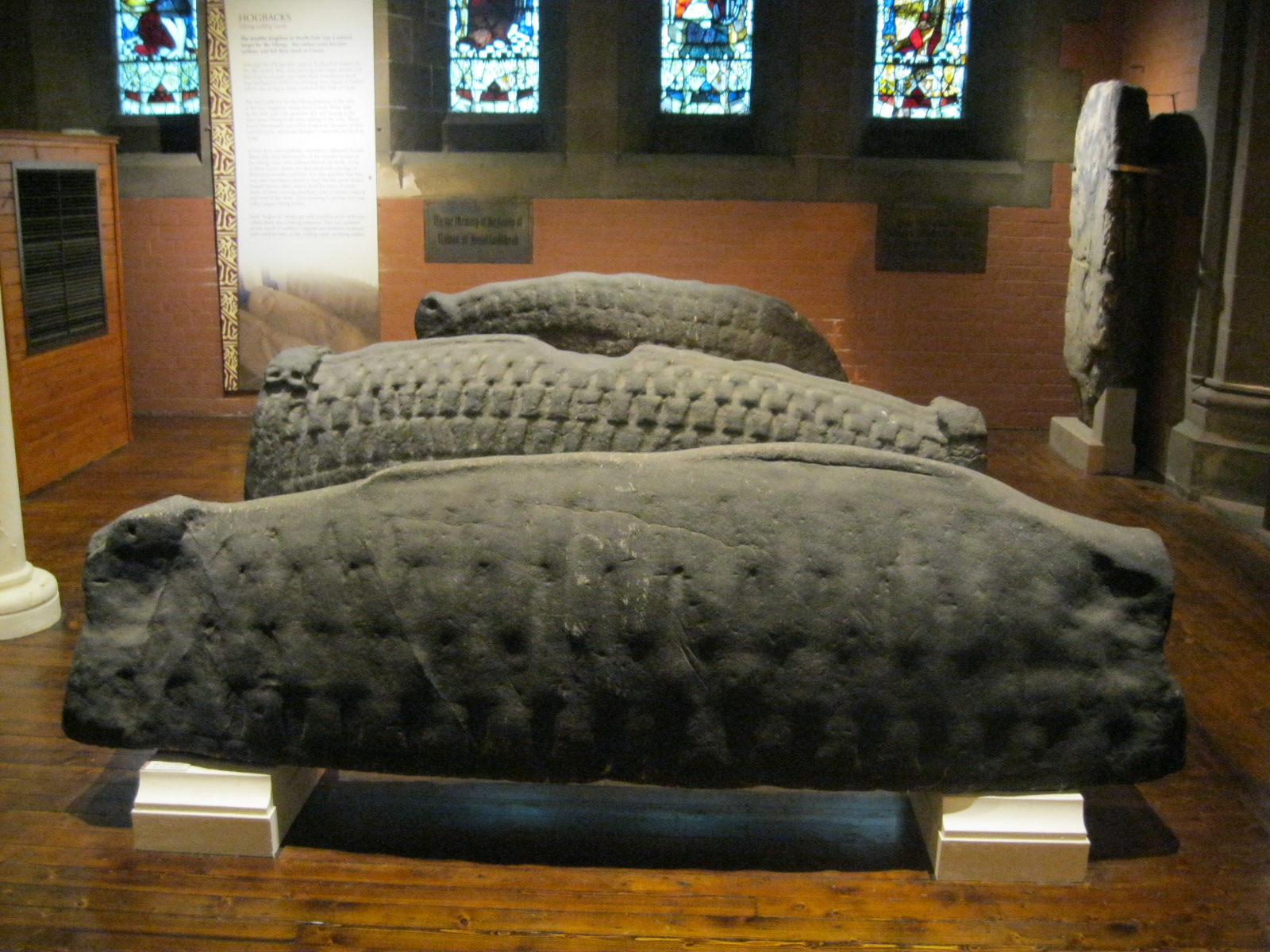
The carved stones make that earlier history tangible. The collection includes cross-shafts, recumbent slabs, upright crosses, hogback monuments and the Govan Sarcophagus. Most of the monuments now inside were moved from the surrounding graveyard in 1926 for protection. Their dates and meanings are matters of continuing scholarship, but together they show that Govan was an important centre of power and belief in the early medieval kingdom of Strathclyde.
From parish church to heritage centre
Govan Old ceased to function as an ordinary Church of Scotland parish church and is now cared for as the home of the Govan Stones. The building supports seasonal visiting, guided tours, learning, conservation and public events. This new use allows both the architecture and the sculpture collection to be read together, while continuing repair work seeks to improve the building’s long-term accessibility.
Why it matters
Govan Old is significant on two connected levels. It is an outstanding church by Rowand Anderson, one of the leading Scottish architects of his generation, and it shelters one of Britain’s most remarkable groups of early medieval carved stones in the place where they were found. The combination of building, monuments and burial ground gives the site an unusual depth of continuity.
What to notice
- The unbuilt steeple junction at the west end, where the intended composition stops short.
- The contrast between red brick and grey stone bands in the nave.
- The tall lancets, rose windows and traceried openings, each adapted to a different part of the cruciform plan.
- The extended chancel’s tiled floor, carved arcade and wrought-iron gates.
- The variety of early medieval monuments, especially the hogbacks and the Govan Sarcophagus.
Visiting and access
The Govan Stones currently advertises free opening daily from 1 April to 31 October, 11am–4pm, with guided tours available from 1pm; larger groups should contact the venue in advance. These are seasonal arrangements, so check the official visitor page before travelling.
Renovation work is intended to make the church fully accessible, but the operator’s 2026 guidance says the present entrance still has five steps. A mobile ramp can be provided but is not suitable for larger powered wheelchairs, and temporary toilets during the works are not wheelchair accessible. The team asks visitors who may need assistance to contact it before arrival. The graveyard and river-edge setting should be explored respectfully and only by lawful public routes.
Timeline
- Early medieval period Govan develops as an important religious and political centre; carved monuments now known as the Govan Stones are created for people associated with the site.
- 1826 A predecessor church is built on the ancient site; its foundations later influence the orientation of Anderson’s building.
- 1883–1888 Sir Robert Rowand Anderson builds the present church, the sixth known on the site.
- 1906–1908 The chancel is lengthened and subsequently dedicated.
- 1926 Most of the surviving early medieval stones are transferred from the graveyard into the church for protection.
- Present Govan Old operates seasonally as the home of the Govan Stones, with visiting, tours, events, conservation and accessibility works.
What we know — and what remains uncertain
The Category A listing applies to the church; the surrounding burial ground and early medieval archaeology have their own heritage significance and protections. “Sixth church” summarises the known sequence, but the form and chronology of the earliest buildings remain archaeological questions. Current access is also transitional while renovation work continues, so the venue’s own information takes priority over older event notices.
Sources & further reading
- Historic Environment Scotland: 866–868 Govan Road, Govan Old Parish Church, LB33353 — Category A status, statutory address, Rowand Anderson’s design, 1906 extension, fabric, stained glass, unbuilt steeple and early medieval monuments.
- The Govan Stones: official visitor site — Current seasonal opening, free admission, guided tours, contact details and heritage operation, checked 26 September 2026.
- The Govan Stones: 2026 event access information — Current renovation context, entrance steps, mobile-ramp limitations, assistance arrangements and temporary-toilet restrictions.
Location
OS grid reference NS 55349 65917 · Location confidence: High: the statutory designation supplies an exact National Grid Reference and a current official or operator source confirms the place relationship. · Select the marker to open its satellite view in Google Maps. On desktop, drag Pegman (the yellow figure) onto a blue road. On mobile, turn on the Street View layer and tap a blue road. Other photo markers may be user-contributed.
Suggest a marker correction
Suggest a more accurate position
The teal marker is the current published position. The orange marker starts slightly to its right so both remain visible; this is only a visual starting position. Tap the correct place on the map or drag the orange marker. Sending this form creates a private review entry only; it does not move the published marker.
Check this area in Google Maps Choose the Satellite layer there if useful.
Map: © OpenStreetMap contributors. You can also enter checked coordinates below.
Govan Old Church. Photograph: Archaeology Scotland, 12 October 2013. CC BY-SA 4.0.
