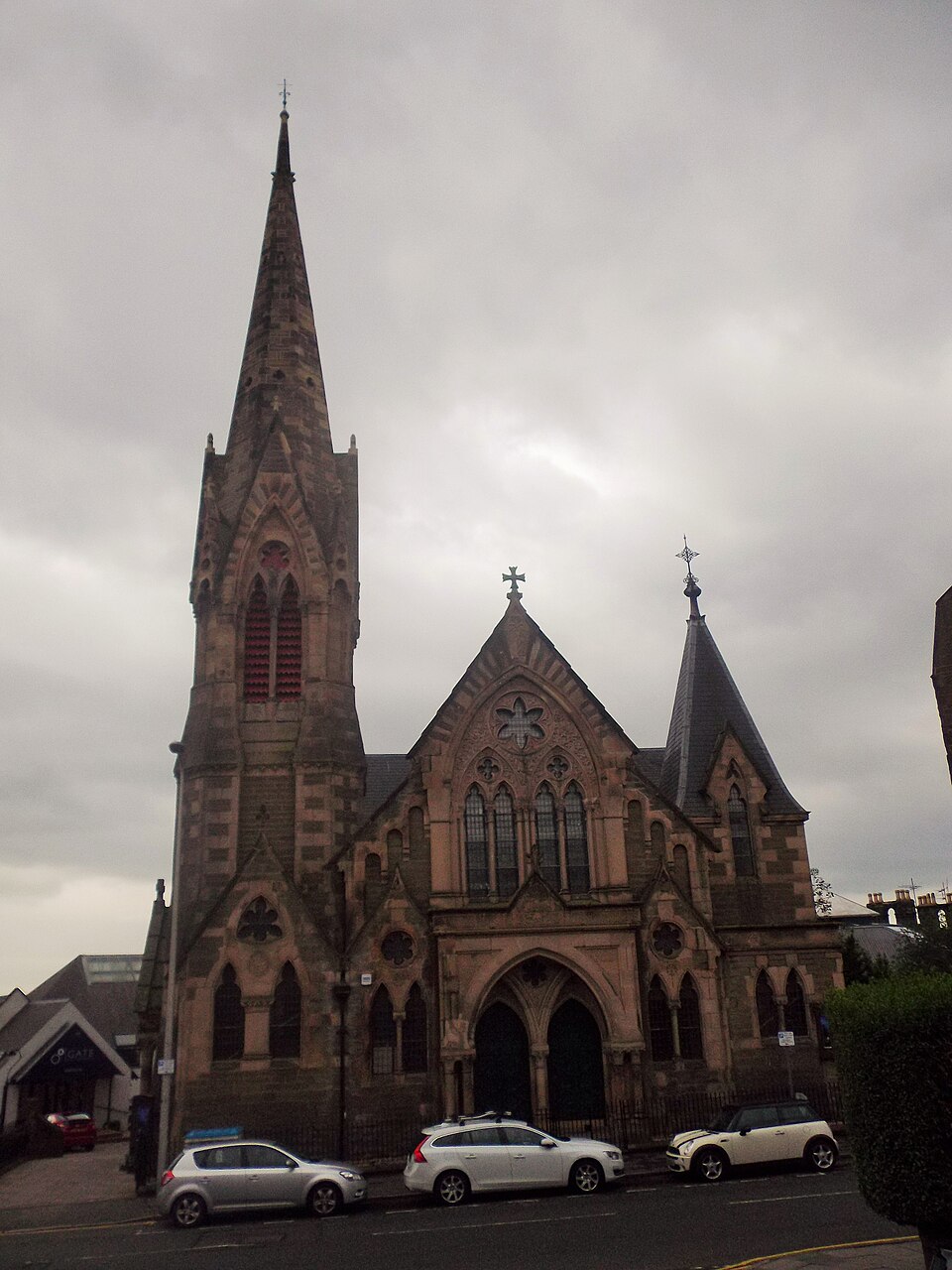
Image: Gate Church International, Dundee by Stanley Howe, sourced via Wikimedia Commons and Geograph and licensed under CC BY-SA 2.0.

A strongly modelled Victorian Gothic church, built as St Mark’s in 1868–1869 and enlarged in 1879, remains a place of worship under Gate Church International.
Quick facts
- Date
- Built 1868–1869; extended in 1879
- Architect / designer
- Frederick Thomas Pilkington of Pilkington and Bell; 1879 extension by Ireland and MacLaren
- Type
- Gothic church with corner tower and spire, galleries and basement hall
- Designation
- Listed building, Category A (LB25601)
- OS grid reference
- NO 39365 29763
- Current use
- Active church and community building
Architecture
Frederick Thomas Pilkington gave the former St Mark’s a deliberately vigorous silhouette and richly worked surfaces. Two colours of ashlar form bands and picked-out details, while steep gables, projecting bays and the north-east tower build an irregular but coherent composition along Perth Road. The tower has clasping buttresses and paired louvred openings at belfry level; above it, a decorated octagonal spire rises between finials.
The broad north front is the principal public face. Paired pointed doorways sit within an arched porch, with carved foliage, cusped forms, quatrefoils and hexafoils carrying the detail upward into the gables. The side elevations continue the rhythm through gabled bays and traceried windows. Ireland and MacLaren’s 1879 work extended the church at the rear, adding the chancel arrangement, angle turrets and supporting rooms without abandoning the earlier Gothic language.
Inside
A U-plan gallery is supported first on substantial masonry columns and twisted timber shafts, then by slender cast-iron columns at gallery level. Timber hammerbeam roofs span the gabled volumes and are tied with iron. Historic Environment Scotland records the ornate bowed timber pulpit, organ case, original pews and light fittings, together with stained glass installed in the late nineteenth and early twentieth centuries, including windows by Glasgow designer Stephen Adam.
The interior remains in use for worship and community activity.
From St Mark’s to Gate Church
The church was erected in 1868–1869 for the St Mark’s congregation and expanded in 1879. Historic Environment Scotland notes that a Lyon MacKenzie window and some furnishings later moved with that congregation to Roseangle Ryehill Church, an important reminder that the present interior does not contain every feature historically associated with St Mark’s.
Gate Church traces its own beginnings to a prayer meeting led by Stewart and Mairi Brunton in 1976. After meeting in several Dundee venues, the fellowship acquired the former St Mark’s building in 1984. Originally known as Gate Christian Fellowship and now as Gate Church International, it has retained the building’s ecclesiastical use while establishing a different congregational history within it.
Why it matters
The Category A church combines ambitious massing, polychromatic stonework, sculptural carving, a complex gallery structure and substantial surviving fittings. It is also a useful study in continuity and change: a nineteenth-century denominational church whose religious purpose continues through a later congregation.
What to notice
- The way the coloured stone bands strengthen the horizontal stages of the tower and contrast with the steep gables.
- The carved foliage and geometric openings concentrated around the Perth Road entrance front.
- The transition from the square tower to the octagonal spire.
- During permitted interior access, the unusual sequence of masonry, twisted timber and cast-iron gallery supports.
- The distinction between Pilkington’s 1868–1869 work and the 1879 extension by Ireland and MacLaren.
Access today
Gate Church’s current website invites visitors to its Sunday service at 11am and lists other activities through its calendar. That makes worship a clear form of public access, but it does not establish unrestricted architectural opening throughout the week. Services and church activities take priority; anyone wishing to study the interior outside an advertised event should contact the congregation in advance. The exterior and spire can be appreciated from the public pavement on Perth Road without entering the building.
Timeline
- 1868–1869 Pilkington and Bell build St Mark’s Church to Frederick Thomas Pilkington’s Gothic design.
- 1879 Ireland and MacLaren extend the church to the south.
- Late 19th–early 20th century Stained glass is added in several phases, including work by Stephen Adam.
- 1976 The fellowship that becomes Gate Church begins with a small Dundee prayer meeting.
- 1984 Gate Christian Fellowship acquires the former St Mark’s building.
- Present Gate Church International uses the building for Sunday worship and community activity.
What we know — and what remains uncertain
The statutory record securely establishes the design, phases, fabric and designation. Gate Church’s own history explains its occupation from 1984 and its present website confirms Sunday worship. Published sources do not provide a complete room-by-room account of later alterations, nor do they establish routine weekday heritage access; those points should not be inferred from the church’s active use.
Sources & further reading
- Historic Environment Scotland: 158 Perth Road, St Mark’s Church (Gate Fellowship), LB25601 — Category A designation, construction phases, architects, exterior and interior fabric, fittings and transferred furnishings.
- Gate Church International: current website — Current address and Sunday service time.
- Gate Church International: history — Congregational origins, earlier meeting places and acquisition of the building in 1984.
- Gate Church International: visitor information — Current congregation, address, contact details and travel information.
Location
OS grid reference NO 39365 29763 · Location confidence: High: the statutory designation supplies an exact National Grid Reference and a current official or operator source confirms the place relationship. · Select the marker to open its satellite view in Google Maps. On desktop, drag Pegman (the yellow figure) onto a blue road. On mobile, turn on the Street View layer and tap a blue road. Other photo markers may be user-contributed.
Suggest a marker correction
Suggest a more accurate position
The teal marker is the current published position. The orange marker starts slightly to its right so both remain visible; this is only a visual starting position. Tap the correct place on the map or drag the orange marker. Sending this form creates a private review entry only; it does not move the published marker.
Check this area in Google Maps Choose the Satellite layer there if useful.
Map: © OpenStreetMap contributors. You can also enter checked coordinates below.