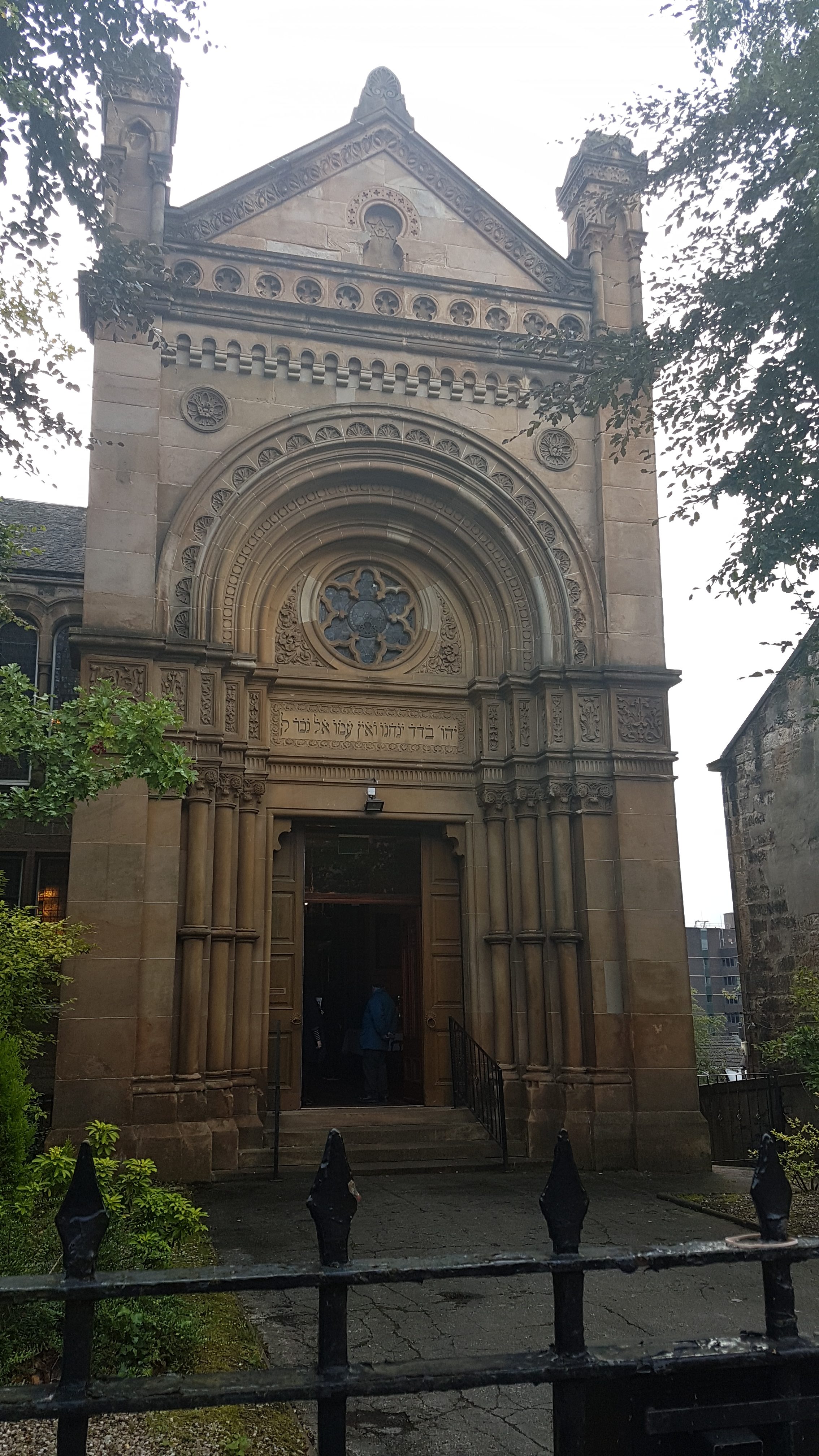
Garnethill Synagogue, Glasgow. Photograph: Stinglehammer / Wikimedia Commons, 16 September 2018. CC BY-SA 4.0.

Scotland’s first purpose-built synagogue remains a place of worship and now opens its architecture and collections through guided heritage visits.
Quick facts
- Date
- Built 1877–1879; restored in 1998; heritage centre opened in 2021
- Architect / designer
- John McLeod with Nathan Solomon Joseph
- Type
- Purpose-built synagogue combining Moorish, Classical and Romanesque detail with a richly furnished prayer hall
- Designation
- Listed building, Category A (LB33040)
- OS grid reference
- NS 58191 66096
Architecture and continuing use
Rubble walls frame an elaborate ashlar entrance of compound arches, carving and a Hebrew inscription. Inside, stained glass, carved pews, bimah, women’s gallery and a richly ornamented ark survive beneath a compartmented ceiling.
Its story
Glasgow’s growing Jewish congregation selected the Garnethill site in 1875 and consecrated the new synagogue in 1879. Conservation and the 2021 heritage centre expanded interpretation while retaining worship.
Why it is included
It is a landmark of Scottish Jewish religious, migration and community history with exceptional interior survival and a responsible guided-access model.
What to notice
- The Star of David and carved Hebrew inscription over the entrance.
- Floral stained glass by J. B. Bennett and Sons.
- The ark, bimah, gallery and suspended eternal light inside.
Reading the surroundings
The building has active worship and strict security. Heritage visits require advance booking and adult visitors must follow the published identification and bag arrangements.
Timeline
- Built 1877–1879 Glasgow’s growing Jewish congregation selected the Garnethill site in 1875 and consecrated the new synagogue in 1879.
- Present Active Orthodox synagogue, Scottish Jewish Heritage Centre and Scottish Jewish Archives Centre.
What we know — and what remains uncertain
Tour access is controlled and does not imply unrestricted entry at other times; worship and security requirements take priority.
Sources & further reading
- Historic Environment Scotland: Garnethill Synagogue, LB33040 — Designation category, mapped location, construction phases, fabric, authorship and architectural interest.
- Scottish Jewish Heritage Centre: plan your visit — Current worship and heritage-centre use, address, guided-tour requirement, security and accessibility arrangements.
- Garnethill Synagogue — Current congregation, architect, dates, address and continuing religious identity.
Location
OS grid reference NS 58191 66096 · Location confidence: High: the statutory designation supplies a mapped National Grid Reference and a current official operator, responsible public body or institutional source confirms the Place relationship and present identity. · Select the marker to open its satellite view in Google Maps. On desktop, drag Pegman (the yellow figure) onto a blue road. On mobile, turn on the Street View layer and tap a blue road. Other photo markers may be user-contributed.
Suggest a marker correction
Suggest a more accurate position
The teal marker is the current published position. The orange marker starts slightly to its right so both remain visible; this is only a visual starting position. Tap the correct place on the map or drag the orange marker. Sending this form creates a private review entry only; it does not move the published marker.
Check this area in Google Maps Choose the Satellite layer there if useful.
Map: © OpenStreetMap contributors. You can also enter checked coordinates below.