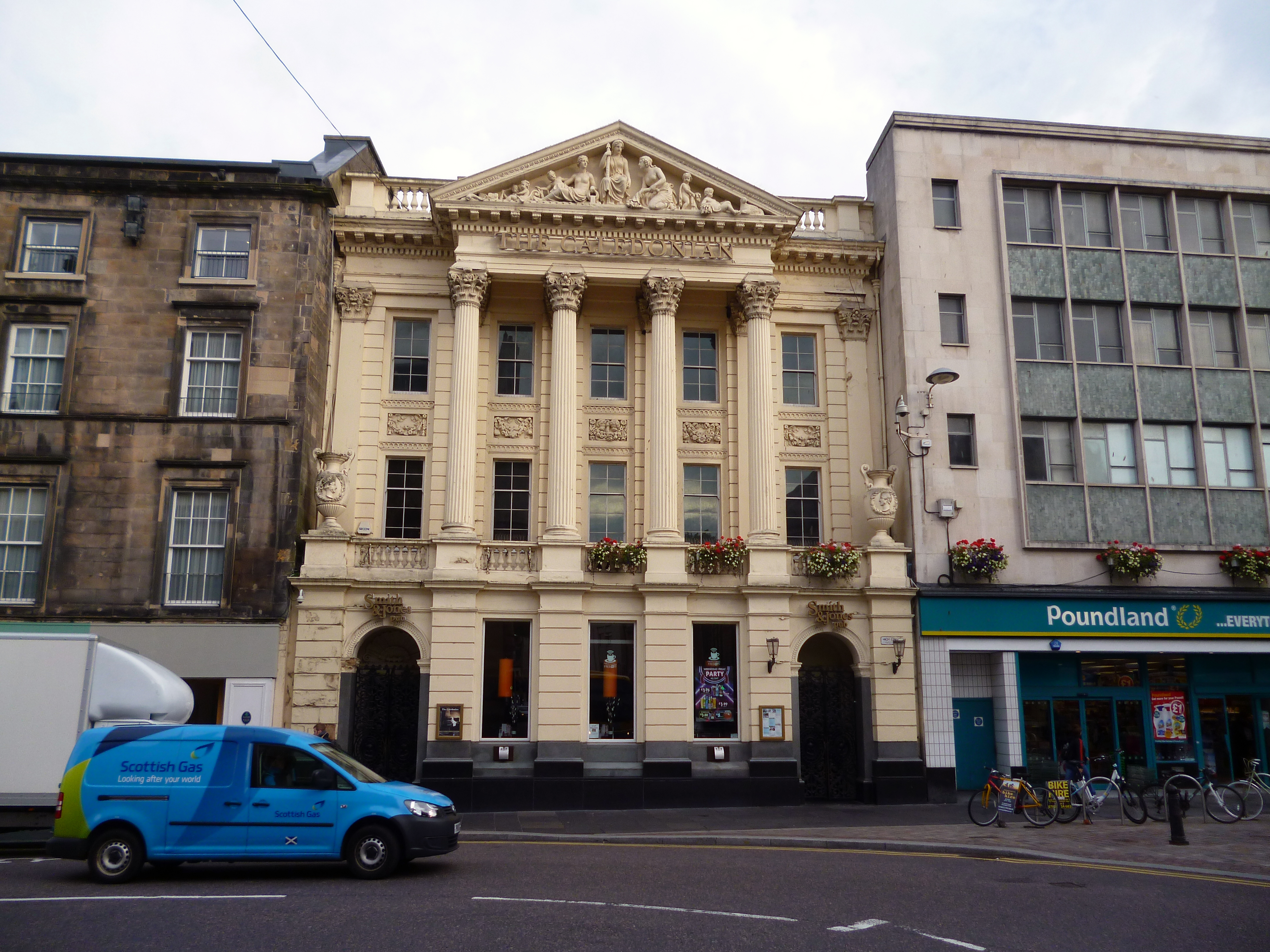
Image: Former Caledonian Bank, Inverness by Dr Neil Clifton, 4 September 2013, sourced from Wikimedia Commons and licensed under CC BY-SA 2.0.
.jpg)
Built in 1847–1848 as the head office of a Highland bank, this commanding classical building turns finance into civic theatre through giant Corinthian columns, royal portrait medallions and allegorical sculpture. It now has a public life as The Caledonian pub.
Quick facts
- Date
- 1847–1848; interior altered in 1925; later converted for hospitality
- Architect / designer
- Mackenzie and Matthews; architectural sculpture by Alexander Handyside Ritchie; 1925 alterations by R. Carruthers-Ballantyne & Taylor
- Type
- Former bank head office, now a public house
- Designation
- Listed building, Category A (LB35251)
- OS grid reference
- NH 66676 45251
A bank designed as an urban monument
Mackenzie and Matthews designed the building for the Caledonian Banking Company, founded in Inverness in 1838. Its five-bay, three-storey front is deliberately more ceremonial than an ordinary commercial building. A projecting ground floor is divided by piers and capped by a cornice and parapet. Above the central bays, a giant tetrastyle Corinthian order rises through the upper part of the composition and supports a pediment.
The monumental order continues as Corinthian pilasters across the first and second floors. Round-arched, key-blocked doorways occupy the end bays, with wrought-iron gates recorded in the statutory description. Window aprons carry carved swags, while the roofline is finished by a cornice and balustrade. Together these elements give the narrow High Street frontage the gravity of a public institution.
Sculpture and meaning
The façade’s sculpture was not merely decorative. Large vases at the ends of the parapet carry medallion portraits of Queen Victoria and Prince Albert, linking the young bank with monarchy, stability and the wider British economy. In the central pediment, allegorical figures carved by Alexander Handyside Ritchie turn the bank’s commercial role into a public image of prosperity and confidence.
The sculpture is best understood as part of one carefully staged façade. Channelled ashlar gives the lower storey visual weight; columns and pilasters organise the upper floors; and carving supplies identity at the skyline and pediment. The composition was intended to be read from the High Street, where the bank competed for attention with Inverness’s civic and commercial buildings.
From Highland bank to hospitality
The Caledonian Banking Company used the building as its head office. The company remained independent until its absorption by the Bank of Scotland in 1907. The interior was altered in 1925 by R. Carruthers-Ballantyne & Taylor, and further change followed as banking use ended and the premises were adapted for hospitality.
That change of use keeps the building active but means the interior should not be read as an untouched survival of the 1840s. The statutory account identifies the principal exterior and records the 1925 intervention; later pub fittings and operational spaces belong to subsequent phases.
Why it matters
The former bank is one of Inverness High Street’s most ambitious nineteenth-century commercial buildings. It records the confidence of a bank founded in the Highlands and headquartered in Inverness rather than in Edinburgh or Glasgow. Its Category A status reflects the quality of the classical composition, its architectural sculpture and its importance in the city’s commercial history.
Its present use also demonstrates adaptation rather than abandonment. Customers can experience a historic commercial building in everyday use, while the public façade continues to anchor the High Street.
What to notice
- The giant Corinthian columns and pilasters, which make the upper storeys read as a single monumental order.
- The contrast between the channelled lower storey and the smoother architectural framework above.
- The portrait medallions of Queen Victoria and Prince Albert on the parapet vases.
- Alexander Handyside Ritchie’s allegorical sculpture in the pediment.
- The round-arched end doorways, carved swags, cornice and balustraded skyline.
Visiting and access
The building operates as The Caledonian public house, so customer areas can be entered during the venue’s advertised hours. The pub changed ownership and was reported to have reopened on 11 July 2026 after a short refresh, with further work being considered. Opening times and interior arrangements may therefore change; check the current venue listing or contact the business before making a special journey.
Access as a customer does not imply access to staff, service or upper areas, and surviving historic fabric may not be visible in every part of the adapted interior. The full classical façade can be appreciated from the pedestrianised High Street without entering the premises. Normal licensed-premises conditions apply.
Timeline
- 1838 The Caledonian Banking Company was founded in Inverness.
- 1847–1848 Mackenzie and Matthews designed and built the company’s High Street head office.
- 1907 The Caledonian Bank was absorbed by the Bank of Scotland.
- 1925 R. Carruthers-Ballantyne & Taylor altered the interior.
- Later twentieth and twenty-first centuries The former banking premises were adapted for hospitality.
- 11 July 2026 The Caledonian was reported to have reopened under new ownership after a short refresh.
What we know — and what remains uncertain
The statutory record securely identifies the 1847 design, exterior composition, sculpture and 1925 alterations. It does not provide a room-by-room account of surviving original interiors, so no claim is made that present customer spaces preserve the first banking arrangement. Hospitality ownership, hours and refurbishment plans can change and were checked separately from the designation evidence.
Sources & further reading
- Historic Environment Scotland: 9 and 11 High Street, Bank of Scotland, LB35251 — designation, grid reference, architects, façade, sculpture, 1925 alterations and original head-office use.
- Dictionary of Scottish Architects: Caledonian Bank — architectural job record and documentary references.
- Highland Historic Environment Record: The Caledonian — local record of the bank’s foundation, building history and later use.
- Lloyds Banking Group archives: Caledonian Banking Company — company dates, 1838–1907.
- Inverness BID: The Caledonian — current public-house identity, address and advertised opening information.
- Press and Journal, 23 June 2026 — change of ownership, planned reopening and refurbishment intentions.
Location
OS grid reference NH 66676 45251 · Location confidence: High: the statutory designation supplies an official mapped National Grid Reference and the current source confirms the Place relationship or present identity. · Select the marker to open its satellite view in Google Maps. On desktop, drag Pegman (the yellow figure) onto a blue road. On mobile, turn on the Street View layer and tap a blue road. Other photo markers may be user-contributed.
Suggest a marker correction
Suggest a more accurate position
The teal marker is the current published position. The orange marker starts slightly to its right so both remain visible; this is only a visual starting position. Tap the correct place on the map or drag the orange marker. Sending this form creates a private review entry only; it does not move the published marker.
Check this area in Google Maps Choose the Satellite layer there if useful.
Map: © OpenStreetMap contributors. You can also enter checked coordinates below.