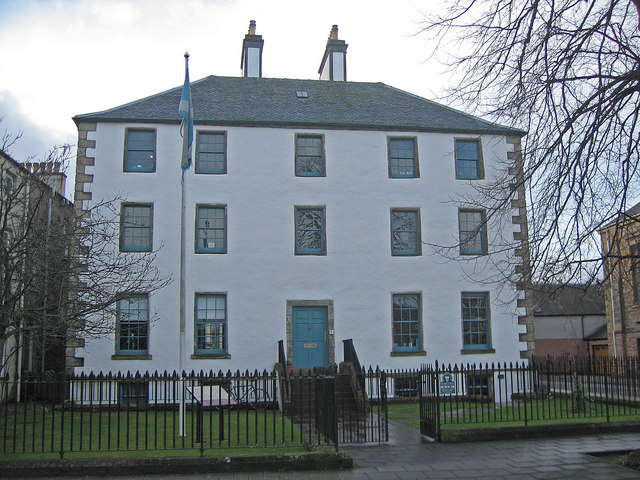
Image: White-painted classical frontage of Balnain House in Inverness, with three storeys, a hipped roof and railed forecourt by wfmillar, licensed under CC BY-SA 2.0.

A tall harled house with a symmetrical front survives close to the river as one of Inverness’s earliest substantial domestic buildings.
Quick facts
- Date
- Built 1726; later alterations
- Architect / designer
- Original designer not identified; later work associated with Alexander Ross
- Type
- Early eighteenth-century town house
- Designation
- Listed building, Category A (LB35276)
- OS grid reference
- NH 66312 45365
Architecture and continuing use
Balnain House rises three storeys in five bays, its windows placed to either side of a central entrance reached by a flight of steps. The harled walls are dressed with rusticated quoins—large corner stones cut to suggest a heavier, more textured masonry frame. Historic Environment Scotland also describes the walls as entasised, meaning that their surfaces have a subtle outward curve rather than being entirely flat. A low piended, or hipped, slate roof slopes on all four sides, with chimney stacks placed towards its centre. The restrained frontage belongs to the formal domestic architecture of early eighteenth-century Inverness.
Its story
The house dates from 1726. The Highland Historic Environment Record also notes Alexander Ross in an architectural record dated January 1867, indicating a later documented building phase rather than identifying the original designer. During the 1990s the restored house became a centre for Highland traditional music, providing a home for collections, musicians and public engagement. The Highland Music Trust was formed in 1998 partly to support the work being undertaken there. The Trust records that the Balnain music centre closed in 2001; its publications and collections continued through the Trust. Balnain House later served as the National Trust for Scotland’s Highlands and Islands regional office.
What to notice
- The orderly three-storey, five-bay front and raised central doorway.
- Rusticated quoins contrasting with the harled wall surface.
- The piended slate roof and paired chimney placement.
- The building’s modest scale relative to later commercial frontages along Huntly Street.
Reading the surroundings
This is a working office. View from public space and make an appointment for any business that requires entry.
Timeline
- 1726 Balnain House was built as a substantial Inverness townhouse.
- 1867 A Highland historic-environment record associates an architectural record with Alexander Ross; the extent of that work is not established here.
- 1990s The restored building housed a Highland traditional-music centre.
- 1998–2001 Highland Music Trust was founded partly to support Balnain’s work; the centre closed in 2001.
- Later use The house became the National Trust for Scotland’s Highlands and Islands regional office.
What we know — and what remains uncertain
The 1726 date and principal exterior are recorded in the Category A listing. Alexander Ross appears in a local record for 1867, but this should not be mistaken for an attribution of the original house. The precise internal changes made for the music centre and later office use have not been reconstructed from the available evidence.
Sources & further reading
- Historic Environment Scotland: Balnain House, LB35276 — 1726 date, Category A designation, five-bay frontage, harling, quoins and roof form.
- Highland Historic Environment Record: Balnain House, MHG15565 — Local record and the separate 1867 reference to Alexander Ross.
- Highland Music Trust: about — The house’s former traditional-music centre, the Trust’s 1998 establishment and the centre’s 2001 closure.
- National Trust for Scotland: regional offices — Later use as the Highlands and Islands office.
Location
OS grid reference NH 66312 45365 · Location confidence: High: the statutory designation supplies an official mapped National Grid Reference and the current source confirms the Place relationship or present identity. · Select the marker to open its satellite view in Google Maps. On desktop, drag Pegman (the yellow figure) onto a blue road. On mobile, turn on the Street View layer and tap a blue road. Other photo markers may be user-contributed.
Suggest a marker correction
Suggest a more accurate position
The teal marker is the current published position. The orange marker starts slightly to its right so both remain visible; this is only a visual starting position. Tap the correct place on the map or drag the orange marker. Sending this form creates a private review entry only; it does not move the published marker.
Check this area in Google Maps Choose the Satellite layer there if useful.
Map: © OpenStreetMap contributors. You can also enter checked coordinates below.