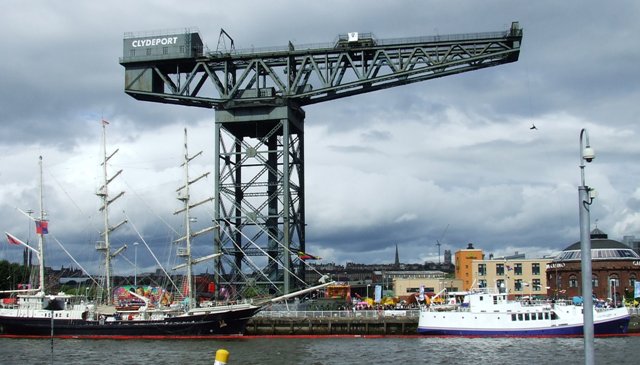
A 175-ton giant cantilever crane at Stobcross Quay, the Finnieston Crane is a rare survivor of the machinery that linked Clyde engineering works with overseas markets. Its structure is not open to visitors, but its full silhouette can be appreciated from public waterfront approaches.
Quick facts
- Date
- HES dates the project from 1926 and records completion in 1931; operation began in 1932
- Designer / maker
- Cowans Sheldon & Company, under Daniel Fife for the Clyde Navigation Trust; the cantilever was made by the Cleveland Bridge & Engineering Company
- Type
- 175-ton giant steel cantilever quayside crane
- Designation
- Listed building, Category A (LB33285)
- OS grid reference
- NS 57103 65151
- Access
- Exterior viewing from public waterfront routes only; there is no public entry to or climbing access on the crane
An engineering machine, not a conventional building
The crane is organised around a tall lattice-steel girder tower. At its head, a roller track allowed the asymmetrical cantilever truss jib to rotate: the long working arm projected over the quay and river, while the shorter end carried the machinery house and counterweight. The open latticework keeps the immense structure visually legible, so the load path from jib to tower can still be read from the ground.
Historic Environment Scotland identifies two especially unusual fittings. The tower contains the only personnel lift recorded on a British crane of this type, and a separate horizontal rail carried a jigger hoist for lighter loads. These details show that the crane was designed not simply for occasional spectacular lifts, but for a range of heavy-quay handling tasks.
Why Stobcross needed a giant crane
The Clyde Navigation Trust required lifting capacity for exceptionally heavy manufactured cargo. The present crane replaced an earlier facility upstream after proposals for a high-level road bridge threatened to interfere with its operation. HES records that the new structure was placed about 500 feet downstream; although the bridge was never built, the crane went ahead and was completed in 1931.
The Big Cran Company describes its principal work as loading complete locomotives for export, alongside ships’ machinery and other heavy cargo. That role connected the quayside directly with Glasgow’s locomotive works and wider engineering economy: the crane was the last transfer point between land manufacture and ocean transport.
Rarity and significance
The statutory designation emphasises both rarity and setting. It records the Stobcross crane as one of only three giant cantilever cranes of its type built for port authorities and notes that its prominent riverside position gives it exceptional symbolic force. Its Category A interest therefore lies in the survival of a highly specialised working machine, its uncommon fittings and its continuing power as a landmark of industrial Glasgow.
The contract is also historically revealing. Cowans Sheldon, rather than Glasgow firm Sir William Arrol & Company—the dominant maker of giant cantilever cranes—secured the work. The result is an important comparison with the Arrol-built cranes that survive elsewhere on the Clyde.
From cargo handling to civic landmark
The crane has long ceased regular cargo work, but its conspicuous outline has allowed it to take on new cultural roles without disguising its industrial character. The Big Cran Company records its use for George Wyllie’s Straw Locomotive in 1987 and Paper Boat in 1989.
Glasgow City Council approved Clyde Mission funding in 2021 for urgent structural work, and a 2024 council report described fabric repairs as ongoing with completion then due that year. That source establishes the repair programme, but it should not be read as proof that every proposed intervention was completed exactly to that timetable.
For the Glasgow 2026 Commonwealth Games, artist Emer Tumilty and creative studio NEWSUBSTANCE created the monumental Glasgow Rose, inspired by the work of Charles Rennie Mackintosh and Margaret Macdonald Mackintosh. Glasgow Life records the artwork being suspended from the crane for the Games festival. It was a temporary cultural intervention: the permanent heritage subject remains the crane itself.
What to notice
- The strong imbalance between the long working jib and the compact machinery-and-counterweight end.
- The roller-track zone at the top of the tower, which allowed the cantilever assembly to rotate.
- The contrast between the open lattice steelwork and the solid machinery house.
- The crane’s relationship with the quay edge, River Clyde and later arena buildings: its setting explains both its original function and its present landmark role.
Visiting and access
The crane can be seen safely from public waterfront approaches around Stobcross Quay and the SEC area. This is exterior appreciation only. The tower, jib, machinery spaces, quay-edge work areas and any fenced maintenance zones are not public visitor spaces; do not climb the structure or cross barriers. Temporary event management, repairs or riverside works may alter the closest available viewpoint.
Timeline
- 1926–1931 HES dates the crane from 1926 and records completion in 1931 under Daniel Fife for the Clyde Navigation Trust.
- 1928 A proposed high-level Clyde bridge prompts the decision to provide a new crane downstream; the bridge itself is not built.
- 1932 The Big Cran Company records the crane entering operation.
- 1987 and 1989 The crane is used in George Wyllie’s Straw Locomotive and Paper Boat art projects.
- 1989 The crane is added to the statutory list at Category A.
- 2021–2024 Council records document funding and an ongoing programme of fabric repairs.
- 2026 The temporary Glasgow Rose artwork is suspended from the crane for the Glasgow 2026 Festival and Commonwealth Games.
What we know — and what remains uncertain
The statutory record is authoritative for designation, fabric and the crane’s historic special interest, while the council papers document repair funding and progress at particular dates. They do not establish current operational capability or public access inside the structure. The Glasgow Rose belongs specifically to the 2026 festival programme and should not be assumed to be a permanent alteration.
Sources & further reading
- Historic Environment Scotland: Stobcross Quay, Stobcross Crane / Finnieston Crane, LB33285 — Category A designation, mapped location, engineering description, authorship, rarity and statement of special interest.
- The Big Cran Company CIC: History of the Cran — Operational history, makers, cargo role and later art projects.
- Glasgow City Council: Clyde Mission Fund report, 28 January 2021 — Funding for urgent structural repairs and prospective community-led activity.
- Glasgow City Council: Govan–Partick and River Clyde action programme update, 2024 — Repair-programme progress and Clyde regeneration context.
- Glasgow Life: The rose rises, 27 July 2026 — Artists, commission, festival context and installation of the temporary Glasgow Rose.
Finnieston Crane. Photograph: Thomas Nugent, 14 July 2007. CC BY-SA 2.0.
