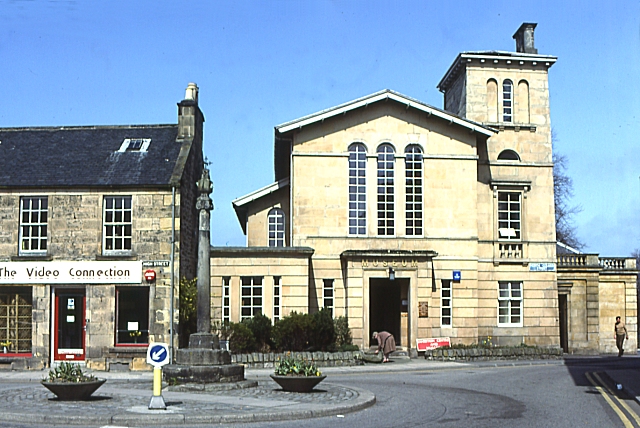
Image: Elgin Museum’s pale classical street front, with tall round-headed windows and a small corner tower by Anne Burgess / Geograph, licensed under CC BY-SA 2.0.

A pioneering independent museum whose Italianate building, collections and later hall record nearly two centuries of local scientific and antiquarian activity.
Quick facts
- Date
- Designed 1842 and opened 1843; additions 1896; alterations and Museum Hall 1920–1921; colour scheme restored 1979
- Architect / designer
- Thomas Mackenzie; 1920 work by A. Marshall Mackenzie and Son
- Type
- Museum and museum hall
- Designation
- Category A listed building (LB30714)
- OS grid reference
- NJ 21902 62910
A museum built for a learned society
Thomas Mackenzie’s polished-stone Italianate frontage gives the museum a formal presence on the High Street. A tower, tall round-headed windows and the galleried main hall express the building’s original purpose as a place where collections could be studied and displayed.
Its story
The Elgin and Morayshire Literary and Scientific Association was founded in 1836. Its museum building was designed in 1842 and opened in 1843. Additions followed in 1896, with alterations and Museum Hall associated with A. Marshall Mackenzie and Son in 1920–1921. The Moray Society continues to own and manage the museum as an independent institution.
Why it is included
It brings museums, collecting and local learned culture into the Elgin directory, while its current building difficulties show that heritage organisations must care for historic fabric as well as collections.
What to notice
- The Italianate tower and tall round-headed windows addressing the High Street.
- The relationship between the original museum and later Museum Hall, which records the institution’s growth.
- Inside, only when safely and publicly accessible, the galleried main hall and the restored historic colour scheme.
Reading the surroundings
The museum stands at the east end of Elgin High Street near the Little Cross. Ongoing problems with the more-than-180-year-old building restrict normal access, so the museum’s own website should be checked before any visit.
Timeline
- 1836 The Elgin and Morayshire Literary and Scientific Association was founded.
- 1842 Thomas Mackenzie designed the museum building.
- 1843 The museum opened to the public.
- 1896 An addition expanded the museum.
- 1920–1921 A. Marshall Mackenzie and Son carried out alterations and the Museum Hall phase.
- 1979 The original interior colour scheme was restored.
- 2026 A limited Side Hall offer was operating while building problems restricted the usual museum visit.
What we know — and what remains uncertain
Historic Environment Scotland dates Thomas Mackenzie’s building to 1842, while the museum’s own guide records its public opening in 1843. This draft distinguishes design and construction from opening rather than choosing one date. Visitor arrangements are temporary and fast-changing because of building problems; they must be rechecked before publication or travel.
Sources & further reading
- Historic Environment Scotland: Elgin Museum, LB30714 — Designation, dates, architects, additions, architectural description, ownership and grid reference.
- Trove: Elgin Museum — National record cross-reference, precise coordinates, archive holdings and related designation.
- Elgin Museum: current homepage — Current limited opening, building problems, address and independent status.
- Elgin Museum: brief guide — Moray Society ownership and management, 1843 opening, architect and institutional history.
Location
OS grid reference NJ 21902 62910 · Location confidence: High: the statutory grid reference and Trove coordinates agree with the museum’s published address. · Select the marker to open its satellite view in Google Maps. On desktop, drag Pegman (the yellow figure) onto a blue road. On mobile, turn on the Street View layer and tap a blue road. Other photo markers may be user-contributed.
Suggest a marker correction
Suggest a more accurate position
The teal marker is the current published position. The orange marker starts slightly to its right so both remain visible; this is only a visual starting position. Tap the correct place on the map or drag the orange marker. Sending this form creates a private review entry only; it does not move the published marker.
Check this area in Google Maps Choose the Satellite layer there if useful.
Map: © OpenStreetMap contributors. You can also enter checked coordinates below.