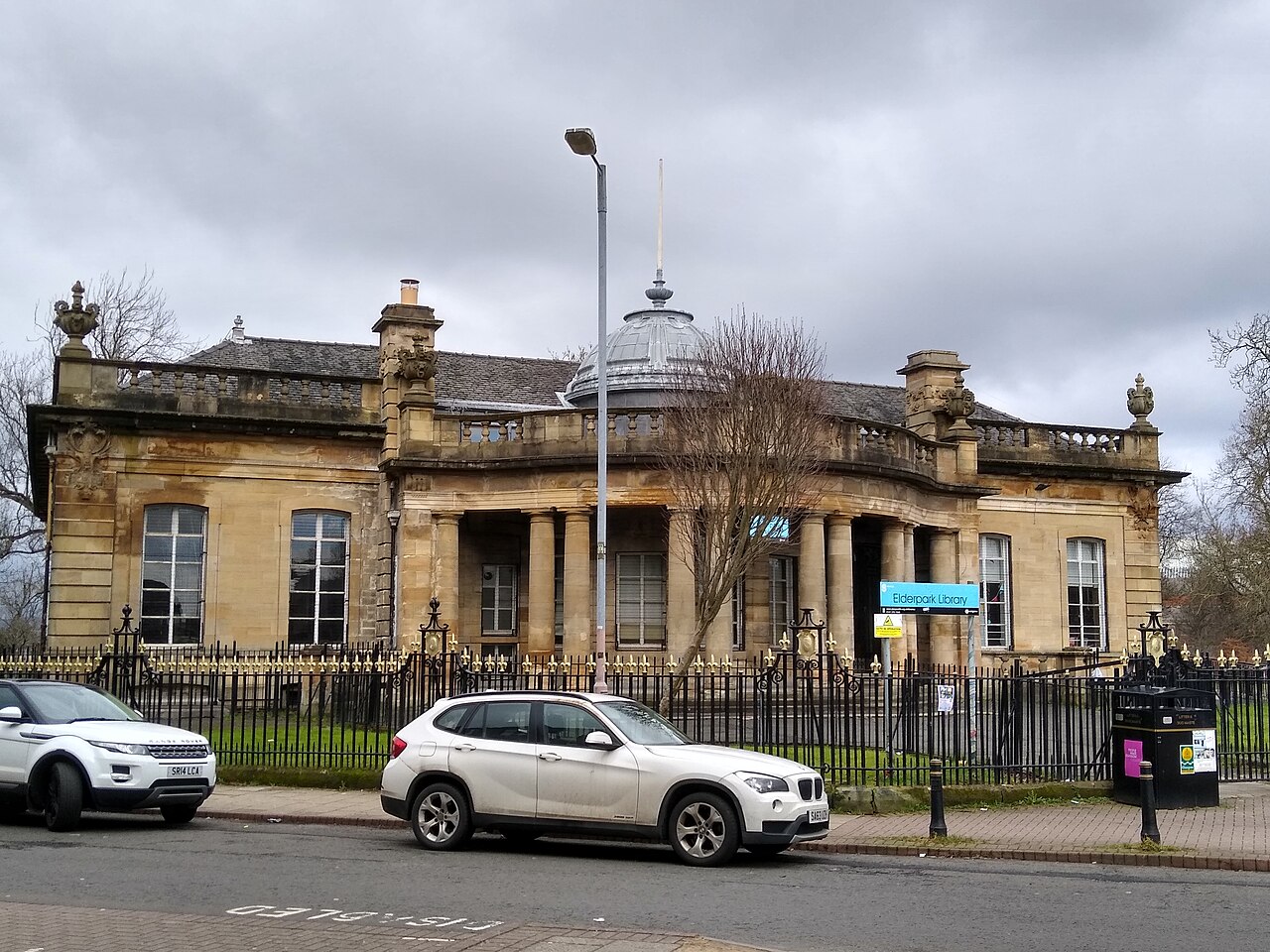
Image: Elder Park Library by Twospoonfuls, sourced from Wikimedia Commons and licensed under CC BY-SA 4.0.

Elder Park Library is a finely modelled Edwardian Baroque public building whose architecture, philanthropic origins and continuing free use are closely bound to Govan’s shipbuilding history. Restored as a library and community hub in 2024, it remains a civic interior rather than a monument preserved without purpose.
Quick facts
- Date
- Built 1902–03; extended and adapted in the 1920s; restored and reopened in 2024
- Architect / designer
- Sir John James Burnet
- Type
- Edwardian Baroque public library and community hub
- Designation
- Listed building, Category A (LB33310)
- OS grid reference
- NS 54777 65641
Architecture and materials
The library is a single-storey Edwardian Baroque composition in stugged sandstone ashlar with polished dressings. Its front is serpentine rather than flat: a wide, shallow-curved portico on paired Tuscan columns draws the entrance into a sheltered recess, while the outer bays read as the ends of flanking ranges. Channelled angle pilasters, deep entablatures and roof balustrades with sculpted urns give the low building a strongly civic silhouette. A small dome rises behind the central balustrade.
Historic Environment Scotland identifies segmental-arched windows with original glazing, slate-pitched and lead-covered flat roofs, and decorative iron railings enclosing the site. The rear ranges are pedimented and use canted bays and circular oculi, with further oculi in the wall between them. Inside, deep mutule cornices, coffered ceilings and segmental vaults carry the architectural character into the reading rooms. The result is formal but not forbidding: Burnet used the language of a public institution at the scale of a neighbourhood library beside a park.
Isabella Elder’s gift
Isabella Elder donated £10,000 towards the building, conceived for the people of Govan and associated with the memory of her husband, the marine engineer and shipbuilder John Elder. The library belongs to a wider programme of philanthropy in which she supported public health and education, especially opportunities for women, while Elder Park itself provided recreation close to the great Fairfield shipyard.
The building opened in 1903, with Andrew Carnegie present. Glasgow Life’s archival account records three original departments—a reference room, newsroom and young people’s room—but no lending library. The distinction is revealing: the first institution was arranged around reading and consultation on the premises. Demand was substantial. In 1912 the library entered Glasgow’s municipal library service, and Elder provided a further £27,000 for furnishings, books and maintenance under an agreement intended to prevent disposal of the building.
Adaptation and continued service
Pressure for lending services and additional civic facilities grew after Govan’s annexation by Glasgow. The library began lending books for home use and an extension opened during the 1920s. Later refurbishment in 1962 renewed finishes, furniture, services and bookcases; a special collection for blind readers followed. These changes form part of the building’s history rather than a break from it: the institution has repeatedly adjusted its rooms and services while retaining its public purpose.
A £4 million project undertaken with Elderpark Housing Association culminated in reopening as Elder Park Library and Community Hub on 24 June 2024. Glasgow Life describes full internal and external refurbishment, improved library and community rooms, a community kitchen, additional bookable spaces and toilets, better baby-changing provision, natural ventilation, energy-efficient boilers, renewed wiring and lighting, and modern fire, security and building-management systems. The official reopening ceremony followed on 18 September 2024.
Why it is included
The Category A designation recognises Burnet’s confident Edwardian Baroque design and the survival of important exterior and interior fabric. Its deeper significance comes from the relationship between architecture and use. Shipbuilding wealth was translated into a public resource; the building then passed into municipal service and continues to offer books, digital access, study, events and community activity without an admission charge.
The 2024 work is also a useful case study in adapting a highly listed building. Historic ceilings, glazing, masonry, railings and spatial character coexist with environmental, safety and accessibility improvements needed by a contemporary public service.
What to notice
- The shallow curve of the entrance front and the paired Tuscan columns drawing visitors towards recessed doors.
- The contrast between the low, spreading plan and the small central dome above the balustrade.
- Polished dressings against stugged ashlar, and the way pilasters, entablatures and urns animate the roofline.
- The rear pediments, canted bays and circular oculi, which make secondary elevations architecturally deliberate.
- Inside, the deep cornices, coffering and segmental vaults that preserve the dignity of the original reading rooms.
- The close relationship with Elder Park and the wider landscape of Govan’s industrial and philanthropic history.
Visiting and access
Elder Park Library and Community Hub is an active public building with free entry. Glasgow Life currently lists opening seven days a week: Monday 1pm–8pm; Tuesday to Saturday 10am–5pm; and Sunday noon–5pm. Hours, events and bookable-room arrangements can change, so check the official venue page before a special journey.
The operator lists an accessible entrance, an accessible toilet in the foyer about 30 metres from that entrance, a portable hearing loop and welcome for assistance dogs. There is no dedicated public car park; the area immediately in front is reserved for deliveries and accessibility, with on-street parking on Langlands Road. An independent detailed access guide is linked from the official venue page.
Timeline
- 1902–03 Sir John James Burnet designs the library; Isabella Elder contributes £10,000 and the building opens in 1903.
- 1912 The library joins Glasgow’s municipal service; Elder’s further endowment supports books, furnishings and maintenance.
- 1920s Lending develops and an extension adds capacity; the enlarged library is ceremonially reopened in 1929.
- 1962–63 A major refurbishment renews finishes, fittings and services; provision for blind readers follows.
- 24 June 2024 The building reopens after a £4 million restoration as Elder Park Library and Community Hub.
- Present It provides free library, digital, study, event and community facilities seven days a week.
What we know — and what changed
Historic Environment Scotland attributes the 1902–03 design to Sir John James Burnet; this replaces an earlier attribution in this record to James Robert Rhind. The listed-building description is strongest on original fabric, while Glasgow Life documents the institution’s social history and current operation. Modernisation has altered layouts, services and some finishes, so surviving historic elements should be distinguished from the 1920s, 1962 and 2024 interventions rather than treating the interior as unchanged since 1903.
Sources & further reading
- Historic Environment Scotland: Elder Park Library, LB33310 — Category A designation, Burnet attribution, exact location, exterior materials and surviving interior details.
- Glasgow Life: Elder Park Library — current opening, free admission, facilities, accessibility information, events and 2024 reopening.
- Glasgow Life: Celebrating Elder Park Library — Isabella Elder’s gifts, original departments, municipal transfer, later lending and twentieth-century refurbishment.
- Glasgow Life: £4 million restoration and reopening — scope of the 2024 work, sustainability improvements and community-hub use.
Location
OS grid reference NS 54777 65641 · Location confidence: High: the statutory designation supplies an exact National Grid Reference and the current official, operator or responsible-organisation source confirms the Place relationship. · Select the marker to open its satellite view in Google Maps. On desktop, drag Pegman (the yellow figure) onto a blue road. On mobile, turn on the Street View layer and tap a blue road. Other photo markers may be user-contributed.
Suggest a marker correction
Suggest a more accurate position
The teal marker is the current published position. The orange marker starts slightly to its right so both remain visible; this is only a visual starting position. Tap the correct place on the map or drag the orange marker. Sending this form creates a private review entry only; it does not move the published marker.
Check this area in Google Maps Choose the Satellite layer there if useful.
Map: © OpenStreetMap contributors. You can also enter checked coordinates below.