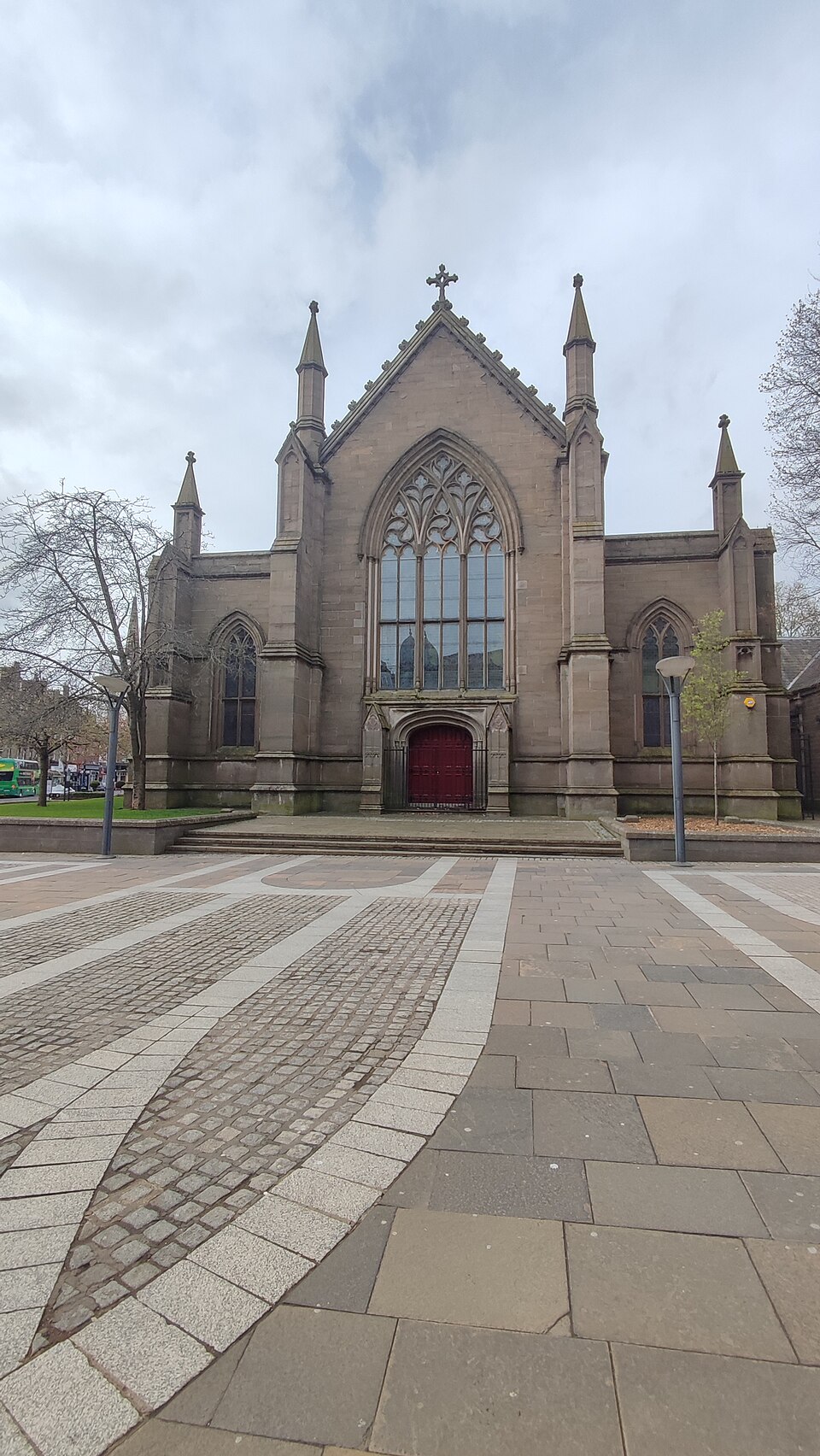
Image: Dundee Parish Church (St Mary’s) by Arossmorrison, sourced from Wikimedia Commons and licensed under CC0 1.0.

William Burn’s lofty 1843–1844 church occupies the eastern part of Dundee’s remarkable City Churches complex, combining a medieval parish tradition with outstanding Victorian stained glass and continuing worship.
Quick facts
- Date
- Rebuilt 1843–1844 after the fire of 1841; hall added 1896–1897
- Architect / designer
- William Burn; hall by William Alexander
- Type
- Decorated Gothic parish church forming the east part of Dundee City Churches
- Designation
- Listed building, Category A (LB25382)
- OS grid reference
- NO 40186 30136
A church within a larger church
St Mary’s is the easternmost compartment of the joined City Churches beside the medieval Old Steeple. William Burn rebuilt it on the site of the earlier choir after fire swept through the complex in 1841. The result is a clerestoried nave and aisles in a disciplined Decorated Gothic style: ashlar walls, buttressed bays, flowing and geometric tracery, gargoyle spouts and a large east window under a crocketed gable and cross-finial.
Inside, round arches rise from stout clustered piers to carry the nave arcade. Galleries fill the aisles and curve in a horseshoe at the west on cast-iron columns, while a timber hammer-beam roof spans the main space. This layered arrangement is important: the church is not an isolated Gothic Revival building but one component of a connected group whose parts have separate histories and statutory listings.
From medieval parish kirk to Victorian rebuilding
The congregation’s historical tradition traces the parish church to a foundation around 1190 by David, Earl of Huntingdon. The present church should not, however, be mistaken for that medieval fabric. The wider site endured repeated destruction and alteration, and the great fire of 1841 left the Old Steeple as the principal intact medieval survival. Burn’s east church was built in 1843–1844 as part of the post-fire reconstruction.
The later nineteenth century enriched the interior rather than fundamentally changing its Gothic structure. William Alexander added the north-side hall in 1896–1897. The church also accumulated stained glass, memorials, furnishings and an organ that connect the rebuilt architecture with Dundee’s civic, military, commercial and congregational life.
Stained glass and furnishings
Historic Environment Scotland’s designation description records the stained glass in detail. The great east Jubilee window of 1897 was made by Morris & Co, with most figures designed by Edward Burne-Jones and St Bartholomew by William Morris. Further windows include work by Morris & Co and Burne-Jones, Daniel Cottier & Co, the Newcastle Stained Glass Company, Ballantine, Powell & Son, A. L. Russell and T. S. Halliday.
The organ was made by Forster and Andrews of Hull in 1865 and has been repaired and altered more than once. An older reading desk reuses timber from the seventeenth-century pulpit of Dundee’s Parish Church. The 1921 Black Watch memorial, made by Thoms and Wilkie with woodwork by H. H. Martyn & Co, commemorates the 4th (City of Dundee) Battalion; its folding bronze panel reveals the names of 917 men. The civic pew, colours and other memorials show the continuing relationship between congregation, city and service.
Worship and visiting
Dundee Parish Church remains an active Church of Scotland congregation. Its current worship page advertises a traditional service at 11.15am every Sunday and states that all are welcome to Holy Communion on listed Sundays. Worship, pastoral activity and private services take priority.
The congregation still provides a downloadable visitor leaflet describing the interior, but that leaflet dates from 2019 and does not establish a current weekday opening schedule. No general daily heritage opening has been verified. Visitors who want to see the stained glass, organ and memorials outside Sunday worship should contact the church in advance. Public pavements around the City Churches allow exterior appreciation, but the connected buildings should not be assumed to share one entrance or one opening arrangement.
What to notice
- The large flowing-traceried east window beneath its crocketed gable.
- The five buttressed south bays, niche details and blind-quatrefoil parapet.
- The hammer-beam roof, clustered piers and galleries carried on cast-iron columns.
- The Morris & Co and Burne-Jones glass, especially the 1897 east window.
- The Black Watch memorial and civic pew, which connect the church with Dundee’s public life.
Timeline
- c. 1190 The parish tradition associates David, Earl of Huntingdon with the foundation of St Mary’s on this site.
- 1841 Fire devastates the City Churches complex; the medieval tower survives intact.
- 1843–1844 William Burn rebuilds St Mary’s on the eastern choir site.
- 1865 The Forster and Andrews organ is installed.
- 1896–1897 William Alexander adds the hall; the Morris & Co Jubilee window follows in 1897.
- 1921 The Black Watch war memorial is installed.
- Present St Mary’s continues as an active parish church with regular Sunday worship.
What we know — and what remains uncertain
The standing east church is securely attributed to William Burn and dated 1843–1844. The congregation traces its foundation to the medieval period. Service times are current at the date of review; visitor-leaflet information is historical and should not be treated as proof of present weekday access.
Sources & further reading
- Historic Environment Scotland: Dundee Parish Church, LB25382 — Designation, exact location, Burn rebuilding, exterior and interior fabric, stained glass, furnishings and group value.
- Dundee Parish Church: worship — Current Sunday service pattern, Communion and congregational welcome.
- Dundee Parish Church: home and visitor leaflet — Current congregational identity and the downloadable 2019 visitor guide.
- Dundee Parish Church visitor leaflet (2019) — Historical interpretation of the foundation tradition, windows, memorials, organ, civic pew and City Churches arrangement; not used as evidence of current opening.
Location
OS grid reference NO 40186 30136 · Location confidence: High: the statutory designation supplies an exact National Grid Reference and the current official, operator or responsible-organisation source confirms the Place relationship. · Select the marker to open its satellite view in Google Maps. On desktop, drag Pegman (the yellow figure) onto a blue road. On mobile, turn on the Street View layer and tap a blue road. Other photo markers may be user-contributed.
Suggest a marker correction
Suggest a more accurate position
The teal marker is the current published position. The orange marker starts slightly to its right so both remain visible; this is only a visual starting position. Tap the correct place on the map or drag the orange marker. Sending this form creates a private review entry only; it does not move the published marker.
Check this area in Google Maps Choose the Satellite layer there if useful.
Map: © OpenStreetMap contributors. You can also enter checked coordinates below.