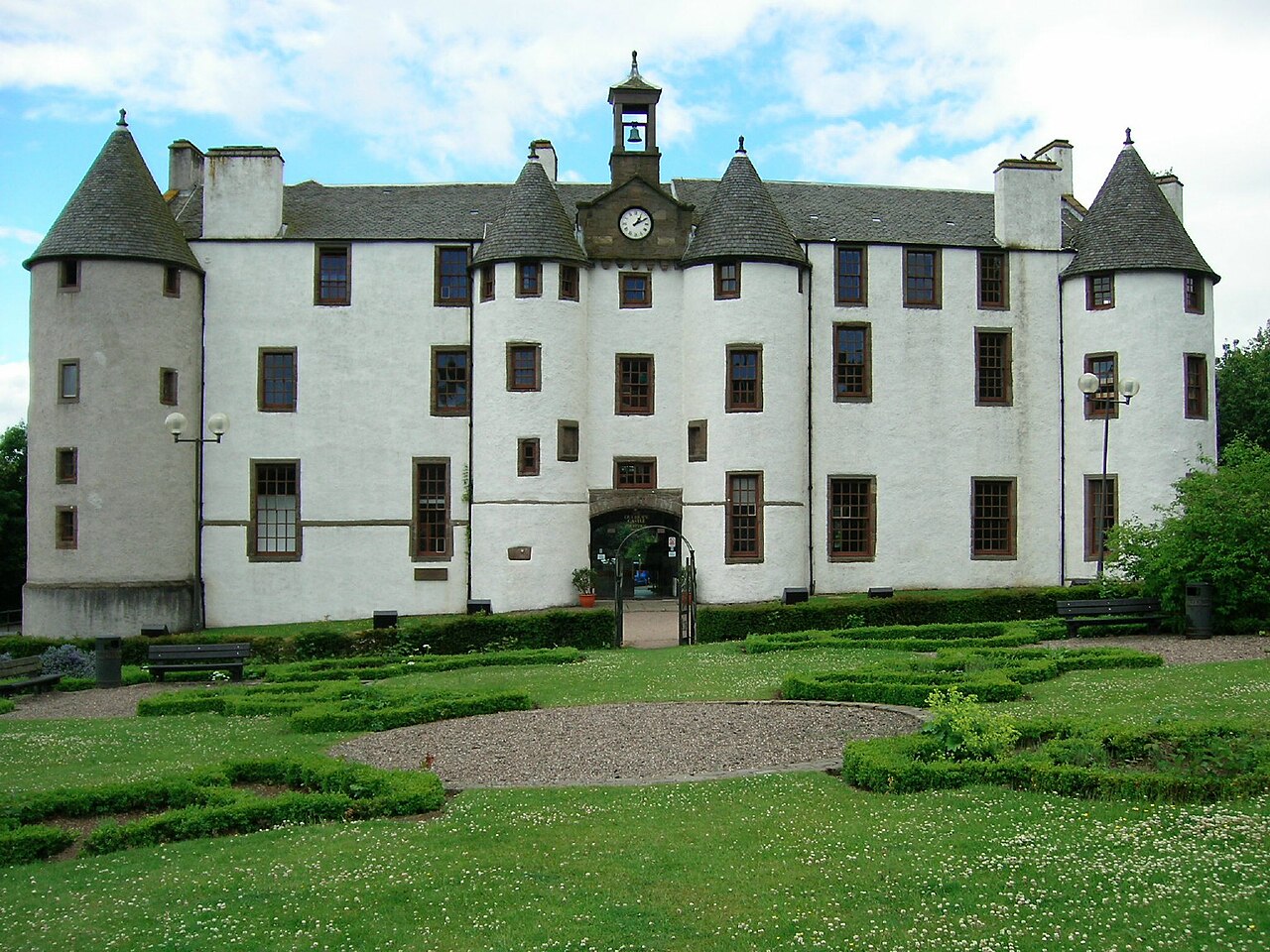
Image: Dudhope Castle by Ydam, sourced from Wikimedia Commons and licensed under CC BY-SA 3.0.

Dudhope Castle is Dundee’s great surviving tower house: a late-sixteenth- and seventeenth-century seat of the city’s constables, later a barracks, and now a community-business and events hub within a public park.
Quick facts
- Date
- Late sixteenth and seventeenth centuries; converted for industrial and military use in the 1790s; restored 1985–1989
- Architect / designer
- Early builders not identified; Samuel Bell altered it for barracks in 1799; late-twentieth-century restoration by Dundee local-authority architects
- Type
- Large L-plan tower house and former fortress, manufactory and barracks
- Designation
- Listed building, Category A (LB25195)
- OS grid reference
- NO 39459 30670
Architecture
The castle is an L-plan, rubble-built tower house rising mainly to four storeys, with clasping angle turrets and a complex roofline. Its south-west wing was begun around 1588 and heightened in stages; the entrance-pend section is dated 1600. The north-east wing was formed around 1684–1689 on the site of a fifteenth-century keep. Thick walls, small lower windows and barrel- and groin-vaulted basement rooms preserve the defensive character, while altered window levels, rebuilt roofs and internal floors record repeated adaptation.
The east entrance is the most theatrical elevation. A segmental-headed pend is flanked by twin round towers with conical roofs, while a swept-roof bellcote rises above on a corbelled gablet. Other telling details include roll-moulded door and window openings, sockets for bars, skewputts showing earlier roof levels, and the armorial stone of Dame Madelene Livingstone, wife of Sir James Scrymgeour. Historic Environment Scotland notes that much timberwork and barrack equipment was lost before or during the twentieth-century restoration, so the surviving castle should not be read as an untouched interior.
Constables, conflict and changing authority
Dudhope was the seat of the hereditary Constables of Dundee, whose role was to hold the burgh for the Crown. The Scrymgeour family retained the office until 1668; it subsequently passed through Charles Maitland and, in 1684, to John Graham of Claverhouse, remembered as “Bonnie Dundee”. The castle is associated with Graham’s confrontation with the Convention of Estates and the beginning of the 1689 campaign that ended at Killiecrankie.
The Douglas family remained at Dudhope until about 1790. The castle then entered a markedly different phase: it was leased for a woollen manufactory in 1792–1793 and soon converted to government barracks during the French Revolutionary crisis. It served the military until about 1880 and was requisitioned again during both world wars. Dundee acquired the site in 1893, and the castle was comprehensively restored and harled between 1985 and 1989.
From fortress to community hub
The building’s latest reuse continues its long pattern of adaptation. Current material from The Circle identifies Dudhope Castle as its Dundee hub, offering offices, meeting and event space for charities, social enterprises and small organisations. An August 2026 workspace notice advertises step-free access, a lift and accessible toilet. The Circle’s 2024 account records that repairs to the accessible toilet were completed after a fundraising campaign.
An older Dundee City Council park page still describes council office use, while the current operator’s 2026 information shows The Circle in occupation. The Circle’s more recent information establishes its current occupation; individual tenants and room uses can change.
Visiting and access
Dudhope Park is a public green space with paths, recreation facilities and broad views across Dundee, so the castle exterior can be appreciated from lawful park routes. Interior access is tied to workspaces, booked meetings, training, services and advertised public or private events. Dundee City Council’s events listing currently treats Dudhope Castle as an event venue; visitors should use the organiser’s booking details rather than assume that every room is open.
The Circle advertises step-free access, a lift and an accessible toilet, but a historic tower house can still present route and room constraints. Anyone attending an event or meeting should confirm the entrance, lift availability and accessible facilities with the organiser. Tenant offices and staff areas are private.
What to notice
- The twin drum towers and entrance pend on the east front.
- The armorial stone on a lower skewputt of the south-west wing.
- Different masonry, window levels and rooflines that reveal successive building campaigns.
- The contrast between the fortified mass of the castle and the open recreational landscape of Dudhope Park.
Timeline
- Fourteenth century onward Dudhope is established as the seat of Dundee’s hereditary constables.
- c. 1588–1600 The south-west wing and entrance-pend phase take shape.
- 1684–1689 The north-east wing is rebuilt on the site of the earlier keep; John Graham of Claverhouse becomes constable.
- 1792–1799 A short-lived woollen manufactory is followed by conversion to barracks, with major internal and roof alterations.
- 1790s–1880 Dudhope serves as a government barracks.
- 1893 Dundee acquires the site.
- 1985–1989 The derelict castle is restored, harled and adapted to modern standards.
- 2022 onward The Circle develops Dudhope Castle as a community-business, office and events hub.
What we know — and what remains uncertain
The broad sequence is well documented, but the precise date of the earliest surviving masonry and the relationship between the present north-east wing and the 1460 keep remain less certain. The attribution of individual early phases is also incomplete. Current occupancy and public programming are verified from recent operator and council material, but tenant arrangements and event access can change.
Sources & further reading
- Historic Environment Scotland: Dudhope Castle, LB25195 — Designation, mapped location, construction phases, fabric, military conversion, historical associations and restoration.
- The Circle: office space at Dudhope Castle — August 2026 evidence for current hub, workspace, event use and advertised accessibility.
- The Circle: eighth-birthday review — Confirmation that the Dudhope Castle accessible-toilet repair was completed.
- Dundee City Council: Dudhope Park and Castle — Public park, recreation, exterior setting and older council-use wording.
- Dundee City Council: What’s On at Dudhope Castle — Current venue listing and advertised-event access.
Location
OS grid reference NO 39459 30670 · Location confidence: High: the statutory designation supplies an official mapped National Grid Reference and the current source confirms the Place relationship or present identity. · Select the marker to open its satellite view in Google Maps. On desktop, drag Pegman (the yellow figure) onto a blue road. On mobile, turn on the Street View layer and tap a blue road. Other photo markers may be user-contributed.
Suggest a marker correction
Suggest a more accurate position
The teal marker is the current published position. The orange marker starts slightly to its right so both remain visible; this is only a visual starting position. Tap the correct place on the map or drag the orange marker. Sending this form creates a private review entry only; it does not move the published marker.
Check this area in Google Maps Choose the Satellite layer there if useful.
Map: © OpenStreetMap contributors. You can also enter checked coordinates below.