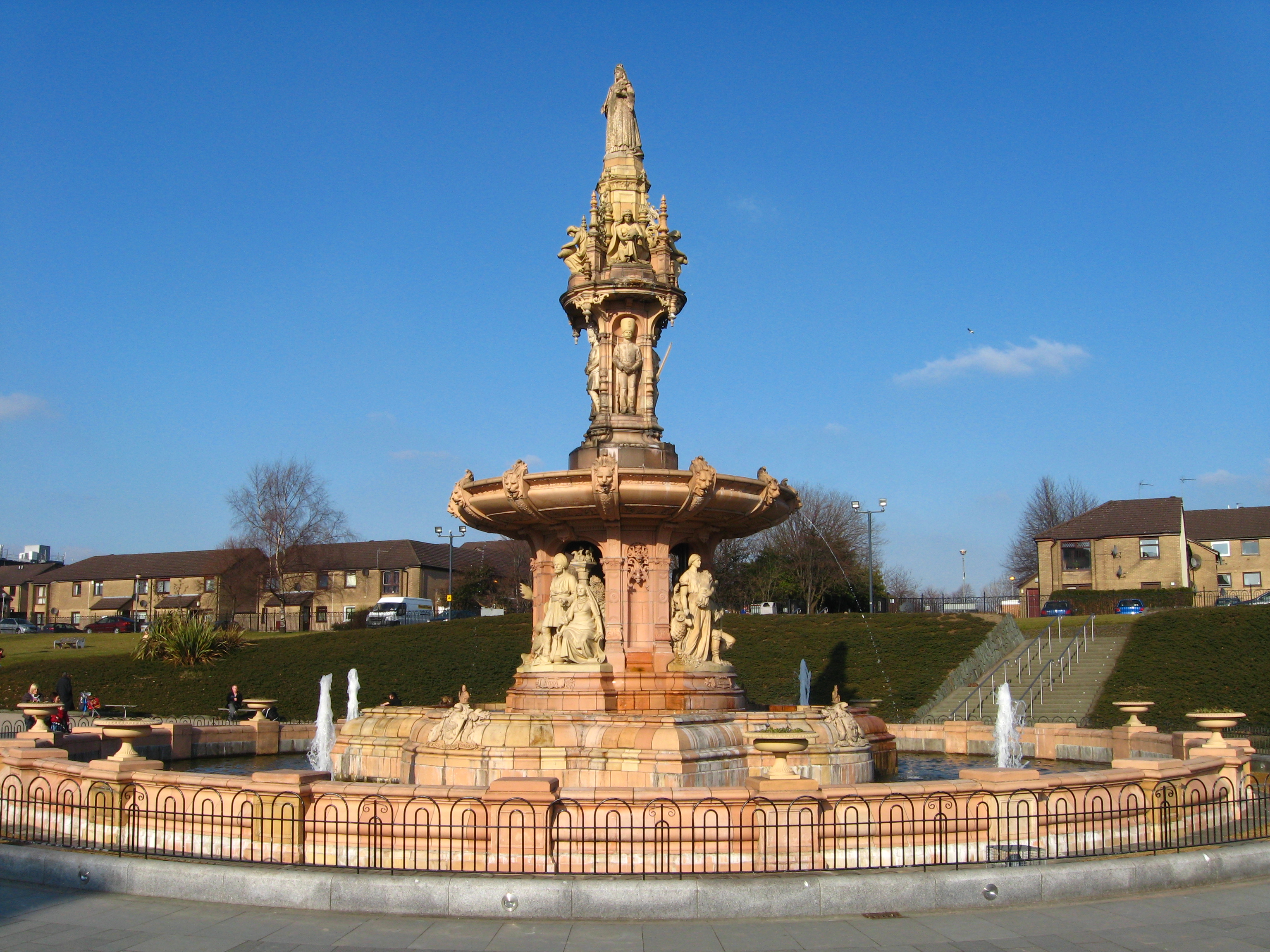
Doulton Fountain, Glasgow. Photograph: Chris Phan / Wikimedia Commons, 7 March 2010. CC BY 2.0.

The Doulton Fountain is a feat of large-scale terracotta manufacture and an unusually explicit monument to Victorian monarchy and empire. Made as Doulton & Company’s showpiece for Glasgow’s 1888 International Exhibition, it now stands in Glasgow Green as both an exuberant public fountain and difficult historical evidence.
Quick facts
- Date
- Designed for the 1888 Glasgow International Exhibition; presented to the city and erected on Glasgow Green in 1890; dismantled and restored around 1999–2005
- Architect / designer
- A. E. Pearce for Doulton & Company
- Type
- Monumental terracotta fountain with imperial figure groups
- Designation
- Listed building, Category A (LB33836)
- OS grid reference
- NS 60105 64314
Architecture and materials
The fountain is built as a broad, highly modelled terracotta composition rather than a stone monument with applied ceramic ornament. Historic Environment Scotland describes three tiered basins set within a wide outer basin. City collection sources give an overall height of about 46 feet (14 metres) and an outer-basin diameter of about 70 feet (21 metres), dimensions which make the hierarchy legible across the open park.
Colour, moulding and repetition do much of the architectural work. Lobed and circular basins, colonnettes, panels, foliage, scrolls and figure groups build upwards towards the crowning statue. The material advertised Doulton’s command of industrial ceramic production: many separately formed components could be fired, assembled and enriched into a structure on a scale normally associated with carved stone or cast metal.
The figure programme
Queen Victoria occupies the summit. Below her, figures of a Royal Navy sailor and soldiers associated with the Grenadier Guards, Black Watch Highlanders and Royal Irish Fusiliers present imperial authority in military form. Four lower groups represent India, Canada, the South African colonies and Australia, accompanied by products and emblems intended to characterise their economies and natural resources.
This arrangement is not neutral decoration. It places the monarch above armed power and colonised territories, turning the fountain into a confident late-Victorian statement about hierarchy, possession and commerce. The craftsmanship can be studied without repeating that political message uncritically. Glasgow Life’s learning material expressly uses the fountain to examine how empire was represented and how wealth, display and exploitation were connected.
From exhibition showpiece to public monument
Doulton & Company made the fountain for the 1888 International Exhibition in Kelvingrove Park. It commemorated Queen Victoria’s Golden Jubilee of 1887 while serving as an advertisement for the firm’s technical and artistic range. After the exhibition, the company presented it to Glasgow. It was installed on Glasgow Green in 1890, years before the People’s Palace opened in 1898.
Weathering, vandalism and the complexity of maintaining a working terracotta fountain brought serious deterioration during the twentieth century. Historic photographs and council records show its declining condition; Historic Environment Scotland recorded it as neglected in 1992, with at least one figure removed to the People’s Palace for safety. Glasgow Life records that it was dismantled in 1999 for restoration. The repaired structure was reassembled in the more prominent axial position in front of the People’s Palace and switched on in May 2005. Historic Environment Scotland then described it as functioning and floodlit.
Why it is included
The Category A listing recognises an elaborate and technically remarkable survivor. The fountain is important not only because of its size or rarity, but because form, material, industry and ideology remain inseparable: it shows how a commercial exhibit could become civic ornament, and how Glasgow’s public landscape helped normalise imperial power.
Its later history also matters. Dismantling, conserving and reconstructing so many ceramic components was a major exercise in public-monument care. The present fountain is therefore both a nineteenth-century artefact and the result of a substantial late-twentieth- and early-twenty-first-century conservation campaign.
What to notice
- The change of scale from the broad outer basin to the compact figure of Victoria at the summit.
- How repeated moulded units, glazed colour and dense relief give terracotta the visual authority of stone or bronze.
- The military figures immediately below Victoria and the four colonial groups arranged beneath them.
- The products, animals and emblems used to reduce complex societies to resources within an imperial display.
- The fountain’s present alignment with the People’s Palace, created by the restoration and relocation rather than by the original 1890 siting.
Visiting and access
The exterior is freely visible from public paths in Glasgow Green. Glasgow City Council states that the park is open at all times, although particular facilities and routes can be affected by events, maintenance or construction. The adjacent People’s Palace and Winter Gardens are currently closed for refurbishment; that closure should not be mistaken for closure of the fountain or the park, but local diversions may apply.
This is an outdoor monument rather than an interior visitor attraction. Appreciate it from the surrounding public realm, remain outside the basin and do not climb or touch the sculpture. Water operation and lighting are maintenance-dependent and should not be assumed on a particular visit.
Timeline
- 1887 Queen Victoria’s Golden Jubilee provides the commemorative theme.
- 1888 Doulton & Company exhibits the fountain at Glasgow’s International Exhibition in Kelvingrove Park.
- 1890 The company presents it to the city and it is erected on Glasgow Green.
- 1992 Historic Environment Scotland records neglect and the removal of at least one figure for safety.
- 1999–2005 The fountain is dismantled, conserved and reconstructed in front of the People’s Palace; it is switched on in May 2005.
- Present It remains a publicly visible Category A monument in Glasgow Green; the adjacent museum is closed for refurbishment.
What we know — and what remains uncertain
The designation securely identifies the designer, date, material, principal composition and Category A status. Glasgow Life and city collection sources document the exhibition, gift, deterioration and restoration. Descriptions calling it the world’s largest terracotta fountain are common in official city material; because such superlatives depend on definitions and surviving comparators, it is safer to describe it as widely regarded as the largest of its kind. Its water and lighting status can change with maintenance, and no permanent operating schedule has been assumed here.
Sources & further reading
- Historic Environment Scotland: Doulton Fountain, LB33836 — Category A designation, location, principal form, 1888 authorship and the 2004–05 restoration record.
- Glasgow Life: Glasgow’s fountains — exhibition history, gift to the city, dismantling, restoration and May 2005 reopening.
- Glasgow Life: Doulton Fountain learning notes — identification of the military and colonial figure groups and their use in critical interpretation of empire.
- TheGlasgowStory: Doulton Fountain — Glasgow Collection evidence for dimensions, condition and the restoration campaign.
- Glasgow City Council: Glasgow Green — current park access.
- Glasgow Life: People’s Palace — current closure of the adjacent museum and refurbishment context.