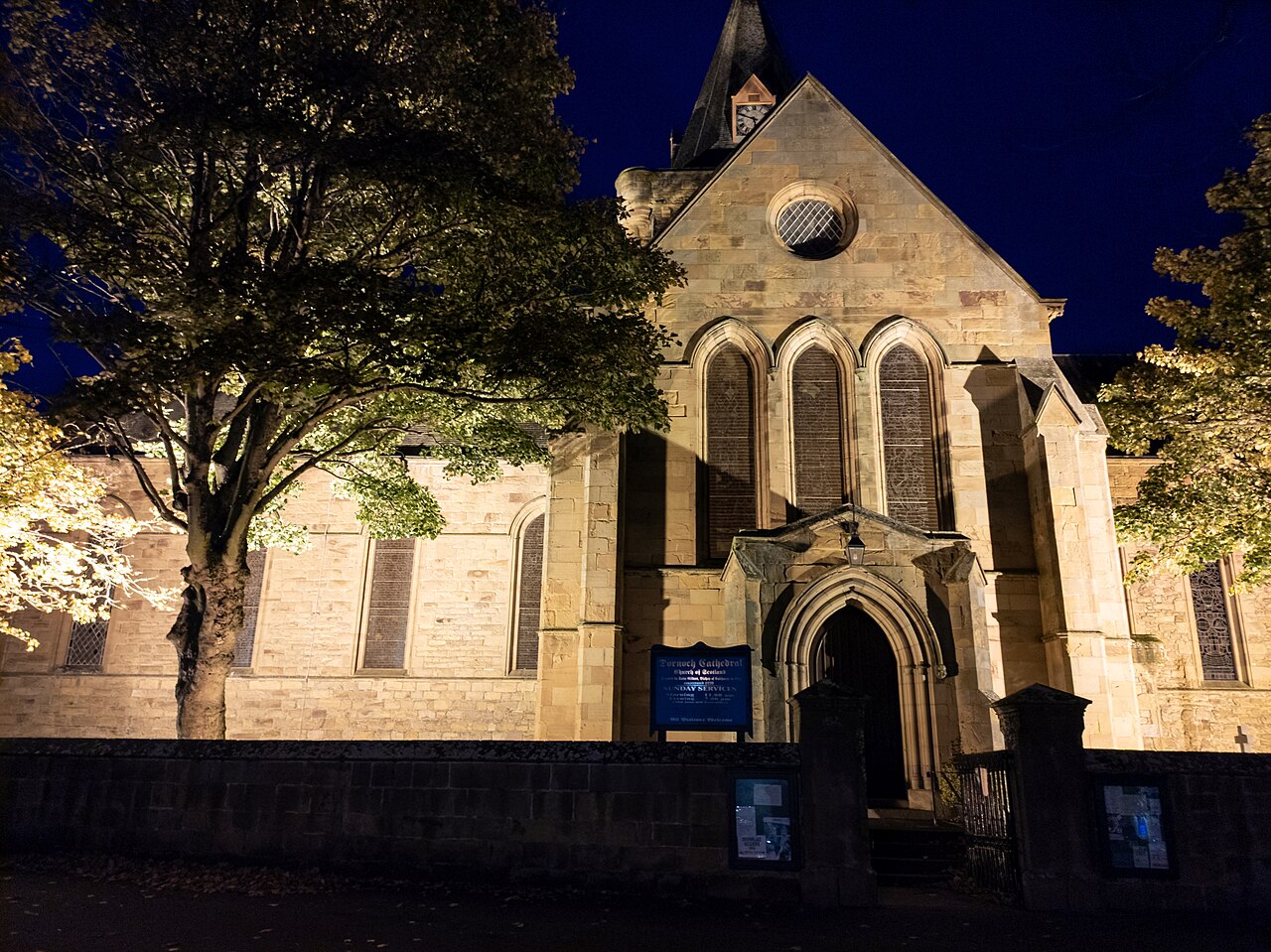
Image: Dornoch Cathedral by Tom Page, sourced from Wikimedia Commons and licensed under CC BY-SA 2.0.
.jpg)
Medieval crossing piers, a seventeenth-century tower parapet and William Burn’s nineteenth-century restoration coexist in Dornoch’s defining building.
Quick facts
- Date
- 13th century; restored 1835–37
- Architect / designer
- Medieval masons; restoration by William Burn
- Type
- Cruciform medieval church with central tower and later spire
- Designation
- Listed building, Category A (LB24632)
- OS grid reference
- NH 79720 89692
Architecture and continuing use
Rubble walls with ashlar dressings shape a cruciform church of nave, choir and transepts. The crossing retains exceptional transitional clustered piers; lancets, tracery, a corbelled parapet and slated spire reveal successive campaigns rather than a single date.
Its story
Founded by Gilbert de Moravia in 1224, the cathedral was damaged by fire in 1570 and repaired in the early seventeenth century. William Burn rebuilt the nave and restored the whole church in 1835–37; later work preserved medieval masonry while renewing the interior.
Why it is included
Category A status, rare medieval crossing fabric, a long sequence of rebuilding and continuing worship make the cathedral essential to understanding Dornoch.
What to notice
- The irregular clustered crossing piers and their early capitals.
- Lancet groups contrasted with the large west window.
- The change from the tower’s corbelled parapet to its slated spire.
Reading the surroundings
The congregation publishes worship and visitor opening information. Enter quietly when open, avoid services unless attending, and remember that the adjoining scheduled ground is separately protected.
Timeline
- 1224 Bishop Gilbert’s foundation made Dornoch an ecclesiastical focus for medieval Caithness.
- 1570 Fire damaged the building during a period of religious and political upheaval.
- 1835–37 William Burn rebuilt the nave and carried out a comprehensive restoration.
- 2026 Dornoch Firth Church continues worship and visitor opening in the cathedral.
What we know — and what remains uncertain
The designation separates the listed church from scheduled monument SM10828; access arrangements and service times can change.
Sources & further reading
- Historic Environment Scotland: Dornoch Cathedral, LB24632 — Designation category, mapped location, construction phases, fabric, authorship and architectural or historical interest.
- Dornoch Cathedral: worship and visitor information — Current congregation, worship, visitor opening and contact information.
Location
OS grid reference NH 79720 89692 · Location confidence: High: the statutory designation supplies an official mapped National Grid Reference and the current source confirms the Place relationship or present identity. · Select the marker to open its satellite view in Google Maps. On desktop, drag Pegman (the yellow figure) onto a blue road. On mobile, turn on the Street View layer and tap a blue road. Other photo markers may be user-contributed.
Suggest a marker correction
Suggest a more accurate position
The teal marker is the current published position. The orange marker starts slightly to its right so both remain visible; this is only a visual starting position. Tap the correct place on the map or drag the orange marker. Sending this form creates a private review entry only; it does not move the published marker.
Check this area in Google Maps Choose the Satellite layer there if useful.
Map: © OpenStreetMap contributors. You can also enter checked coordinates below.