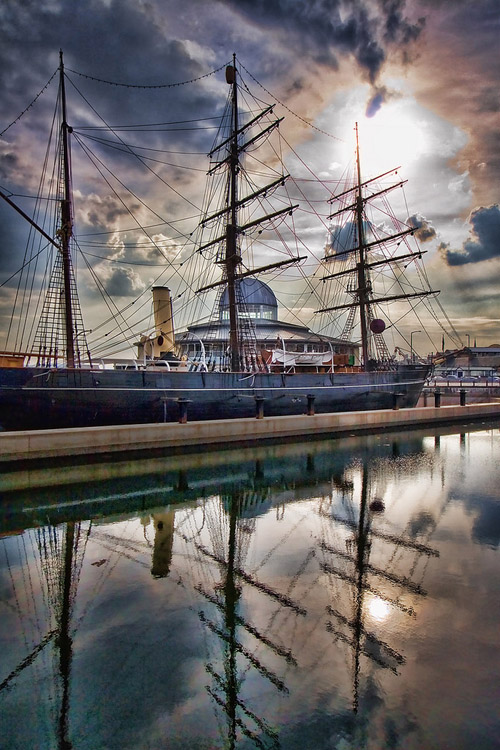


Dundee’s purpose-built Antarctic research ship and its waterfront museum, bringing shipbuilding, science, exploration and continuing conservation together.
Quick facts
- Date
- Ship launched in Dundee on 21 March 1901; returned permanently in 1986; Discovery Point opened in 1993; later conservation undertaken in phases
- Architect / designer
- Ship designed under Sir William Smith and built by Dundee Shipbuilders’ Company; the museum-complex architect is unconfirmed
- Type
- Historic research ship, dry dock and museum visitor centre
- Designation
- National Historic Fleet vessel; no linked statutory building designation for the museum complex identified in the sources consulted
- OS grid reference
- NO 40394 29812
Architecture and history
Designed under Sir William Smith and built by Dundee Shipbuilders’ Company, Discovery was launched on 21 March 1901. The wooden three-masted barque also had auxiliary steam power. Its hull was heavily strengthened for pressure from ice, with limited openings and careful internal organisation suited to polar work.
The rudder and propeller could be lifted to protect them from ice. Accommodation, stores, laboratories and working decks formed a compact system capable of supporting a long expedition far from conventional ports.
Discovery Point, opened in 1993 beside the dry-docked ship, provides the interpretive route and visitor facilities.
The hull was sheathed in hard greenheart timber. A coal-fired, three-cylinder engine made by Gourlays supplemented the sails, but bunker capacity was too small for steam alone to sustain long voyages. After sale to the Hudson’s Bay Company in 1905, laboratories became officers’ accommodation as the ship carried supplies north and brought furs back.
What to notice
- The strong wooden hull and relatively few external openings.
- The lifting rudder and propeller arrangement developed for ice.
- Masts, rigging and auxiliary-steam features within one vessel.
- The close physical relationship between ship and dry dock.
- Views linking Discovery with Dundee’s wider waterfront and shipbuilding story.
Change and conservation
Discovery returned permanently to Dundee in 1986 after a long and varied working life. Conservation is necessarily continuous. A dry-docked wooden vessel still responds to moisture, temperature and structural load, while decks, fastenings, caulking and coatings weather at different rates.
A curious detail
Discovery’s return to Dundee in 1986 was made aboard a floating-dock transport ship, rather than under her own sail or steam.
Location and Photos
Discovery Point is an active museum. Opening, ticketing and routes aboard the ship can change, particularly during conservation, so consult Dundee Heritage Trust before travelling. Some compartments may be inaccessible because of their historic form or current works.
Sources & further reading
- Trove: Discovery Quay — National catalogue point and precise location.
- Dundee Heritage Trust: Discovery Point — Current museum use, address and visitor information.
- Dundee Heritage Trust: RRS Discovery conservation — Current phased conservation and visitor-access context.
- Dundee Heritage Trust: 1901 expedition — Launch, construction and polar-design features.
- National Historic Ships UK: RRS Discovery — Greenheart sheathing, Gourlays auxiliary engine, limited coal capacity, 1905 Hudson’s Bay adaptation and transport to Dundee in a floating-dock ship in 1986.