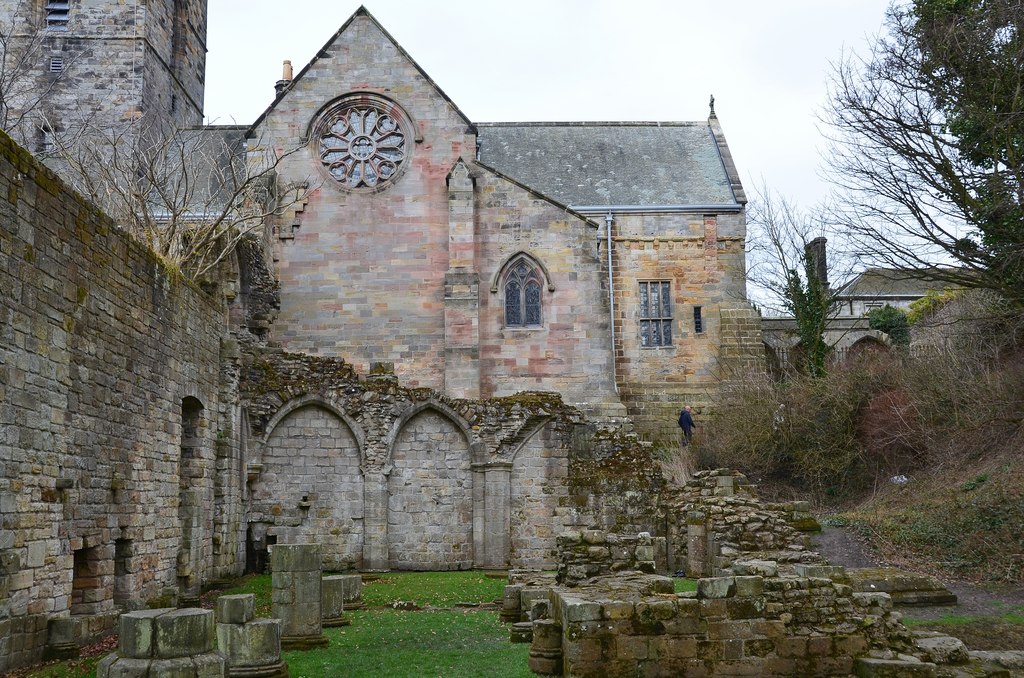
The roofed church at the eastern end of Culross’s former Cistercian abbey served as the parish church for centuries. Standing above the village on Kirk Street, it retains medieval stonework, a tower built around 1500 and later additions associated with parish worship and the Bruce family. It is a Category A listed building (LB23960), distinct from the separately scheduled abbey ruins.


Quick facts
- Origins
- Cistercian abbey founded in 1217; church contains thirteenth-century fabric
- Later work
- Tower around 1500; Bruce burial vault, 1642; William Stirling, 1824; Robert Rowand Anderson, 1905–06
- Designation
- Category A listed building, LB23960, including churchyard and boundary walls
- Location
- Kirk Street, Culross, Fife; NS 98884 86246
- Recent use
- Former Church of Scotland parish church; closed in August 2025 and subsequently marketed for sale
Medieval church and tower
The Cistercian abbey of St Mary and St Serf was established in 1217 as a daughter house of Kinloss. Its church originally formed part of a larger monastic complex. The present roofed church preserves the eastern part of that building. The tall, four-stage tower at its west end dates from around 1500, after part of the medieval nave had been taken down. It has a crenellated parapet, corner turrets, a projecting circular stair tower and moulded medieval openings.
The church’s ashlar masonry, pointed windows and surviving arches show successive building periods. West of the tower, masonry of the former nave continues into the ruined abbey. The cloister buildings and other monastic remains have a different legal designation: Culross Abbey ruins are protected as a scheduled monument (SM13334).
Parish church and Bruce burial aisle
After the Reformation, the eastern part of the abbey church was retained for Protestant worship. Culross Abbey became the parish church in 1633, superseding the old West Kirk. The north transept was adapted as the burial aisle of Sir George Bruce of Carnock. Its 1642 inscription and alabaster family monument preserve an important connection between the church and Culross’s merchant and mining history.
William Stirling altered the parish church in 1824. Robert Rowand Anderson directed extensive restoration in 1905–06. The interior contains historic furnishings, memorials and stained glass from different periods; Scotland’s Churches Trust identifies work by Ballantine & Sons, Stephen Adam and Emma Butler-Cole Aiken.
Closure and future use
Scotland’s Churches Trust reports that the Church of Scotland closed the church in August 2025. The Church of Scotland subsequently advertised the building for sale with offers over £35,000 and, when checked on 6 November 2026, its property listing was marked under offer. The church’s own website also states that the building is closed during a change of ownership. These statements establish closure and a proposed change of ownership, but do not independently establish the date of any completed transfer or a new permanent use.
The building remains Category A listed. The listing’s statutory name includes “Church of Scotland”, reflecting its name at designation rather than proof of continuing congregational use.
Location and Photos
The church stands above Culross on Kirk Street, beside the medieval abbey ruins and the churchyard. The image shows the roofed church behind the lower surviving walls of the monastic complex. Visiting and interior access arrangements need to be confirmed with the current custodian; the church website presently states that it is closed. The map point is derived from Historic Environment Scotland’s listed-building grid reference, not a surveyed entrance.
Explore further
Culross Abbey ruins · Culross · Sacred Spaces of Scotland: Faiths and Architecture
Sources & further reading
- Historic Environment Scotland: Culross Abbey Church LB23960 — Category A listing; location and grid reference; medieval fabric, west tower, Bruce Vault, 1824 alterations and 1905–06 restoration.
- Scotland’s Churches Trust: Culross Abbey — History as parish church from 1633; Bruce family monument and stained glass; reported Church of Scotland closure in August 2025.
- Church of Scotland: Culross Abbey property listing — Building marketed for sale with listing marked under offer; asking price offers over £35,000, checked 6 November 2026.
- Culross Abbey: website — Website states closed because of a change of ownership; no independent confirmation of completed transfer.
- Wikimedia Commons: Abbey church, Culross — Jim Barton — 22 March 2015 photograph depicting the roofed church and medieval remains; CC BY-SA 2.0.
- Historic Environment Scotland: Culross Abbey scheduled ruins SM13334 — Separately scheduled medieval monastery remains excluded from the church listing.
Location
OS grid reference NS 98884 86246 · Location confidence: HES listed-building NGR NS 98884 86246 transformed from OSGB36 to WGS84; point represents the listed church area, not a surveyed entrance. · Select the marker to open its satellite view in Google Maps. On desktop, drag Pegman (the yellow figure) onto a blue road. On mobile, turn on the Street View layer and tap a blue road. Other photo markers may be user-contributed.
Suggest a marker correction
Suggest a more accurate position
The teal marker is the current published position. The orange marker starts slightly to its right so both remain visible; this is only a visual starting position. Tap the correct place on the map or drag the orange marker. Sending this form creates a private review entry only; it does not move the published marker.
Check this area in Google Maps Choose the Satellite layer there if useful.
Map: © OpenStreetMap contributors. You can also enter checked coordinates below.
In these guides: Sacred Spaces of Scotland: Faiths and Architecture