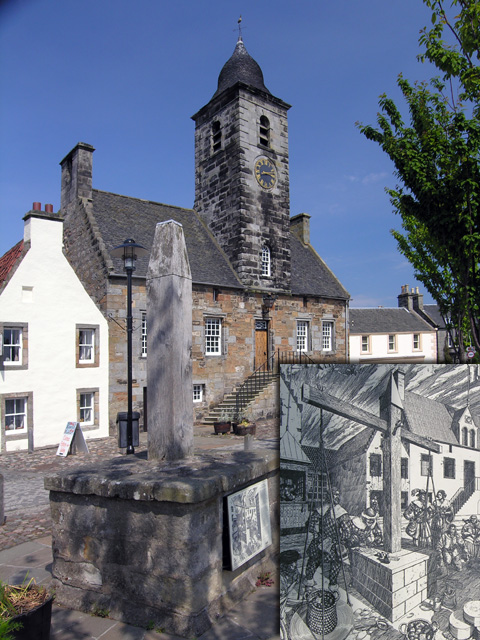
Image: Culross Town House and Tron by Nigel J C Turnbull, sourced from Wikimedia Commons and licensed under CC BY-SA 2.0.

A double stair and clock tower announce the former civic centre, where administration and confinement shared a single building.
Quick facts
- Date
- 1626; clock tower and forestair 1783; refurbishment 1957–1959
- Architect / designer
- Original designer not identified; refurbishment by Ian G Lindsay and Partners
- Type
- Burgh town house with council rooms and former cells
- OS grid reference
- NS 98572 85916
Architecture and development
A broad sandstone front is approached by a double external stair. Above it, an off-centre clock tower adds a vertical accent. HES records cells below the principal council and court rooms, expressing different levels of authority and access within the building.
Its story
The town house was built in 1626. The clock tower and double forestair followed in 1783; Laurence Dalgleish made the clock mechanism. Ian G Lindsay and Partners refurbished the building in 1957–1959. The council used it until local government reorganisation in 1975, after which it passed to the National Trust for Scotland.
Why it is included
It shows how a burgh gave architectural form to government, justice and public timekeeping.
What to look for
- The two stair flights joining at the first-floor entrance.
- The clock tower’s position within the long frontage.
- The distinction between lower cells and principal rooms.
Reading the surroundings
View the exterior from public space. Check with the National Trust for Scotland before assuming that historic upper rooms are accessible.
Timeline
- 1626 The present town house was constructed.
- 1783 Clock tower and double forestair transformed the frontage.
- 1957–1959 Ian G Lindsay and Partners carried out refurbishment.
A curious detail
The Town House once stood much nearer the shore. HES explains that late-nineteenth-century reclamation at Sandhaven moved the edge of the Forth away from the building.
What we know — and what remains uncertain
The listing describes several internal uses in the present tense. Current NTS information confirms a Townhouse shop, but does not establish unrestricted access to the council rooms or cells.
Sources & further reading
- Historic Environment Scotland: Culross Town House, LB23994 — Category A listing, coordinates, building phases and civic functions; full record read 16 September 2026.
- National Trust for Scotland: Royal Burgh of Culross — Current operator information confirms the Townhouse shop; checked 16 September 2026.
Location
OS grid reference NS 98572 85916 · Location confidence: Catalogue point converted from HES grid coordinates checked 16 September 2026; not a boundary or entrance. · Select the marker to open its satellite view in Google Maps. On desktop, drag Pegman (the yellow figure) onto a blue road. On mobile, turn on the Street View layer and tap a blue road. Other photo markers may be user-contributed.
Suggest a marker correction
Suggest a more accurate position
The teal marker is the current published position. The orange marker starts slightly to its right so both remain visible; this is only a visual starting position. Tap the correct place on the map or drag the orange marker. Sending this form creates a private review entry only; it does not move the published marker.
Check this area in Google Maps Choose the Satellite layer there if useful.
Map: © OpenStreetMap contributors. You can also enter checked coordinates below.