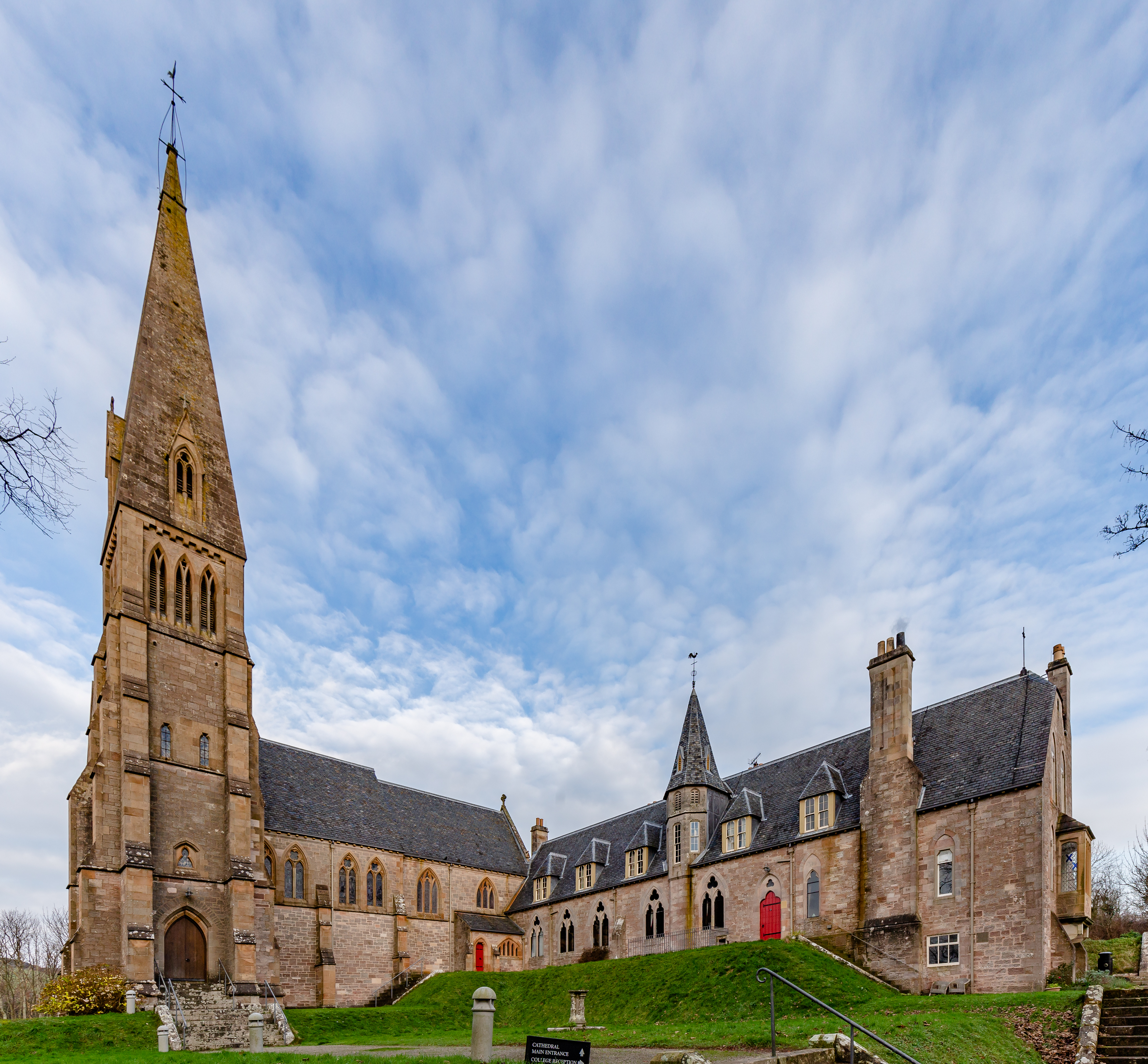
Butterfield’s church, spire and collegiate ranges form a Gothic ensemble on the hillside above Millport.


Quick facts
- Date
- 1849–51; cathedral status from 1876
- Architect
- William Butterfield
- Designation
- Category A listed building, LB37824
- OS grid reference
- NS 16577 55240
A collegiate foundation
George Frederick Boyle, later sixth Earl of Glasgow, commissioned William Butterfield to design a church and associated college buildings. Construction began in 1849 and the foundation opened in 1851. The church became a cathedral in 1876, making this small island town a seat of the Scottish Episcopal diocese of Argyll and the Isles.
Church and residence together
The composition joins a steep spire and pointed church windows to an adjoining residential range. Chimneys, dormers and a turret distinguish the domestic accommodation without breaking the Gothic character of the whole. The surviving ensemble matters as a collegiate foundation, rather than simply as an isolated church tower.
Layers of island history
The heritage trail also records early carved stones associated with Kirkton and a cross found at the Garrison. Their presence here should not be taken as proof that this nineteenth-century building occupies their original setting. Historic Environment Scotland lists the cathedral and collegiate buildings at Category A. Check the institution’s own arrangements before seeking interior access.
Colour and the chancel
The church-supplied account published by the National Churches Trust identifies a carved stone cross within the arch separating nave and chancel. Behind the choir, red, yellow and blue geometric tiles contrast with dark timber, while the chancel ceiling depicts island ferns and wild flowers. Glass by William Wailes and John Hardman adds another layer of colour. These features explain how Butterfield’s relatively small church achieves an elaborate liturgical focus within the larger collegiate ensemble.
Sources and further reading
- National Churches Trust: Cathedral of the Isles — Church-supplied description of the cross, chancel tiles, painted ceiling and stained glass; historical description is not a current opening guarantee.
- Historic Environment Scotland — Cathedral and Collegiate Buildings, LB37824 — Category A designation, architect, date and official location.
- North Ayrshire Heritage Trails — Cathedral of the Isles — Patronage, Butterfield’s college and church, and cathedral status.
Location
OS grid reference NS 16577 55240 · Location confidence: HES statutory grid point transformed from OSGB36 to WGS84; approximate building location, not an entrance or designation boundary. · Select the marker to open its satellite view in Google Maps. On desktop, drag Pegman (the yellow figure) onto a blue road. On mobile, turn on the Street View layer and tap a blue road. Other photo markers may be user-contributed.
Suggest a marker correction
Suggest a more accurate position
The teal marker is the current published position. The orange marker starts slightly to its right so both remain visible; this is only a visual starting position. Tap the correct place on the map or drag the orange marker. Sending this form creates a private review entry only; it does not move the published marker.
Check this area in Google Maps Choose the Satellite layer there if useful.
Map: © OpenStreetMap contributors. You can also enter checked coordinates below.