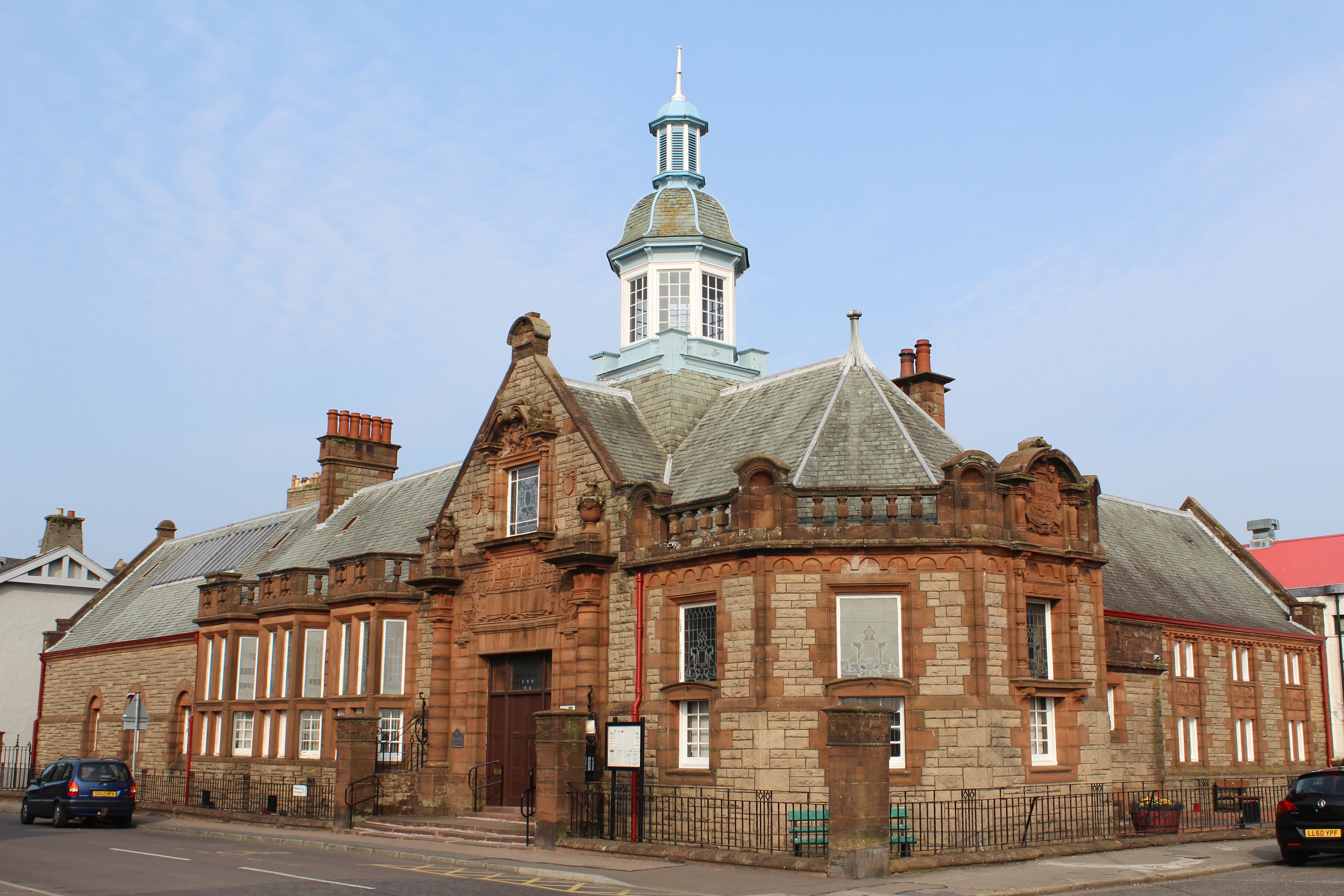
Image: Campbeltown Museum and Burnet Building by Leslie Barrie, sourced from Wikimedia Commons and licensed under CC BY-SA 2.0.

John James Burnet’s richly composed civic building remains the home of Campbeltown Museum after the library’s relocation.
Quick facts
- Date
- Built 1897–1898; opened 1899; refurbished before reopening in 2008
- Architect / designer
- John James Burnet
- Type
- Free Scots Renaissance public library, museum and former librarian’s house
- Designation
- Listed building, Category A (LB22964)
- OS grid reference
- NR 72099 20346
Architecture and continuing use
An L-plan composition in rubble and red sandstone mixes crowsteps, carved dormers, an arcaded porch and a lantern-like cupola. The elaborate original interior and boundary treatment reinforce the building’s status as a late-Victorian cultural institution.
Its story
The Kintyre Scientific Association promoted a combined free library and museum, supported by James Macalister Hall. The building opened in 1899. The library later moved to Aqualibrium, while the museum returned after refurbishment.
Why it is included
It joins ambitious civic architecture to a collection that interprets Kintyre archaeology, art, natural history and maritime life.
An interior planned around several kinds of learning
The original entrance hall distributed visitors to separate reading rooms and the library, using red-sandstone arcades and glazed screens. Etched and leaded glass carried authors’ names, while a U-shaped desk and indicator board belonged to the former closed-access library system. These details explain how staff and readers used the building.
The museum had a distinct architectural character: its barrel-vaulted ceiling and central glazed cupola brought light from above, with smaller side windows available for lighting individual cases. A covered garden walkway provided another route to it. HES describes the historic fittings. Access today is limited to the rooms opened by the museum.
What to notice
- Red sandstone dressings against darker rubble.
- Crowstepped and carved roofline details.
- Lantern cupola marking the corner composition.
- Where publicly accessible, compare roof lighting, glazed screens and timber fittings that distinguish the former reading rooms, library and museum.
Reading the surroundings
Visit the museum during its published opening arrangements. Council offices and former residential or service areas are not included in normal museum access.
Timeline
- Built 1897–1898 The Kintyre Scientific Association promoted a combined free library and museum, supported by James Macalister Hall. The building opened in 1899. The library later moved to Aqualibrium, while the museum returned after refurbishment.
- Present Campbeltown Museum and council accommodation; the public library has moved elsewhere.
What we know — and what remains uncertain
The statutory title preserves the original library function, but the library has moved; current room uses elsewhere in the building can change.
Sources & further reading
- Historic Environment Scotland: Campbeltown Museum and Burnet Building, LB22964 — Designation status, mapped location, construction phases, fabric, authorship and architectural or historical interest.
- Campbeltown Museum: building and collection — Current museum identity, library relocation, reopening and collection context.
- Argyll and Bute Council: Burnet Building conservation works — Recent council evidence for continuing care of the building.
Location
OS grid reference NR 72099 20346 · Location confidence: High: the statutory designation supplies an official mapped National Grid Reference and the current source confirms the Place relationship or present identity. · Select the marker to open its satellite view in Google Maps. On desktop, drag Pegman (the yellow figure) onto a blue road. On mobile, turn on the Street View layer and tap a blue road. Other photo markers may be user-contributed.
Suggest a marker correction
Suggest a more accurate position
The teal marker is the current published position. The orange marker starts slightly to its right so both remain visible; this is only a visual starting position. Tap the correct place on the map or drag the orange marker. Sending this form creates a private review entry only; it does not move the published marker.
Check this area in Google Maps Choose the Satellite layer there if useful.
Map: © OpenStreetMap contributors. You can also enter checked coordinates below.