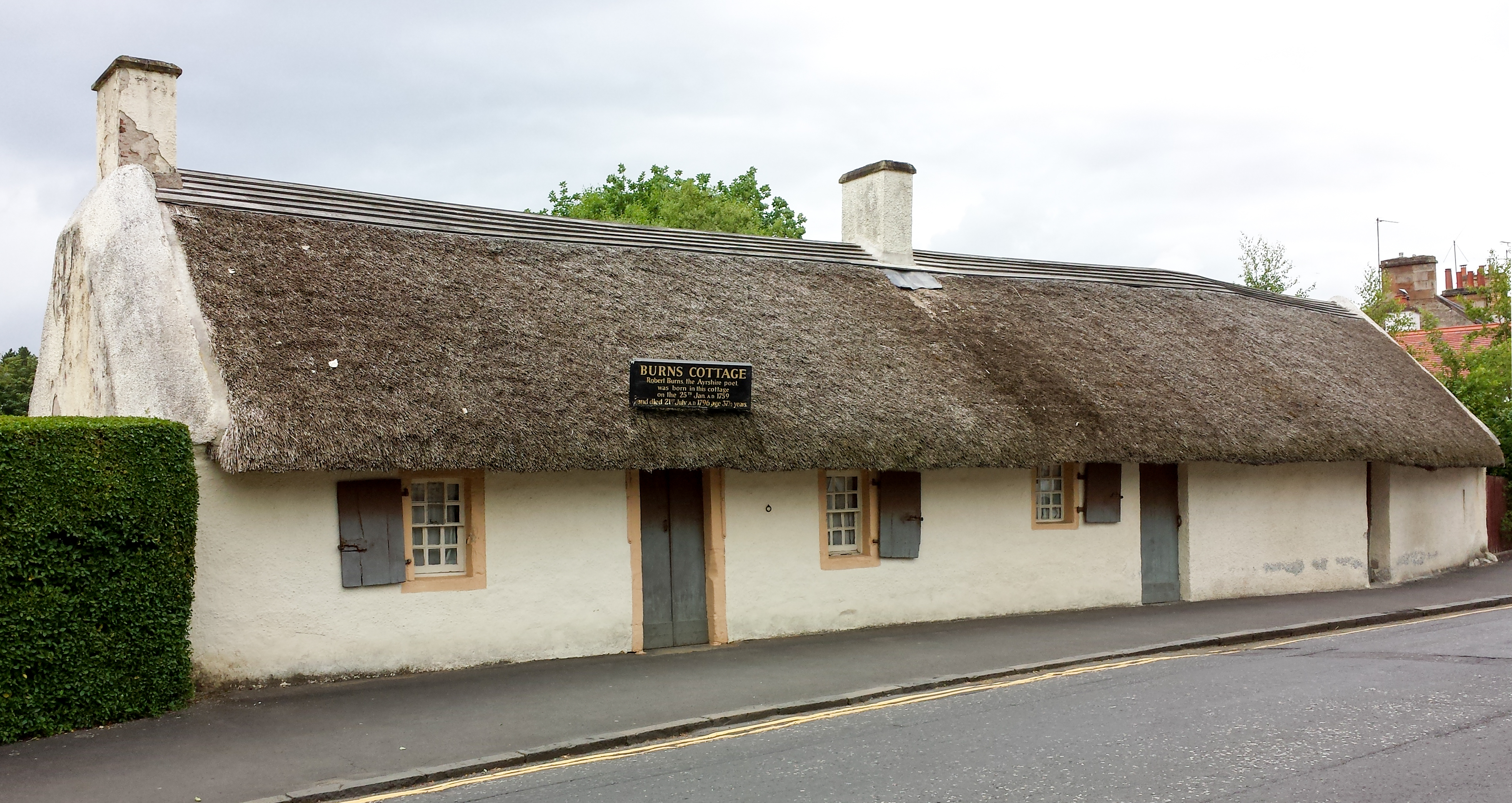
Image: Long whitewashed, thatched Burns Cottage beside the road in Alloway by DeFacto / Wikimedia Commons, licensed under CC BY-SA 4.0.

Built by William Burnes in 1757, this low whitewashed and thatched cottage combined a family home with working agricultural spaces; it is both a rare surviving vernacular building and the birthplace of Robert Burns.
Quick facts
- Date
- Built 1757; extended 1808; restored from 1881 with later conservation work
- Builder / later care
- William Burnes; restored by the Burns Monument Trustees and now cared for by the National Trust for Scotland
- Type
- Traditional thatched cottage combining dwelling, byre and barn; now part of Robert Burns Birthplace Museum
- Designation
- Category A listed Burns Cottage and boundary wall (LB21476)
- OS grid reference
- NS 33474 18591
A house and small farm under one roof
The cottage is a single-storey, near-rectangular building whose slight curve follows the roadside. Its seven-bay entrance front is made from clay-bonded walls, harled and whitewashed, beneath a reed-thatched roof with deep coping, a timber ridge and coped chimney stacks. Timber doors, shutters and sash-and-case windows give the long elevation a plain, practical rhythm.
Historic Environment Scotland describes a sequence of domestic and agricultural spaces: kitchen and living accommodation at the south end, a north room whose original use is uncertain, then byre and barn. The kitchen retains stone flooring and fireplaces, with parts of a box bed and perhaps dresser shelving and doors regarded as original. The barn served threshing and storage, while the byre accommodated cattle, a pony and sometimes other animals. This mixed plan is central to understanding the cottage as a working smallholding rather than a later literary shrine.
Its story
William Burnes built the southern section in 1757 before his marriage and added the present byre and barn after it. Robert Burns was born here on 25 January 1759 and lived in the cottage until the age of seven. The National Trust for Scotland interprets four rooms where the family cooked, ate, read, learned and slept close to their animals; Robert shared a box bed with three siblings.
After the Burnes family left, the cottage was rented as a residence and then used as an alehouse for much of the nineteenth century. It was extended in 1808. The Burns Monument Trustees acquired it in 1880 and restored it, reopening the building in 1881. The present interior is therefore a carefully managed reconstruction informed by surviving fabric and historical evidence, not an untouched survival of every detail from 1759.
Why it matters
Burns Cottage has exceptional associative importance as the poet’s birthplace, but its architecture also records the conditions of a modest Ayrshire household and small farm. Its surviving thatch is especially notable: Historic Environment Scotland identifies it as one of a relatively small number of traditionally constructed thatched buildings remaining in Scotland. The Category A listing includes the stone boundary wall to the northwest.
What to notice
- The unusually long, low roadside profile and the slight curve in the cottage plan.
- The contrast between the whitewashed walls, dark timber openings and deep reed thatch.
- Inside, the change from kitchen and sleeping spaces to the north room, byre and barn.
- The stone floors and fireplaces, together with the surviving or reconstructed box-bed and storage fittings.
Visiting and access
Burns Cottage is a ticketed part of Robert Burns Birthplace Museum. The National Trust for Scotland currently lists cottage opening from 11am to 4.30pm, with last entry at 4pm, from 1 April to 30 September; from 1 October to 31 March 2027 it lists 11am to 3.30pm, with last entry at 3pm. A museum ticket includes both the cottage and the main museum, and tickets can be bought at either site. The two are linked by the 500-metre Poet’s Path. Hours and prices can change, so check the official planning page before travelling.
The cottage is all on one level and wheelchairs can be requested, but its historic doors are narrow and one room has a cobbled floor that may be difficult to negotiate. The Trust advises that an alternative kitchen-door route may help visitors who would find the cobbles difficult. Accessible parking is available at the cottage, and an accessible toilet is in the Education Pavilion beside it. On the first Tuesday of each month, the site offers an accessible opening from 3pm to 5pm, when cottage sound effects are switched off. A busy road must be crossed when moving between parts of the wider site.
Timeline
- 1757 William Burnes built the southern section of the cottage.
- 25 January 1759 Robert Burns was born here.
- 1766 The Burnes family left when Robert was seven.
- 1808 The cottage was extended.
- 1880–81 The Burns Monument Trustees acquired and restored the building.
- Present The National Trust for Scotland operates it as part of Robert Burns Birthplace Museum.
What we know — and what remains uncertain
The 1757 date, later extension and broad division between domestic and agricultural uses are well established. The precise early use of the north room remains uncertain, and the restored visitor interior should not be read as an unchanged room-by-room survival from Burns’s childhood.
Sources & further reading
- Historic Environment Scotland: Burns Cottage, LB21476 — Category A designation, exact grid reference, construction and extension dates, fabric, room sequence, boundary wall and restoration history.
- National Trust for Scotland: Burns Cottage — Current interpretation of family life, Burns’s childhood, later alehouse use and 1881 restoration.
- National Trust for Scotland: planning your visit — Current opening periods, admission, transport, facilities and level-access summary.
- National Trust for Scotland: accessibility guide — Detailed access information for the cottage and wider museum site.
Location
OS grid reference NS 33474 18591 · Location confidence: High: the Category A designation supplies an exact grid reference and the National Trust for Scotland manages the same visitor building. · Select the marker to open its satellite view in Google Maps. On desktop, drag Pegman (the yellow figure) onto a blue road. On mobile, turn on the Street View layer and tap a blue road. Other photo markers may be user-contributed.
Suggest a marker correction
Suggest a more accurate position
The teal marker is the current published position. The orange marker starts slightly to its right so both remain visible; this is only a visual starting position. Tap the correct place on the map or drag the orange marker. Sending this form creates a private review entry only; it does not move the published marker.
Check this area in Google Maps Choose the Satellite layer there if useful.
Map: © OpenStreetMap contributors. You can also enter checked coordinates below.