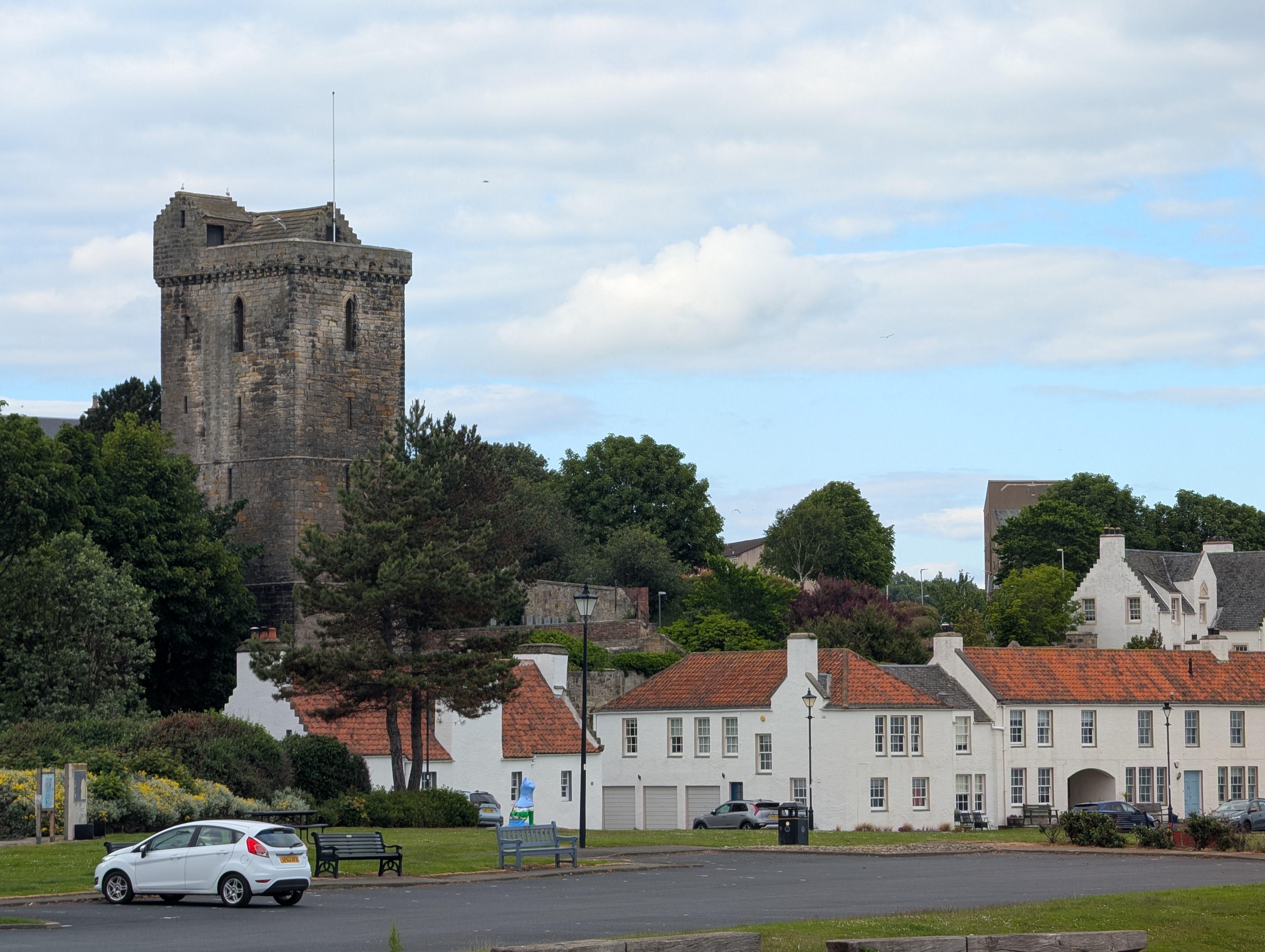


A late-sixteenth-century house beside Dysart harbour, with crowstepped gables, carved stone heads and a history of conservation.
Quick facts
- Date
- Dated 1583; later rear wing; reconstructed in 1969
- Architect / designer
- Early architect not known; reconstruction by W. Schomberg Scott
- Type
- Crowstepped early town house reconstructed for residential use
- Designation
- Listed building, Category A (LB36407)
- OS grid reference
- NT 30335 92924
Architecture
The two-storey, five-bay harled house has crowstepped gables, a pantiled roof and a corbelled central section on the harbour-facing elevation. A prominent wallhead chimney rises above it. The carved skewputts take the form of human heads, and the eastern boundary wall retains a moulded doorway bearing the date 1583.
Its story
Bay House was built for Patrick Sinclair, whose arms and initials were found on a painted ceiling. Early in the nineteenth century it was home to John Ruskin’s grandparents; it later became the Bay Horse Inn. In 1969 W. Schomberg Scott reconstructed the house through the National Trust for Scotland’s Little Houses Scheme. Investigation during the work revealed a first-floor hall and three rooms at ground level.
What to notice
- The corbelled first-floor section and prominent wallhead chimney on the harbour-facing elevation.
- Three carved human heads at the feet of the crowstepped gables.
- The dated doorway in the eastern boundary wall.
Reading the surroundings
Bay House is a residential building beside the public route through Pan Ha’. Its elevations can be viewed from outside without entering the private grounds.
Timeline
- 1583 Date carved on the doorway in the boundary wall.
- Early nineteenth century John Ruskin’s grandparents lived in the house.
- 1969 Reconstruction by W. Schomberg Scott through the National Trust for Scotland’s Little Houses Scheme.
What we know — and what remains uncertain
The date 1583 appears on a doorway in the boundary wall; it does not establish the date of every part of the house. The rear wing may be eighteenth-century and may have replaced an earlier timber gallery.
Sources & further reading
- Historic Environment Scotland: Bay House, LB36407 — Designation category, mapped location, construction phases, fabric, authorship and architectural interest.
- Trove: Bay House, Pan Ha’ — Mapped identity, architectural description, date and reconstruction history.
Location
OS grid reference NT 30335 92924 · Location confidence: High: the HES designation provides an official mapped National Grid Reference and the current source confirms the Place relationship or present identity. · Select the marker to open its satellite view in Google Maps. On desktop, drag Pegman (the yellow figure) onto a blue road. On mobile, turn on the Street View layer and tap a blue road. Other photo markers may be user-contributed.
Suggest a marker correction
Suggest a more accurate position
The teal marker is the current published position. The orange marker starts slightly to its right so both remain visible; this is only a visual starting position. Tap the correct place on the map or drag the orange marker. Sending this form creates a private review entry only; it does not move the published marker.
Check this area in Google Maps Choose the Satellite layer there if useful.
Map: © OpenStreetMap contributors. You can also enter checked coordinates below.