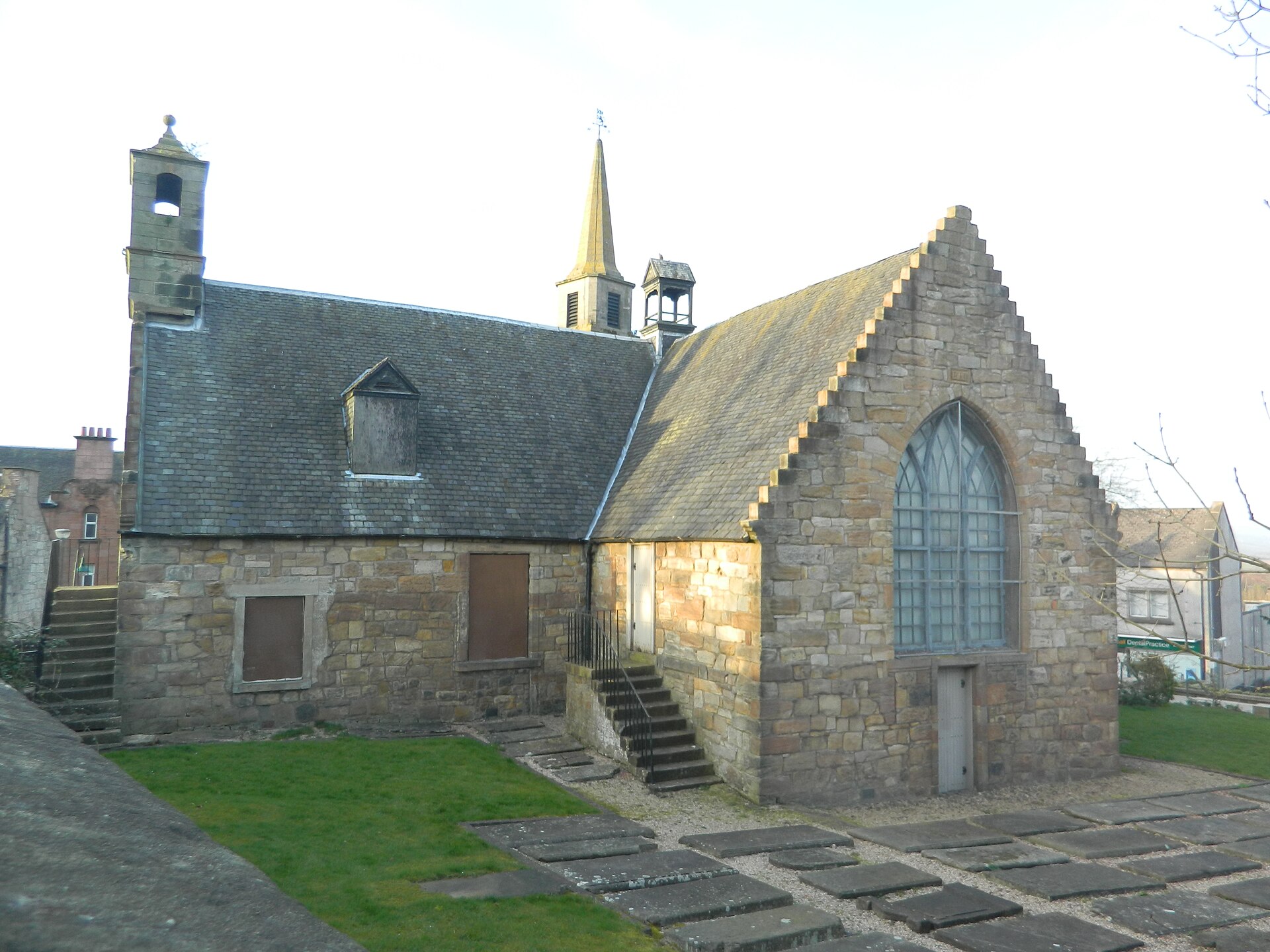
Image: The Auld Kirk, Kirkintilloch by John Lord, 29 March 2012, sourced from Wikimedia Commons / Geograph and licensed under CC BY-SA 2.0.
.jpg)
Kirkintilloch’s 1644 parish church now houses a museum, preserving a crowstepped post-Reformation kirk while interpreting the town around it.
Quick facts
- Date
- 1644; eighteenth-century fittings; later museum adaptation
- Architect / designer
- Original designer not recorded
- Type
- Crowstepped cruciform church adapted as a public museum
- Designation
- Listed building, Category A (LB36645)
- OS grid reference
- NS 65217 74078
Architecture and continuing use
The compact church is cruciform, with a crowstepped gable at each arm. An eighteenth-century pulpit, fittings and a bell cast by Gerhard Koster in 1663 survive, while a modern entrance and steps support museum access and flattened gravestones shape the churchyard.
Its story
The parish moved worship into the burgh in 1644. Successive congregations furnished and altered the kirk before a new St Mary’s opened in the twentieth century. Museum conversion gave the old building a public cultural role and retained objects connecting Roman, industrial and everyday history.
Why it is included
Category A listing recognises an early and unusually legible post-Reformation church whose successful adaptation keeps local history within one of its most important historic buildings.
What to notice
- Four crowstepped gables expressing the cross plan.
- Surviving eighteenth-century pulpit and fittings.
- 1663 bell by Gerhard Koster.
Reading the surroundings
Check EDLC opening information and exhibition-change notices. Respect collection barriers, staff guidance and the historic churchyard, and do not assume access outside museum hours.
Timeline
- 1644 A new parish kirk opened within the burgh.
- 1663 Gerhard Koster cast the surviving bell.
- Twentieth century Museum adaptation gave the former church a civic cultural use.
- 2026 EDLC continued to operate regular public exhibitions.
What we know — and what remains uncertain
The designation does not fully date every fitting or museum alteration. Exhibition access and opening hours can change, especially during installation periods.
Sources & further reading
- Historic Environment Scotland: Auld Kirk Museum, LB36645 — Current designation status, mapped location, date, fabric and architectural or archaeological interest.
- Trove designation: LB36645 — Parallel national record identity and archival context.
- EDLC: Auld Kirk Museum — Current museum identity, opening pattern, facilities and possible exhibition-change closures.
Location
OS grid reference NS 65217 74078 · Location confidence: High: the current national designation supplies an exact mapped National Grid Reference; public text separately states access and current-use uncertainty. · Select the marker to open its satellite view in Google Maps. On desktop, drag Pegman (the yellow figure) onto a blue road. On mobile, turn on the Street View layer and tap a blue road. Other photo markers may be user-contributed.
Suggest a marker correction
Suggest a more accurate position
The teal marker is the current published position. The orange marker starts slightly to its right so both remain visible; this is only a visual starting position. Tap the correct place on the map or drag the orange marker. Sending this form creates a private review entry only; it does not move the published marker.
Check this area in Google Maps Choose the Satellite layer there if useful.
Map: © OpenStreetMap contributors. You can also enter checked coordinates below.