
.jpg)
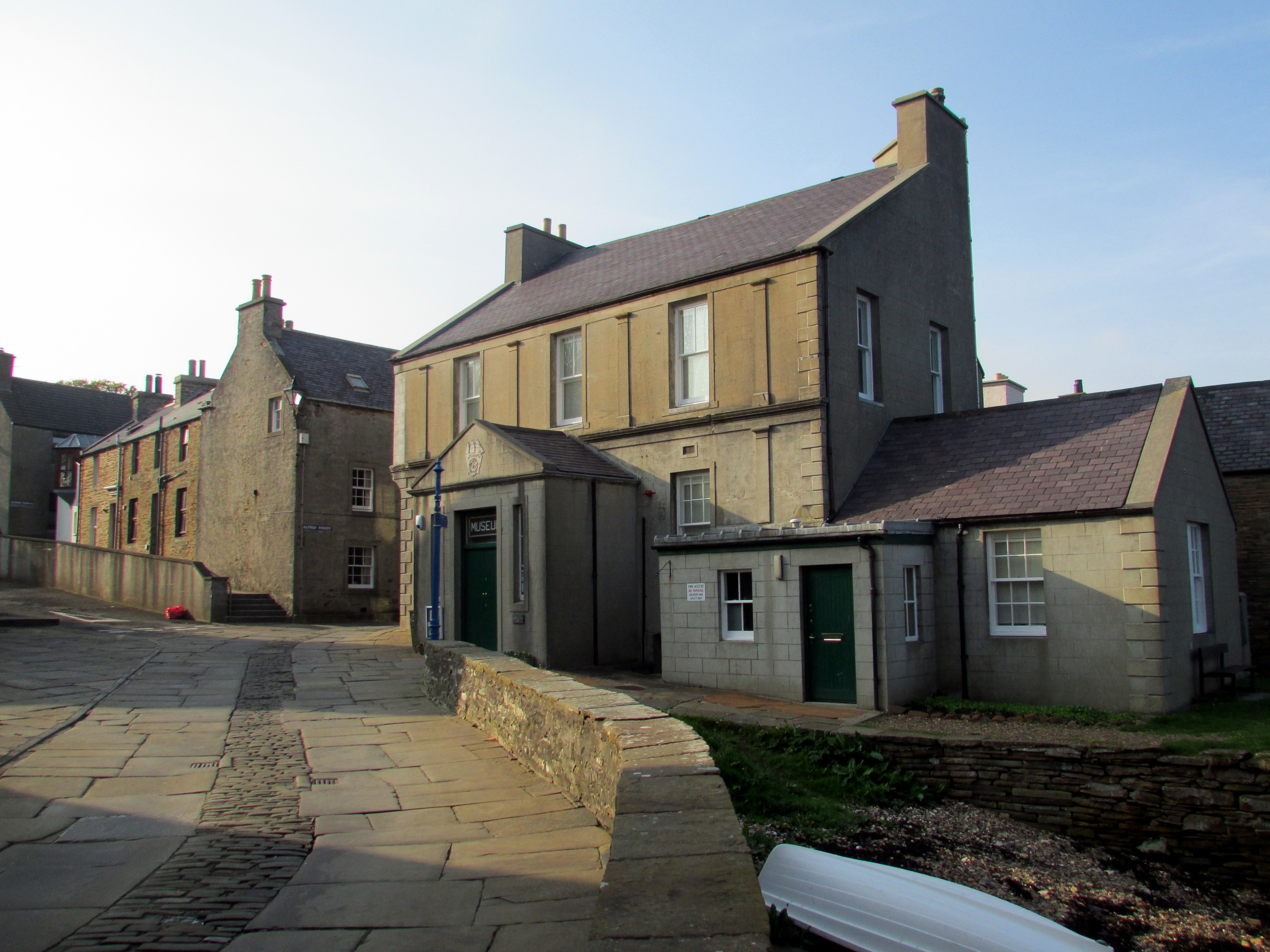
A symmetrical classical town hall became the permanent home of collections connecting Stromness with natural science, Scapa Flow and Arctic trade.
Quick facts
- Date
- 1858; museum expanded in 1929–31
- Architect / designer
- Designer unrecorded
- Type
- Classical former town hall and purpose-associated museum
- Designation
- Listed building, Category B (LB45345)
- OS grid reference
- HY 25249 08571
Architecture, archaeology and continuing use
The main two-storey three-bay block is organised around an advanced pedimented porch. String courses, pilasters and long-and-short quoins give the rubble building a formal civic character, while lower wings and later additions record the museum’s growth.
Its story
The Orkney Natural History Society was founded in 1837 and moved its collection several times before this building opened in 1858, with a museum upstairs and Town Hall below. The society acquired the ground floor in 1929 and opened expanded displays in 1931.
Why it is included
Category B designation recognises a substantial civic building and the long continuity of a local museum whose collections interpret Stromness’s outward-looking history.
What to notice
- The central porch inscribed MUSEUM.
- Classical pilasters dividing the principal bays.
- Changes in scale where later wings meet the 1858 block.
Reading the surroundings
Visit during advertised opening hours and follow museum guidance. External views are available from public streets; adjoining yards and service areas are not general access.
Timeline
- 28 December 1837 The Orkney Natural History Society formed to create a public collection.
- 1858 The new building opened with museum rooms above the Town Hall.
- 1931 Expanded displays opened after acquisition of the ground floor.
- 2026 The independent museum continues to welcome visitors and researchers.
What we know — and what remains uncertain
The designation does not identify an architect, and successive extensions complicate the building’s development sequence.
Sources & further reading
- Historic Environment Scotland: Stromness Museum, LB45345 — Designation status, mapped location, date, fabric and architectural or archaeological interest.
- Stromness Museum — Current museum identity, collections, access and visitor opening information.
Location
OS grid reference HY 25249 08571 · Location confidence: High: the national designation supplies an official mapped National Grid Reference; an additional source confirms the Place relationship, history or current identity. · Select the marker to open its satellite view in Google Maps. On desktop, drag Pegman (the yellow figure) onto a blue road. On mobile, turn on the Street View layer and tap a blue road. Other photo markers may be user-contributed.
Suggest a marker correction
Suggest a more accurate position
The teal marker is the current published position. The orange marker starts slightly to its right so both remain visible; this is only a visual starting position. Tap the correct place on the map or drag the orange marker. Sending this form creates a private review entry only; it does not move the published marker.
Check this area in Google Maps Choose the Satellite layer there if useful.
Map: © OpenStreetMap contributors. You can also enter checked coordinates below.