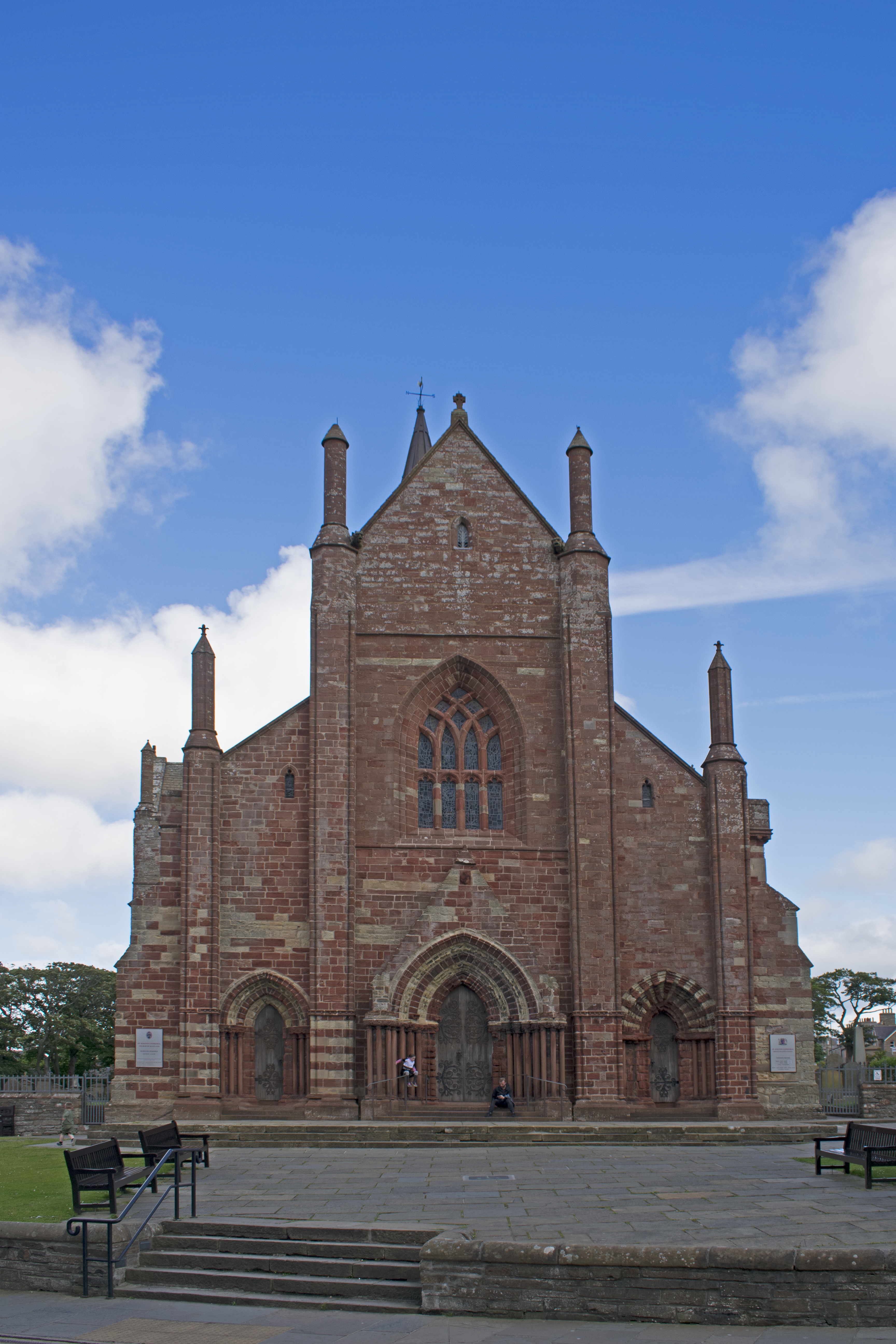
Image: The main west façade of St Magnus Cathedral in Kirkwall by Ymblanter, licensed under CC BY-SA 4.0.

Begun in 1137 for a Norse earldom, St Magnus Cathedral is a many-period church of red and yellow Orkney sandstone whose Romanesque core, Gothic extensions, monuments and continuing worship dominate central Kirkwall.
Quick facts
- Date
- Begun 1137; extended through the medieval period; major restorations 1800–1848 and 1893–1930; copper spire added 1916
- Founder / designers
- Founded by Earl Rognvald in memory of St Magnus; successive medieval masons and later restorers, including George Mackie Watson
- Type
- Cruciform cathedral church with aisled nave and choir, transepts, chapels and central tower
- Designation
- Listed building, Category A (LB36668), including graveyard, boundary walls, railings and war memorial
- OS grid reference
- HY 44921 10872
- Current use
- Active Church of Scotland congregation, civic landmark and free visitor attraction vested in Orkney Islands Council
A Norse cathedral in stone
The cathedral’s foundation belongs to twelfth-century Orkney when the islands formed part of the Norwegian world. Magnus Erlendsson, joint Earl of Orkney, was killed on Egilsay around 1117 and subsequently honoured as a saint. His nephew Rognvald promised a great stone church at Kirkwall if he secured the earldom, and building began in 1137. The dedication therefore joined political authority, family memory and pilgrimage. The cathedral’s own visitor interpretation states that Magnus’s relics remain within a choir pier.
Construction over centuries
The first campaign formed a compact cruciform church: the present choir and aisles, crossing, transepts and the eastern two bays of the nave. Round arches, heavy cylindrical piers and interlaced blind arcading give this Romanesque core its weight. Work then moved westward in stages. The nave was lengthened, its walls and aisles were heightened, and pointed Gothic forms increasingly supplemented the earlier round-arched vocabulary. The west front was among the last medieval elements and was not complete until the fifteenth century. Despite changing fashion, the long campaigns retained a coherent cruciform plan.
Red and yellow sandstone
Local red and yellow sandstone is structural as well as decorative. Masons alternated the colours in concentric rings, bands and checkerwork around doors and windows, particularly at the three west portals and the south transept entrance. Chevron, dog-tooth, nook-shafts, moulded arches, rose windows and changing tracery allow the building’s chronology to be read in its fabric. The long aisles, clerestory, transept gables, chapels and central tower create a building that is visually complex yet strongly ordered. The early-fourteenth-century tower contains four bells cast in Edinburgh in 1528; after lightning damage in 1671, the largest bell was recast in 1682.
Interior, furnishing and memory
Inside, an eight-bay nave leads to the earlier six-bay choir and chancel. Rib-vaulted aisles, a vaulted nave, timber-barrel-vaulted transepts, mural passages and turnpike stairs reveal both ceremonial planning and access to upper levels. Medieval and later grave slabs line the walls. Later furnishings combine work from several periods: seventeenth-century woodwork was incorporated into twentieth-century pieces, much of the 1913–30 work was undertaken by George Mackie Watson, and Stanley Cursiter designed other furnishings executed by Reynold Eunson. Crear McCartney’s vivid west window was installed in 1987 for the cathedral’s 850th anniversary.
Memorials connect the cathedral to Orkney’s civic and maritime history. The original 1621 mercat cross stands inside, while a replica occupies its former outdoor position. The graveyard contains monuments of several centuries, including the burial of Arctic explorer John Rae. The HMS Royal Oak memorial and ship’s bell recall the 1939 sinking in Scapa Flow and the loss of more than 800 lives.
Restoration and civic ownership
By the early nineteenth century the fabric had deteriorated. Government restoration was carried out by 1848 under the mistaken belief that the cathedral belonged to the Crown. Kirkwall Town Council reclaimed it in 1851, and it remains vested in Orkney Islands Council while serving a Church of Scotland congregation. The former spire had already given way to a timber pyramidal roof; the present copper-covered spire was added in 1916.
Current worship, visiting and access
Orkney Museums advertises free entry without advance booking. Published hours are 9am–5pm Monday to Saturday, with Sunday opening from 1pm–5pm during the April–September season; the cathedral is normally Monday–Saturday only from October to March. A Church of Scotland service takes place at 11.15am on Sunday. Weddings, funerals, services, events, visitor numbers and conservation work can alter access, so current notices should be checked before a special journey.
Main visitor entry is through the west doors on Broad Street. Wheelchair access is available through the Bishop’s Door on the south side, and an accessible toilet is provided off the north choir aisle. A hearing loop is available for concerts and events. Historic floors are uneven, some areas have steps and light levels can be low. Ground-floor, upper-level and graveyard tours are offered at advertised times or by arrangement; an ordinary visit does not itself permit access to towers, roofs or other controlled upper spaces.
What to notice
- The alternating red and yellow sandstone around the west doors and south-transept entrance.
- The progression from massive round-arched Romanesque work to later pointed and traceried Gothic forms.
- The nave arcade, triforium and clerestory rising in distinct horizontal stages.
- The interlaced blind arcading in the south aisle and transepts.
- The early-fourteenth-century tower and 1916 copper spire.
- Medieval and later tombstones, the 1621 mercat cross and memorials to Orkney people and events.
- The cathedral’s close relationship with the Bishop’s Palace, Earl’s Palace and Tankerness House group.
Timeline
- About 1117 Magnus Erlendsson was killed on Egilsay and later venerated as a saint.
- 1137 Earl Rognvald began the cathedral in his uncle’s honour.
- Later 12th–15th centuries The nave, west front and other parts were extended and remodelled as architectural styles changed.
- Early 14th century The central tower took its present broad form.
- 1528 Four bells were cast in Edinburgh.
- 1671–1682 Lightning damage was followed by recasting of the largest bell.
- By 1848 A major government restoration addressed serious disrepair.
- 1851 Kirkwall Town Council reclaimed ownership.
- 1913–1930 A sustained furnishing and restoration campaign included work by George Mackie Watson.
- 1916 The present copper-covered spire was added.
- 1987 Crear McCartney’s west window marked the 850th anniversary.
What remains uncertain
No single architect can be assigned to a building constructed and altered over several centuries. Connections with masons associated with Durham and Dunfermline are supported by architectural comparison rather than a complete documentary record.
Sources & further reading
- Historic Environment Scotland: St Magnus Cathedral, LB36668 — Designation, construction sequence, fabric, interior, bells, restoration, graveyard and war memorial.
- Orkney Museums: St Magnus Cathedral — Current visitor opening, access, facilities, tours and interpretation.
- St Magnus Cathedral congregation — Current worshipping community, ecclesiastical use and welcome.
Location
OS grid reference HY 44921 10872 · Location confidence: High: catalogue point derived from a national heritage record or current official mapping; it is not a site boundary. · Select the marker to open its satellite view in Google Maps. On desktop, drag Pegman (the yellow figure) onto a blue road. On mobile, turn on the Street View layer and tap a blue road. Other photo markers may be user-contributed.
Suggest a marker correction
Suggest a more accurate position
The teal marker is the current published position. The orange marker starts slightly to its right so both remain visible; this is only a visual starting position. Tap the correct place on the map or drag the orange marker. Sending this form creates a private review entry only; it does not move the published marker.
Check this area in Google Maps Choose the Satellite layer there if useful.
Map: © OpenStreetMap contributors. You can also enter checked coordinates below.
In these guides: Sacred Spaces of Scotland: Faiths and Architecture