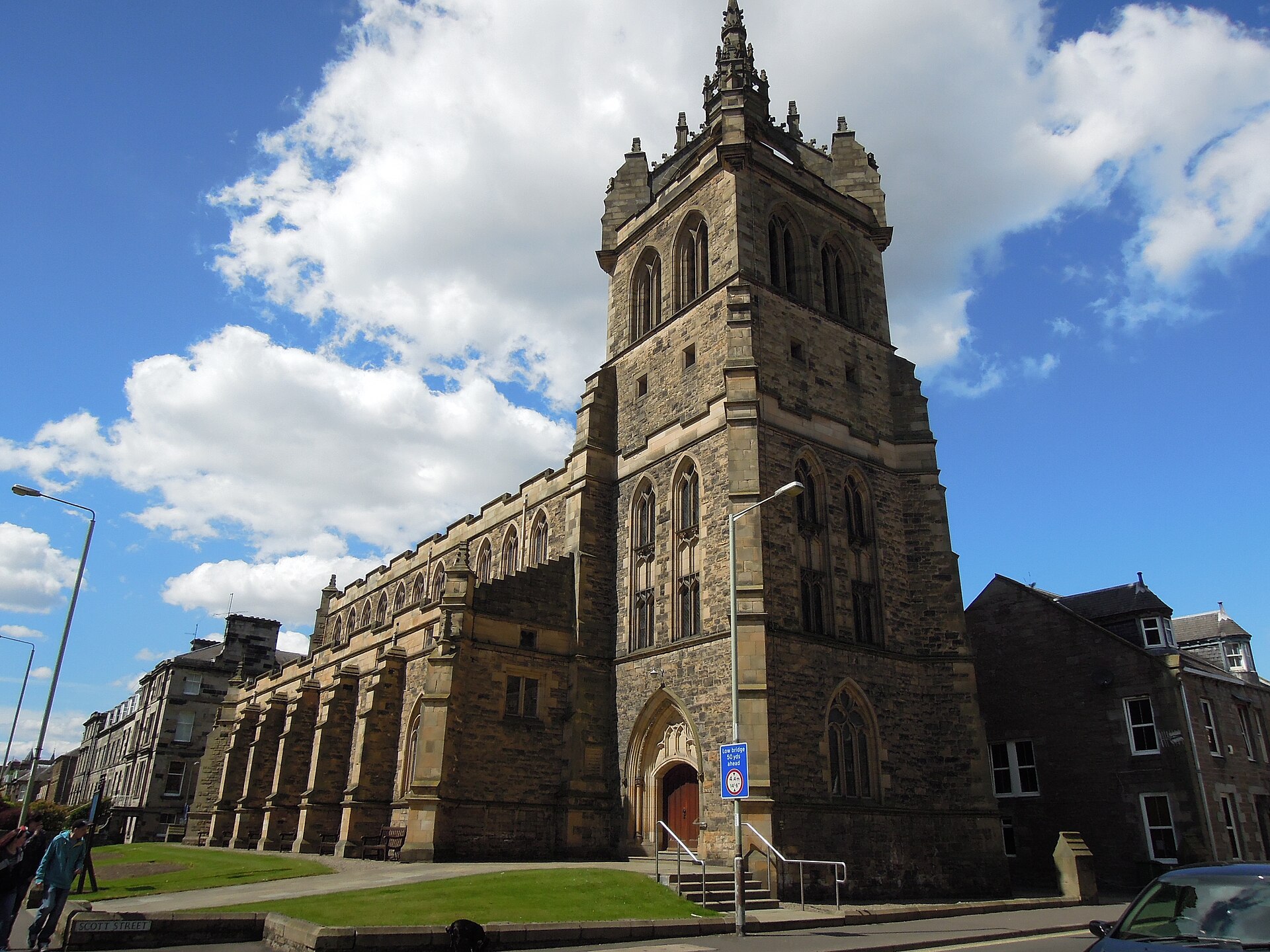
J. J. Stevenson’s Scots Gothic church closes a deliberate gap in Marshall Place with a crown spire, powerful rubble masonry and an unusually coherent late Victorian interior facing Perth’s South Inch.
Quick facts
- Date
- Built 1883–1885; opened 3 September 1885
- Architect / designer
- John James Stevenson
- Type
- Scots Gothic Revival church with halls, offices, boundary wall and gatepiers
- Designation
- Listed building, Category A (LB39310)
- OS grid reference
- NO 11627 23166
A deliberate Scottish Gothic landmark
Stevenson composed the church as a six-bay nave and aisle with a square east tower, polygonal west apse and adjoining halls and offices. Hammer-dressed coursed rubble, smooth ashlar margins, staged buttresses, battlements with broad merlons and curvilinear tracery give the exterior a strongly modelled silhouette. Four flying buttresses rise from the tower to support the tapered crown spire, making the church a conspicuous marker on the northern edge of the South Inch.
The building is more than its tower. The pointed south entrance has engaged colonnettes and carved tracery; halls and offices continue the masonry language to the north, while the original low boundary wall and saddleback-coped gatepiers complete the street composition.
Interior, materials and fittings
The largely intact plan retains an open timber roof, carved corbels, pointed arcades and galleries carried on slender cast-iron bundled columns. Cast iron also supports the gallery structure: a modern material used discreetly within a design conceived in historic Scottish Gothic terms. Timber pews, panelled dados and galleries preserve much of the intended visual unity. The organ now in the church was made by Bryceson Brothers & Ellis for Morningside United Presbyterian Church in Edinburgh and moved here in 1985; the pulpit canopy dates from 1971.
Stone came from Polmaise near Stirling and the grey slates from Westmorland. The congregation records that most building contracts went to Perth firms. Stevenson’s surviving correspondence also reveals close control over design and finish, including a dispute in which his preference for dark-stained pews prevailed.
From Free Church congregation to the present
The congregation’s history begins with a Church of Scotland chapel of ease founded in King Street in 1835. At the Disruption of 1843, its minister and most of the congregation joined the Free Church and built new premises at Victoria Street. A long-running building fund eventually allowed Free St Leonard’s to acquire the difficult Marshall Place gap site in 1882. An old branch of Perth’s lade beneath the ground had discouraged earlier development, but engineering problems were overcome.
Work began in 1883, the memorial stone was laid above the main door on 27 March 1884, and the church opened for worship on 3 September 1885. It became St Leonard’s United Free Church after the 1900 union and took its present “in the Fields” name after the 1929 reunion with the Church of Scotland. Later congregational unions and a 2008 linkage with St John’s Kirk form part of its continuing life as a working church and community building.
Why it matters
Historic Environment Scotland describes St Leonard’s as an outstanding example of Scots Gothic Revival and one of Stevenson’s finest buildings. Its importance lies in the relationship between a scholarly national Gothic language, high-quality materials, the survival of its decorative interior and its commanding setting opposite the South Inch. The halls were built with the church and remain integral to the listed group.
What to notice
- The open stone crown, read against the sky from Marshall Place and the South Inch.
- The contrast between rugged hammer-dressed rubble and smooth dressings around doors and windows.
- The halls and offices continuing the church’s design rather than appearing as incidental additions.
- Inside during respectful access, the open timber roof, dark joinery, galleries and very slender cast-iron columns.
Visiting and access
This is an active Church of Scotland place of worship, not a permanently staffed heritage attraction. The congregation currently advertises its regular Sunday service at 11am, with occasional joint services held elsewhere; check the current website before travelling. Everyone is welcome to worship and refreshments are normally offered in the hall afterwards. The congregation describes the building as dementia-friendly with disabled access and facilities, but does not publish separate daily architectural-opening hours. Outside advertised worship or activities, arrange access through the church office rather than assuming the doors will be open. Services, funerals and private events take priority.
Timeline
- 1835 St Leonard’s is founded as a chapel of ease in King Street.
- 1843 Most of the congregation joins the Free Church at the Disruption and moves to new premises.
- 1882 The Marshall Place site is acquired and Stevenson selected after a competition.
- 1883–1885 The present church and halls are built; the church opens on 3 September 1885.
- 1900 and 1929 Church unions lead first to United Free Church status and then to the present Church of Scotland identity and name.
- 1985 The Bryceson Brothers & Ellis organ is moved here from Edinburgh.
- Present The building continues in worship and community use.
What we know — and what remains uncertain
The principal dates, authorship and surviving fabric are securely documented by the statutory record and the congregation’s archive-based history. The congregation suggests that the crown may be Scotland’s first post-Reformation crown tower; that is a useful interpretation of its design ambition, but not a claim made in the statutory designation and is therefore not treated here as settled fact.
Sources & further reading
- Historic Environment Scotland: St Leonard’s-in-the-Fields Church, LB39310 — Category A designation, architecture, interior, materials, chronology and significance.
- St Leonard’s-in-the-Fields: our church building — Site history, design intentions, materials, contractors and surviving correspondence.
- St Leonard’s-in-the-Fields: history timeline — Congregational development from 1835, building dates and later unions.
- St Leonard’s-in-the-Fields: current congregation — Current worship time, welcome and contact details.
St Leonard’s-in-the-Fields Church. Photograph: Aaron Bradley, 24 May 2013. CC BY-SA 2.0.
.jpg)