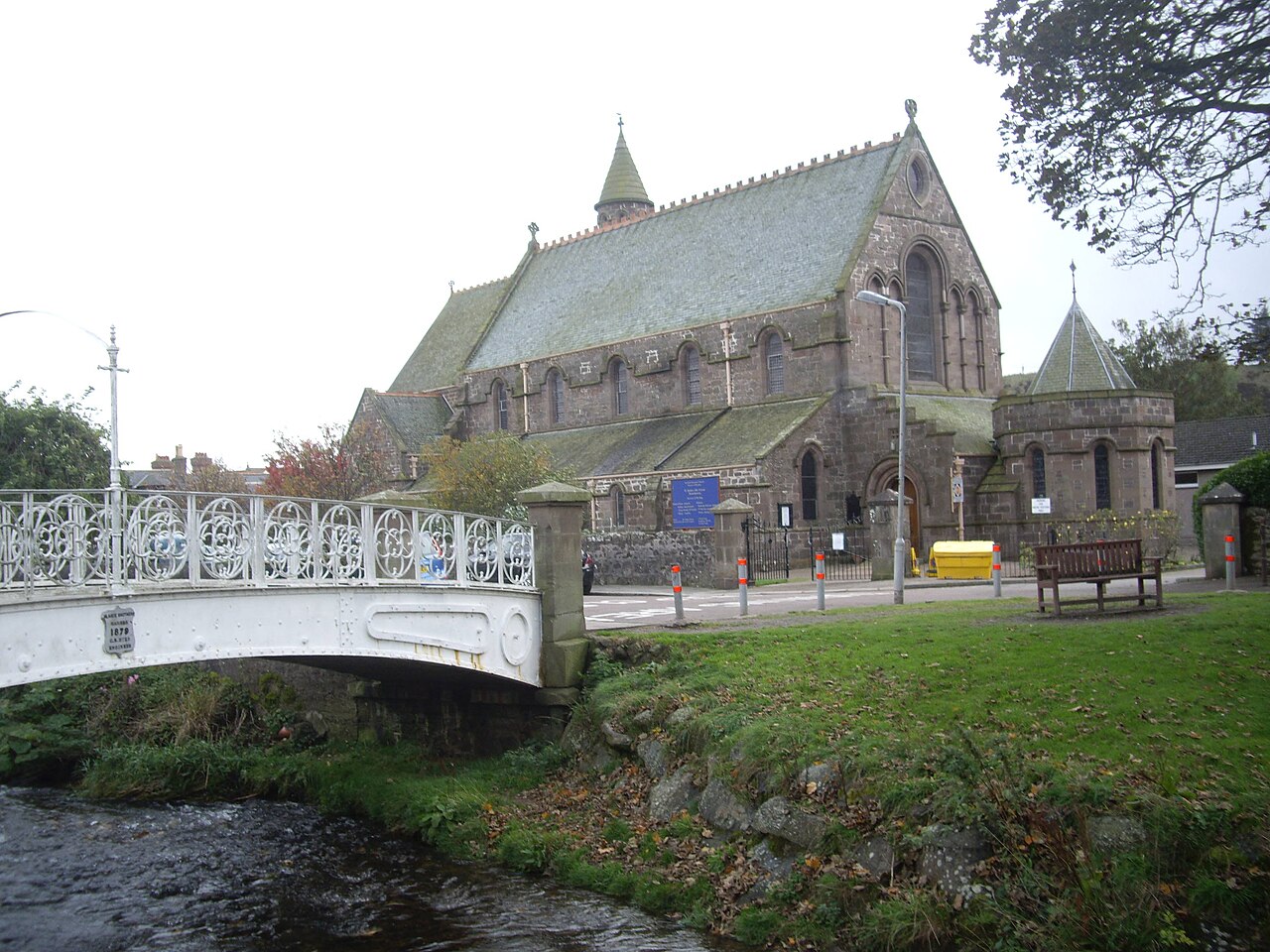
Image: St James the Great Episcopal Church, Stonehaven by Stanley Howe, sourced via Wikimedia Commons and Geograph and licensed under CC BY-SA 2.0.

St James the Great is a richly furnished Romanesque-influenced Episcopal church by Rowand Anderson and Arthur Clyne, open daily for prayer and still centred on worship, music and interpretation.
Quick facts
- Date
- Nave 1875–1877; chancel, organ chamber and vestries 1883–1885; narthex and baptistery 1906
- Architect / designer
- Sir Robert Rowand Anderson with Arthur Clyne; builder John Morgan; fittings and glass by several leading makers
- Type
- Romanesque-influenced Episcopal church with aisled nave, apsidal choir, baptistery and bell tower
- Designation
- Listed building, Category A (LB41552)
- OS grid reference
- NO 87332 85710
- Current use
- Active Scottish Episcopal church, visitor church and community venue
A church completed in stages
The building is not the result of a single campaign. Sir Robert Rowand Anderson designed the five-bay nave, low buttressed aisles and clerestory built between 1875 and 1877. When more space and a fuller liturgical east end were required, Anderson was consulted again; modified plans were carried forward with Arthur Clyne for the chancel, organ chamber and vestries, completed in 1885 by builder John Morgan. Clyne added the crowstepped narthex and semi-octagonal baptistery in 1906.
The stages remain readable but form a remarkably coherent whole. Round-arched openings, continuous hoodmoulds, deep base courses and squared rubble with ashlar dressings establish a robust Romanesque character. The apsidal choir anchors the south-east end, while a slim tower changes from a square lower stage to a circular belfry beneath a conical stone-slated roof. The varied narthex, baptistery, vestries and apse make the silhouette picturesque without becoming arbitrary.
The interior as a designed ensemble
Round nave columns with plain capitals support the arcades and clerestory beneath a hammerbeam roof. A tall chancel arch opens towards the ribbed, timber-lined barrel vault of the choir and apse. The spatial sequence—from low narthex through broad nave to enriched sanctuary—is one of the church’s chief strengths.
The high altar and elaborate reredos by Gambier Perry of London commemorate Annette Maria Baird of Ury and place sculpted saints around a larger seated Christ. Arthur Clyne designed the Caen-stone pulpit; carved heads represent St James, King David I, Bishop Forbes, Bishop Keith and Bishop Jolly. Other significant fittings include choir stalls from 1927, a Wadsworth organ, war memorials and a medieval-looking stone font transferred from St John’s Chapel in Aberdeen. The baptistery contains a belfry stone from the earlier St James’ Chapel and a cross made from communion tokens.
Glass, memory and local history
The stained glass is a compact survey of late nineteenth- and early twentieth-century church art. Clayton & Bell supplied the Crucifixion window in the apse. Other windows depict Christ’s baptism, the baptism tradition associated with Stonehaven Tolbooth, the Good Samaritan, St James and an angel. Sir Ninian Comper’s 1929 baptistery glass commemorates David MacDonald, headmaster of the Episcopal school. This local connection was personal: Comper’s father, the Rev John Comper, had served as rector of the preceding St James’ Chapel.
Foundation and growth
The foundation stone for the new nave was laid on 21 September 1875 by the Rev Alexander Penrose Forbes, rector of the old Episcopal church and later Bishop of Brechin. The first campaign was completed on 1 October 1877. The congregation installed the organ in 1881 after a fundraising bazaar organised by its women. The enlarged east end followed in 1883–1885, and the baptistery was dedicated in 1906.
Historic Environment Scotland highlights the church as a major work by one of Scotland’s foremost architects, with an unusually complete interior and contributions from distinguished designers. Its landscaped position beside the Carron Water also makes it one of Stonehaven’s most recognisable landmarks.
Current worship, visiting and access
St James remains an active Scottish Episcopal church. Its current service page advertises Holy Eucharist at 10am on Sundays and Tuesdays, with contemplative prayer on the first Wednesday evening of each month. It also states that the church is open daily for private prayer from 9am to 4pm and explicitly welcomes visitors and newcomers.
The congregation’s “Priests and Pipes” exhibition interprets the church’s history throughout the year. The church and modern hall are also available for booked events. Current venue information advertises disabled access and use of an accessible toilet in the adjoining hall. Visitors should nevertheless expect worship, pastoral activity, funerals and private events to take priority, and should follow any notices or stewarding in the church and riverside grounds.
Why it matters
St James combines nationally important authorship, carefully staged development and a dense concentration of high-quality fittings, sculpture and glass. It is not a preserved shell: worship, music, interpretation and community use keep the architecture active and legible.
What to notice
- The low aisles and clerestory beneath the five-bay nave roof.
- The transition from square tower stage to circular belfry and conical roof.
- The tall chancel arch and timber-lined barrel vault of the choir.
- Gambier Perry’s reredos and Arthur Clyne’s carved Caen-stone pulpit.
- The baptistery glass by Ninian Comper and the earlier belfry stone.
- The window recalling baptisms associated with imprisoned Episcopal clergy at the Tolbooth.
Timeline
- 21 September 1875 The foundation stone of the new nave was laid.
- 1 October 1877 Rowand Anderson’s first campaign was completed.
- 1881 The Wadsworth organ was installed.
- 1883–1885 Chancel, organ chamber and vestries completed with Arthur Clyne and builder John Morgan.
- 1906 The narthex and baptistery were dedicated.
- 1927–1929 Choir stalls and Comper baptistery glass enriched the interior.
- 1993 The building was upgraded to Category A.
- 2026 Daily prayer opening, worship and year-round interpretation continue.
What remains uncertain
The church website uses the non-Scottish phrase “Grade 1 listed” on its venue page; the statutory Scottish designation is Category A. Historic Environment Scotland’s description calls the pews fixed, while current venue information says that they can be moved with adequate manpower under supervision. Visitors should treat any rearrangement as an operational matter for the congregation, not permission to handle historic furnishings.
Sources & further reading
- Historic Environment Scotland: St James the Great Episcopal Church, LB41552 — Designation, architecture, building campaigns, fittings, glass and significance.
- St James’ Stonehaven: services and opening — Current worship times, daily opening and visitor welcome.
- St James’ Stonehaven — Current congregation, “Priests and Pipes” exhibition and visitor interpretation.
- St James’ Stonehaven: venue hire — Community use, facilities, accessibility and booking arrangements.
Location
OS grid reference NO 87332 85710 · Location confidence: High: the HES designation provides an official mapped National Grid Reference and the current source confirms the Place relationship or present identity. · Select the marker to open its satellite view in Google Maps. On desktop, drag Pegman (the yellow figure) onto a blue road. On mobile, turn on the Street View layer and tap a blue road. Other photo markers may be user-contributed.
Suggest a marker correction
Suggest a more accurate position
The teal marker is the current published position. The orange marker starts slightly to its right so both remain visible; this is only a visual starting position. Tap the correct place on the map or drag the orange marker. Sending this form creates a private review entry only; it does not move the published marker.
Check this area in Google Maps Choose the Satellite layer there if useful.
Map: © OpenStreetMap contributors. You can also enter checked coordinates below.