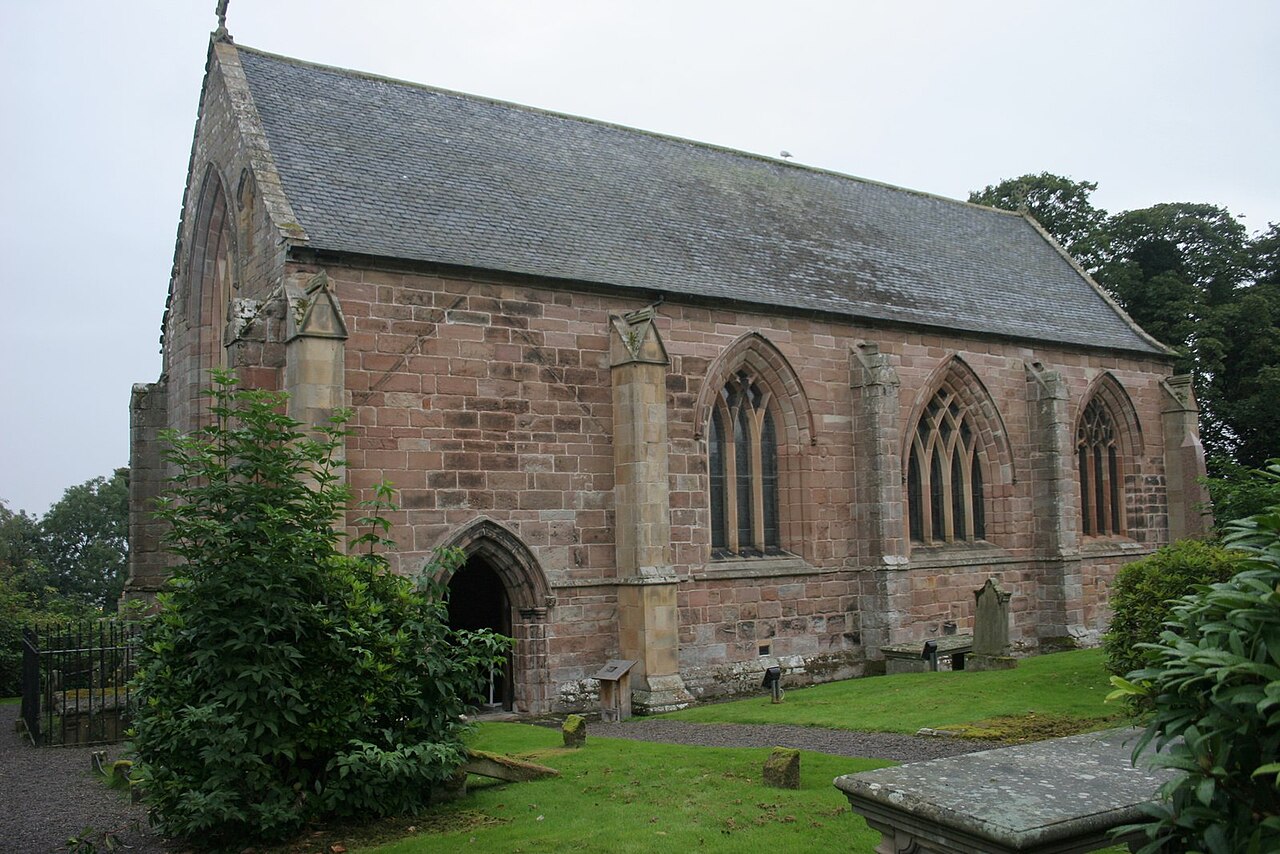
Image: St Duthus Collegiate Church, Tain by Richard Sutcliffe, sourced from Wikimedia Commons and Geograph, licensed under CC BY-SA 2.0.

A medieval pilgrimage church whose present appearance also records later acts of restoration.
Quick facts
- Date
- 14th century; restored in the 18th and 19th centuries
- Architect / designer
- Medieval builders unknown; restorations by Robert Matheson and Hippolyte J Blanc
- Type
- Collegiate church
- OS grid reference
- NH 78015 82187
The building
The rectangular church has four buttressed bays and a stepped base. Its stained glass includes work by James Ballantine and Sons from 1880 and 1882.
At the south-west entrance, mouldings frame a pointed doorway with carved heads at the ends of its hood. The windows vary around the building: tall Y-shaped tracery contrasts with narrow lancets and the renewed geometric design of the east window. Inside, a three-seat recess for clergy, a holy-water recess and a wall cupboard preserve evidence of the church’s liturgical arrangements. These details reward looking beyond the apparently simple rectangular outline.
Its story
HES dates the church to the fourteenth century and relates its architectural ambition to the shrine of St Duthus. Re-roofing around 1752 preceded Robert Matheson’s restoration work of 1849–82 and further work by Hippolyte J Blanc in 1896.
The museum’s account of the church after its closure in 1815 draws on William Shand’s 1819 sketch and Catherine Sinclair’s description of a visit in 1838. They show that the present memorial interior is not an untouched medieval space: earlier pews and galleries had decayed before restoration reshaped it. The surviving fabric and later fittings therefore need to be read as different stages of the building’s life.
What to look for
- Buttresses defining the bays
- The contrast between medieval masonry and restored fittings
Reading the surroundings
The adjacent roofless old parish church and burial ground are separately scheduled as SM2803; they are not included in this listing. This distinction was clarified by HES in 2018. The church is a historic and memorial interior, not a promise of daily public opening; check access with local visitor information before travelling.
Timeline
- 14th century Date assigned to the church by HES.
- 1815 Regular use ended, according to Tain Museum’s historical account.
- 19th century Restoration and new stained glass transformed the interior.
What we know — and what remains uncertain
The origin and earlier use of the pulpit’s carved fragments are debated. The reconstructed fitting should not be presented as an intact Reformation-period survival. Highland’s record notes that Tain Museum holds one of two surviving fragments; competing interpretations connect the carving with a rood screen or earlier choir stalls. Those interpretations remain distinct from the securely documented nineteenth-century reconstruction.
Sources & further reading
- HES: St Duthus Collegiate Church, LB41843 — Designation, phases, fabric and scope of listing.
- Highland HER: MHG8689 — Pulpit reconstruction and competing interpretations of its fragments.
- Tain Museum: A View of the Old Church — Closure in 1815 and evidence of the unrestored interior.
Location
OS grid reference NH 78015 82187 · Location confidence: High: HES National Grid reference converted to WGS84; catalogue point, not an entrance. · Select the marker to open its satellite view in Google Maps. On desktop, drag Pegman (the yellow figure) onto a blue road. On mobile, turn on the Street View layer and tap a blue road. Other photo markers may be user-contributed.
Suggest a marker correction
Suggest a more accurate position
The teal marker is the current published position. The orange marker starts slightly to its right so both remain visible; this is only a visual starting position. Tap the correct place on the map or drag the orange marker. Sending this form creates a private review entry only; it does not move the published marker.
Check this area in Google Maps Choose the Satellite layer there if useful.
Map: © OpenStreetMap contributors. You can also enter checked coordinates below.