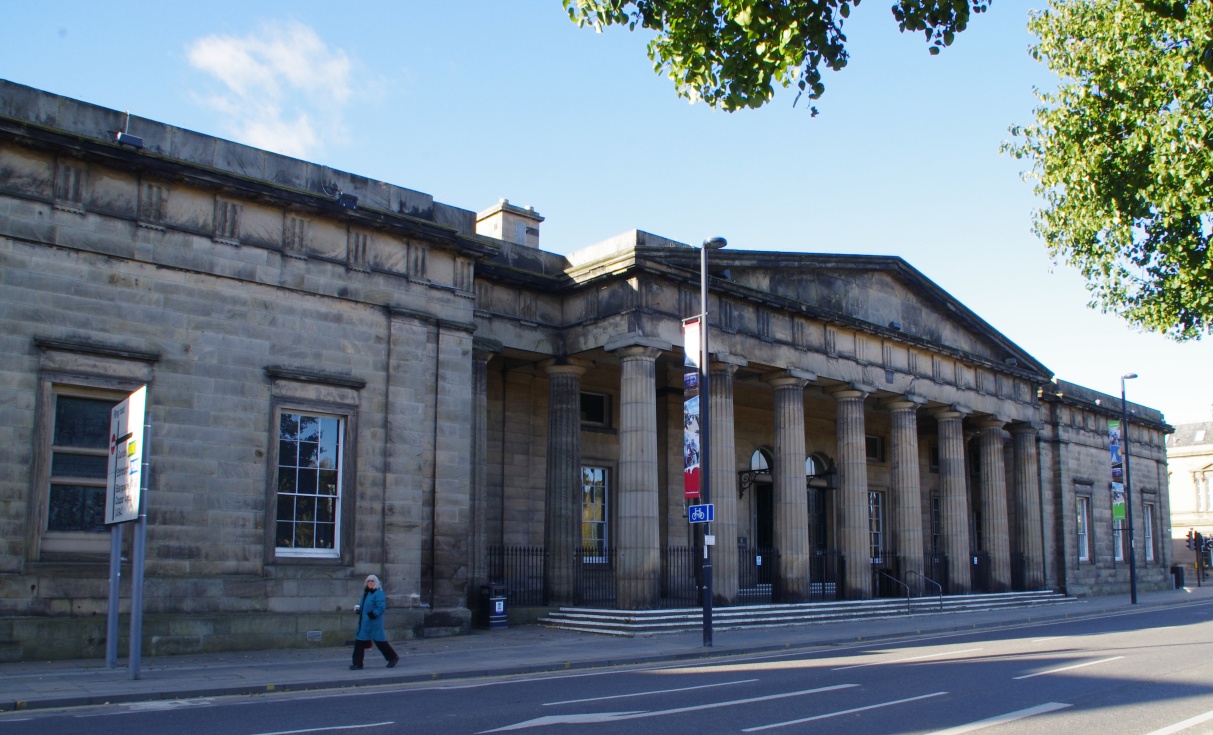
Image: Perth Sheriff Court by Simon Armstrong, sourced from Wikimedia Commons and licensed under CC BY-SA 3.0.

Sir Robert Smirke’s monumental Greek Revival courthouse pairs a riverfront Doric colonnade with unusually complete nineteenth-century court interiors.
Quick facts
- Date
- Built 1819; principal courtroom fittings date from the 1860s
- Architect / designer
- Sir Robert Smirke; later work associated with David Smart
- Type
- Greek Revival courthouse with historic courtrooms and assembly room
- Designation
- Listed building, Category A (LB39325)
- OS grid reference
- NO 12062 23391
Architecture
The courthouse occupies a commanding riverfront site on Tay Street. Its long, symmetrical thirteen-bay front is dominated by a projecting Greek Doric portico of ten fluted columns beneath a triglyph frieze. Behind the monumental screen, the E-shaped plan organised court, administrative and custodial functions. The entrance stair is in Arbroath stone, while the controlled classical exterior makes the building appear both civic and judicial.
Historic Environment Scotland records important nineteenth-century interiors. Courtroom fittings survive from the 1860s, including the gallery, judge’s bench, jury box, witness stand and dock beneath a coffered ceiling. The former Assembly Room retains a marble chimneypiece. These spaces demonstrate how the building worked, not just how authority was represented on its public façade.
History and continuing use
Smirke designed the courthouse in 1819 on the site associated with Gowrie House. The project cost about £32,000 and incorporated courtrooms, public rooms and a prison range connected by a passage. Much of the former jail was demolished in the 1960s, but the principal courthouse survives in active use.
Perth Sheriff Court and Justice of the Peace Court remains an operational justice building. Scottish Courts and Tribunals Service identifies five courtrooms and three resident sheriffs. This living use gives the historic interiors continuing purpose, while also imposing necessary limits on access, photography and movement.
Why it matters
The building is Smirke’s only public work in Scotland and an outstanding example of Greek Revival civic architecture. Its monumental portico, strong relationship with the Tay and survival of courtroom furniture and decorative work give it exceptional architectural and historical interest. The Category A designation also reflects its place in Perth’s civic development and the rarity of such a complete working court ensemble.
What to notice
- The ten-column Greek Doric portico and disciplined triglyph frieze facing the river.
- The contrast between the severe public façade and the more complex E-shaped working plan behind it.
- The Arbroath-stone stair and, during authorised access, the coffered courtroom ceiling and fitted furniture.
- The courthouse’s formal relationship with the Tay and neighbouring civic buildings.
Public access, security and practical information
This is a working court rather than an unrestricted visitor attraction. Scottish Courts and Tribunals Service says courtrooms are generally open to members of the public, but a sheriff or judge may close an individual case. Visitors must report to reception on arrival, follow security screening and staff instructions, and comply with all restrictions on recording and photography. Access can change at short notice according to live proceedings.
The official court page lists public office hours of 9am–1pm and 2pm–4pm on weekdays, subject to public holidays and operational closures. An accessible ramp and induction loops are available. Anyone intending to attend should check current court information before travelling; exterior appreciation from Tay Street is possible without entering the building.
Timeline
- 1819 Sir Robert Smirke’s courthouse is built on the former Gowrie House site.
- 1860s Major courtroom fittings and internal work create much of the surviving judicial interior.
- 1960s Most of the former jail range behind the court is demolished.
- Present The building continues as Perth Sheriff Court and Justice of the Peace Court.
What we know — and what remains uncertain
The statutory designation supplies the strongest evidence for the building’s fabric, plan and surviving interior. The exact sequence and authorship of every nineteenth-century internal alteration is less straightforward than the original Smirke commission, so later work is described cautiously. Public access is conditional and should never be inferred from an archived event or from the building’s listed status.
Sources & further reading
- Historic Environment Scotland: Perth Sheriff Court, LB39325 — statutory designation, architecture, interiors, history and significance.
- Scottish Courts and Tribunals Service: Perth Sheriff Court — current operation, office hours, accessibility and visitor procedures.
- Scottish Courts and Tribunals Service: Visitors — current general rules for public courtroom access and possible closed proceedings.
Location
OS grid reference NO 12062 23391 · Location confidence: High: the statutory designation supplies an exact National Grid Reference and the current official operator or responsible public body confirms the Place relationship. · Select the marker to open its satellite view in Google Maps. On desktop, drag Pegman (the yellow figure) onto a blue road. On mobile, turn on the Street View layer and tap a blue road. Other photo markers may be user-contributed.
Suggest a marker correction
Suggest a more accurate position
The teal marker is the current published position. The orange marker starts slightly to its right so both remain visible; this is only a visual starting position. Tap the correct place on the map or drag the orange marker. Sending this form creates a private review entry only; it does not move the published marker.
Check this area in Google Maps Choose the Satellite layer there if useful.
Map: © OpenStreetMap contributors. You can also enter checked coordinates below.