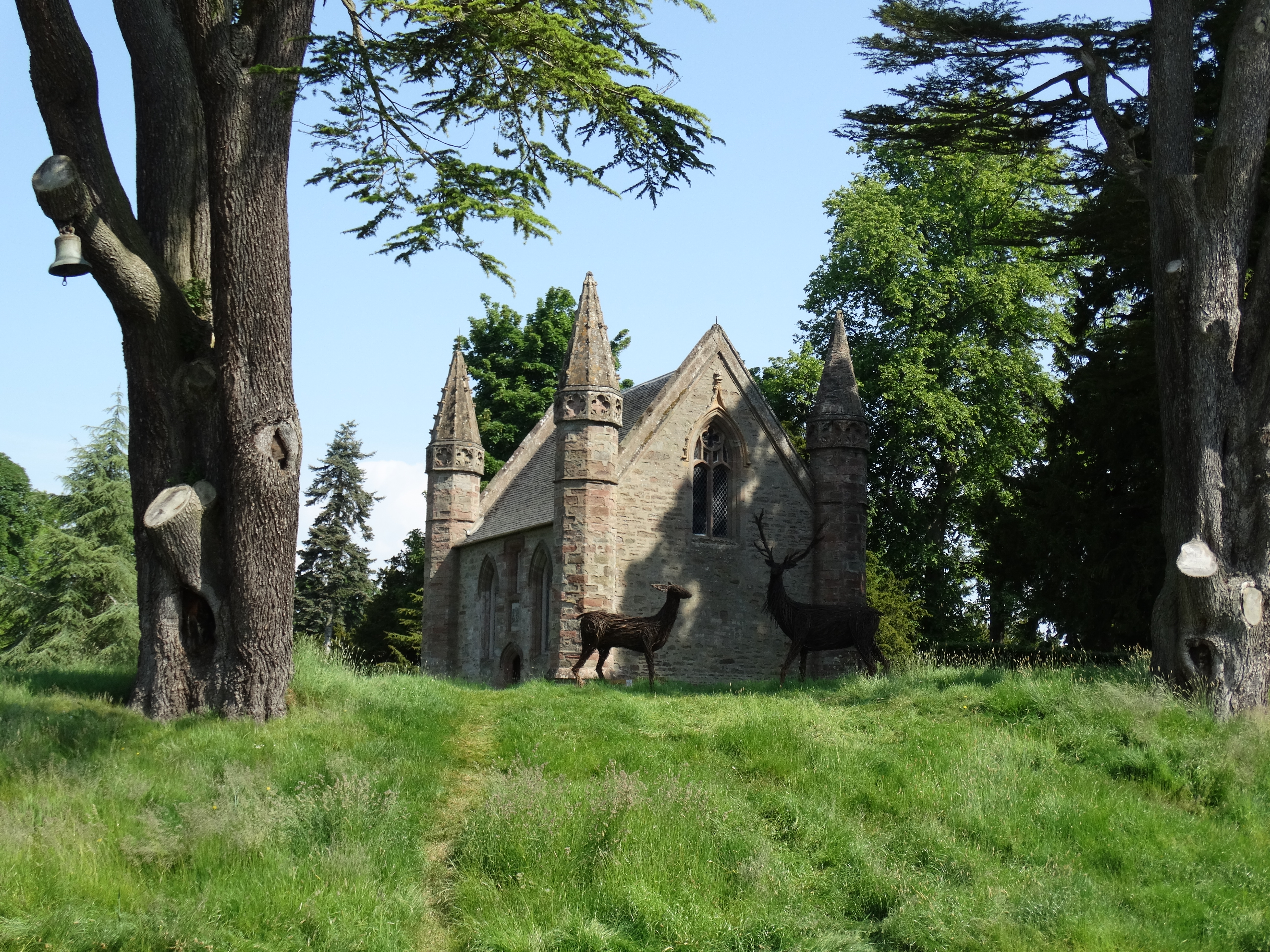
Image: Moot Hill Chapel, Scone Palace by Colin Park, sourced from Wikimedia Commons and licensed under CC BY-SA 2.0.

Moot Hill Chapel is a small Gothic landmark in the ceremonial landscape of Scone: an early nineteenth-century remodelling of an older church site, built over a burial vault and preserving Maximilian Colt’s exceptional alabaster monument to the 1st Lord Stormont.
Quick facts
- Date
- Earlier parish church on the site; remodelled as a Gothic chapel in 1807
- Architect / designer
- William Atkinson; alabaster monument by Maximilian Colt, 1618
- Type
- Gothic Presbyterian chapel, mortuary chapel and mausoleum containing an early seventeenth-century monument
- Designation
- Listed building, Category A (LB18371)
- OS grid reference
- NO 11418 26636
A compact Gothic chapel
The chapel is a rectangular rubble building with droved stone dressings and an octagonal tower at each corner. These small vertical accents give the building a strongly Gothic silhouette without disguising its compact scale. A stair descends to the burial vault, its entrance incorporating an older dormer head. The chapel stands within a churchyard containing historic gravestones, so the architecture is read together with burial and commemoration rather than as an isolated garden ornament.
William Atkinson remodelled the building in 1807, during the period when Scone Palace itself was being rebuilt. Its Gothic treatment complements the palace landscape while preserving a distinct sacred and mortuary function.
The earlier church site
Historic Environment Scotland describes the chapel as standing on the site of Scone’s former parish church and says that it has been regarded as an aisle surviving from the old building. Scone Palace’s account dates a parish church here to 1624, probably on a still earlier religious site. The old church was largely removed in the later eighteenth century before Atkinson’s remodelling. The surviving fabric should therefore be understood cautiously: the present appearance is chiefly that of 1807, but the site, vault and possibly parts of the structure belong to an older sequence.
The chapel’s position on Moot Hill adds another layer. The hill belongs to Scone’s wider royal and abbey landscape, but the present chapel is not a surviving medieval abbey church. Its significance comes from the way later worship, family burial and memorial architecture occupy this highly charged setting.
The Stormont monument
The interior’s principal work is the alabaster monument made by the London sculptor Maximilian Colt in 1618. Set against the north wall within a columned Baroque aedicule, it shows David Murray, 1st Lord Stormont, kneeling on a cushion at an altar. Armoured figures representing the Marquis of Tullibardine and the Earl Marischal flank him. Palace interpretation connects the group with Murray’s part in reconciling the two men after a feud.
The listing’s statement of special interest focuses specifically on this monument. Its pale carved figures, courtly materials and political story contrast with the modest rubble shell around them. Other memorials and old gravestones broaden the chapel from an individual family mausoleum into a place where several layers of Scone’s local and estate history are gathered.
Living worship and remembrance
The chapel remains Presbyterian and is used by the Mansfield family for private services and by the parish of Old Scone. The operator also presents it to visitors. Weddings, christenings, funerals and quieter acts of remembrance therefore continue alongside its architectural and historical interpretation. Private worship can take precedence over sightseeing.
Why it matters
Moot Hill Chapel brings together three kinds of significance in one small building: an older parish-church and burial site, Atkinson’s Gothic reshaping of the early nineteenth-century palace landscape, and a major early seventeenth-century alabaster monument. Its continuing worship prevents it from becoming merely a mausoleum or picturesque estate feature.
What to notice
- The four octagonal corner towers defining the chapel’s silhouette.
- Rubble walling contrasted with carefully worked droved dressings.
- The stair to the vault and the reused or older dormer head above it.
- Colt’s alabaster group: the kneeling Lord Stormont, altar, armoured flanking figures and architectural frame.
- The old gravestones and the chapel’s position on Moot Hill in relation to the palace landscape.
Visiting and access
The chapel lies within the ticketed Scone Palace gardens. For the 2026 main season, the Palace and gardens are advertised as open daily from 1 April to 31 October, 10am–5.30pm, with last entry at 4pm; gardens-only admission is available. Winter garden opening is more limited, and event days or private services may alter access. Check the operator’s current information before travelling and accept any temporary chapel closure for worship or family use.
Scone Palace states that many garden areas are accessible to wheelchair users but that some routes are unsuitable; it does not give a chapel-specific step-free guarantee. The site map marks suitable routes, and visitors with mobility requirements should ask staff at the ticket hut or contact the Palace in advance. Treat the interior as an active sacred space and the gravestones as vulnerable historic fabric.
Timeline
- 1618 Maximilian Colt makes the alabaster monument now preserved inside the chapel.
- 1624 Scone Palace’s history places a parish church on the site, probably succeeding earlier religious use.
- About 1784 The old parish church is largely demolished; the exact extent of surviving fabric is uncertain.
- 1807 William Atkinson remodels the remaining building as the present Gothic chapel and mausoleum.
- Present The chapel remains in family and parish use and is presented to ticketed visitors when circumstances permit.
What remains uncertain
The sources do not establish precisely how much fabric survived from the old parish church into Atkinson’s 1807 work. Historic Environment Scotland records the tradition that the chapel was an aisle of the church, while the operator describes a remodelling of the earlier building. This record therefore distinguishes the secure date and character of the Gothic remodelling from the less certain survival of earlier masonry. It also does not assume that general garden accessibility guarantees step-free entry to the chapel itself.
Sources & further reading
- Historic Environment Scotland: Scone Palace Mortuary Chapel or Mausoleum, LB18371 — Category A status, mapped location, fabric, vault, monument, memorials and special interest.
- Scone Palace: the chapel — Current worship, visitor presentation, the earlier church tradition and interpretation of the Stormont monument.
- Scone Palace: plan your visit — Current seasonal opening, admission, events and travel information.
- Scone Palace: accessibility — Garden-route limitations, visitor assistance and contact information.
Location
OS grid reference NO 11418 26636 · Location confidence: High: the statutory designation supplies an official mapped National Grid Reference and the current source confirms the Place relationship or present identity. · Select the marker to open its satellite view in Google Maps. On desktop, drag Pegman (the yellow figure) onto a blue road. On mobile, turn on the Street View layer and tap a blue road. Other photo markers may be user-contributed.
Suggest a marker correction
Suggest a more accurate position
The teal marker is the current published position. The orange marker starts slightly to its right so both remain visible; this is only a visual starting position. Tap the correct place on the map or drag the orange marker. Sending this form creates a private review entry only; it does not move the published marker.
Check this area in Google Maps Choose the Satellite layer there if useful.
Map: © OpenStreetMap contributors. You can also enter checked coordinates below.