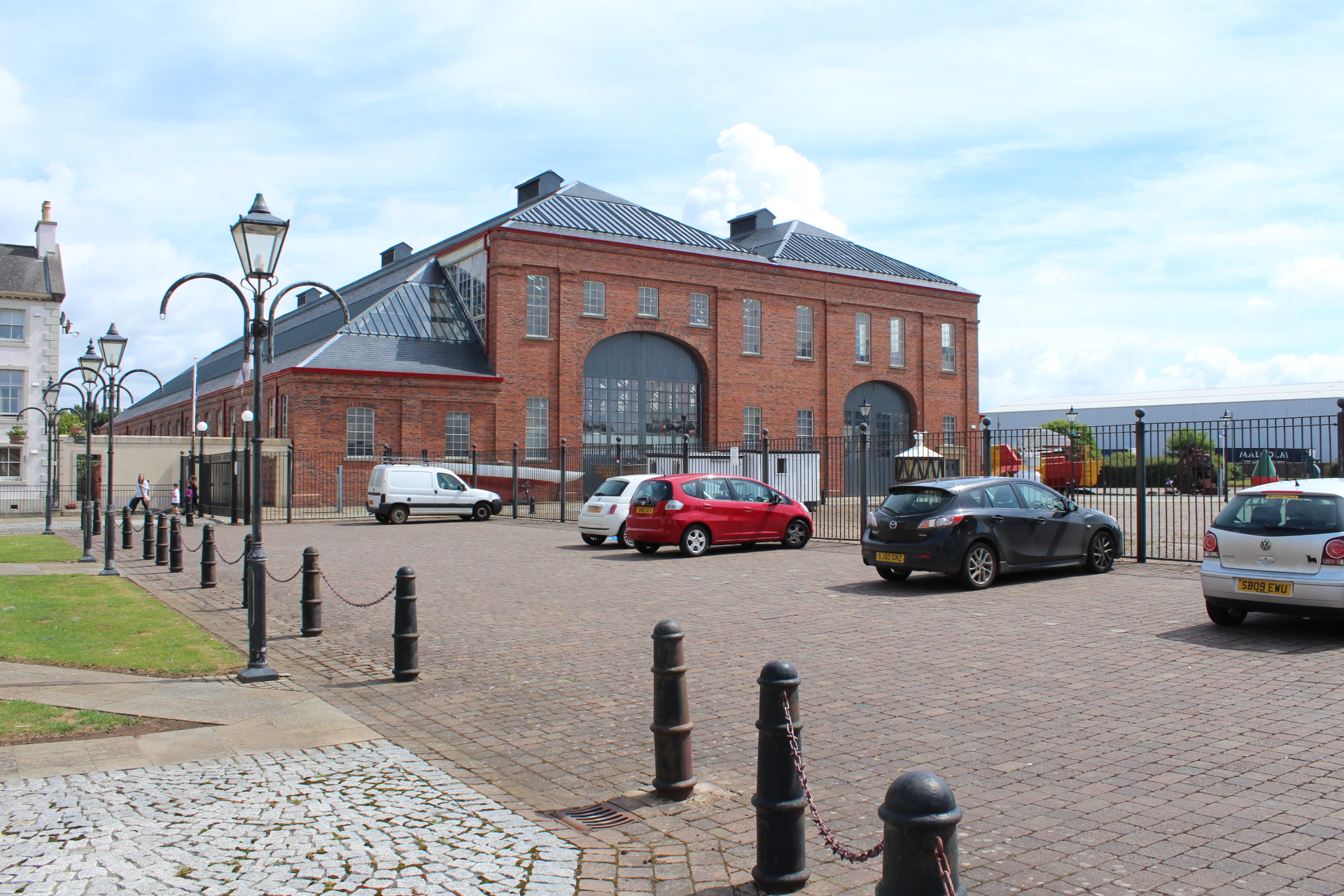
Image: Linthouse Building, Scottish Maritime Museum by Billy McCrorie, sourced from Wikimedia Commons and licensed under CC BY-SA 2.0.

A pioneering Clyde shipyard engine shop survives through careful re-erection as the vast “Cathedral of Engineering” of Scotland’s maritime museum.
Quick facts
- Date
- 1872; dismantled and re-erected 1990–1991
- Architect / designer
- James Spencer; re-erection by Lance Smith, Ironbridge Gorge Museum Trust and Ian Downs
- Type
- Former marine-engine works reconstructed as a national maritime museum hall
- Designation
- Listed building, Category A (LB35450)
- OS grid reference
- NS 31493 38355
Architecture and continuing use
Two tall central spans and lower side aisles are divided by original cast-iron stanchions and timber roof trusses. Wrought-iron crane rails, broad arched entrances, brick walls and long ranks of windows preserve the scale and working logic of the engineering shop.
Its story
James Spencer designed the works for Alexander Stephen and Sons at Linthouse in 1872. The frame was dismantled and reconstructed at Irvine in 1990–91, with replacement walls based on original drawings, to shelter the national maritime collection.
Reading the engineering hall
Two tall central spaces are flanked by lower lean-to aisles. Cast-iron columns divide the length into twelve bays and carry timber roof trusses, while crane rails run through the working volume. The combination provided height for marine-engine construction and movement, with narrower spaces beside the main assembly areas. Roof glazing brought daylight into a deep industrial building.
The building was dismantled at Linthouse and re-erected at Irvine in 1990–91. The surviving columns, roof structure and crane rails are therefore presented within replacement brick walls; the reconstructed elevations drew on original drawings. Present museum circulation differs from the original factory arrangements.
What to notice
- The original cast-iron stanchions dividing the long interior.
- Upper and lower crane rails that reveal the movement of heavy machinery.
- The contrast between the twin high central spans and lean-to side aisles.
- Repeated columns and parallel crane rails extending through the tall central bays towards the lower aisles.
Reading the surroundings
The museum publishes daily opening hours, admission arrangements and accessibility information. Event layouts may alter circulation, and service or collection areas remain restricted.
Timeline
- 1872 James Spencer erected the marine-engine works for Alexander Stephen and Sons at Linthouse.
- 1990–1991 The dismantled structure was re-erected at Irvine for the Scottish Maritime Museum.
- 2022 Historic Environment Scotland updated the listing to clarify the reconstructed fabric and national interest.
- 2026 The Linthouse continues to host the maritime collection, daily visits and public events.
What we know — and what remains uncertain
Replacement brick walls and reconstructed end elevations are part of the 1990–91 re-erection, while the principal iron and timber structure is historic.
Sources & further reading
- Historic Environment Scotland: Linthouse Building, Scottish Maritime Museum, LB35450 — Designation category, mapped location, construction phases, fabric, authorship and architectural or historical interest.
- Scottish Maritime Museum: the Linthouse and Boatshop — Current museum identity, address, hours, visitor arrangements and interpretation of the building.
- Scottish Maritime Museum: 2026 Irvine events — Current evidence that the Linthouse remains an active exhibition and event venue.
Location
OS grid reference NS 31493 38355 · Location confidence: High: the HES designation provides an official mapped National Grid Reference and the current source confirms the Place relationship or present identity. · Select the marker to open its satellite view in Google Maps. On desktop, drag Pegman (the yellow figure) onto a blue road. On mobile, turn on the Street View layer and tap a blue road. Other photo markers may be user-contributed.
Suggest a marker correction
Suggest a more accurate position
The teal marker is the current published position. The orange marker starts slightly to its right so both remain visible; this is only a visual starting position. Tap the correct place on the map or drag the orange marker. Sending this form creates a private review entry only; it does not move the published marker.
Check this area in Google Maps Choose the Satellite layer there if useful.
Map: © OpenStreetMap contributors. You can also enter checked coordinates below.
In these guides: Industrial Scotland in Ten Buildings