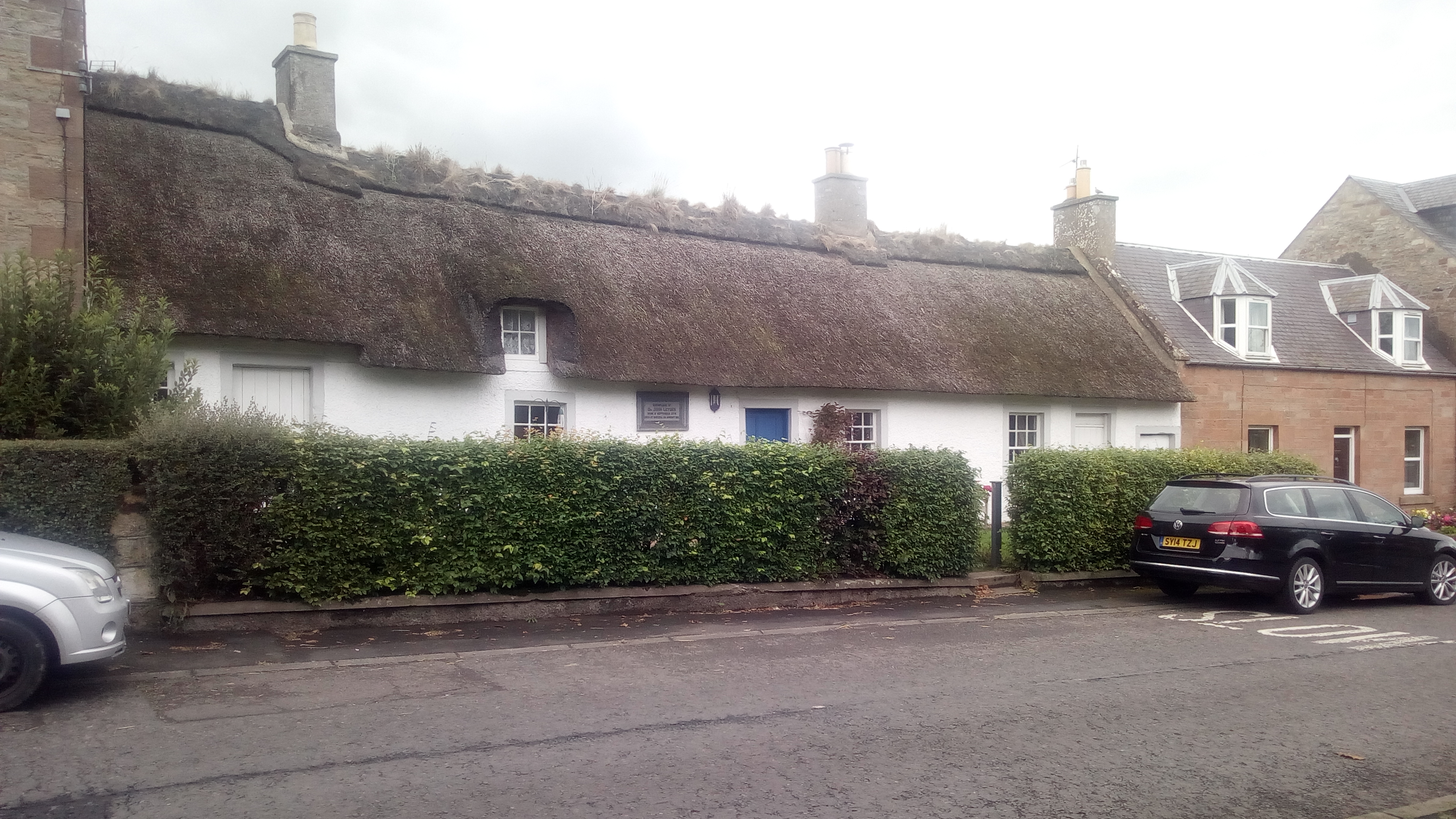
Denholm’s sole surviving thatched cottage combines three early dwellings and preserves the birthplace of poet and linguist John Leyden.
Quick facts
- Date
- Before 1775; restored 1896; altered in the early twenty-first century
- Architect / designer
- Vernacular builders unknown; 1896 restoration by the Edinburgh Border Counties Association
- Type
- Thatched terrace cottages combined as one house
- Designation
- Listed building, Category A (LB2057)
- OS grid reference
- NT 56835 18562
Architecture and history
The long single-storey range has painted rubble walls, irregular sash windows, a cobbled pend and a reed-thatched roof with turf ridge and eyebrow dormers. Early roof trusses, fireplaces and thick cross walls survive inside.
History
The building predates Leyden’s birth here in 1775 and later accommodated stocking work. Restoration in 1896 commemorated him and retained traditional fabric. Early-twenty-first-century alterations adapted the interior while leaving the rare thatched form legible.
Dickson and Beattie established their stocking business here in 1793, using the cottage to clean textile fibres before manufacture. They moved to Hawick in 1803; the later firm, Dickson and Laing, opened Wilton Mills in 1809–10. This gives the house a specific industrial history beyond its association with Leyden.
What to notice
- Reed thatch rising around small eyebrow dormers.
- Irregular windows enlarged for domestic or stocking work.
- The commemorative plaque beside the main door.
Reading the surroundings
This is a private home. View from public space without entering the garden or pend, and do not touch the thatch, walls or plaque.
Timeline
- 1775 John Leyden was born in the cottage.
- 1844 Denholm supported dozens of hand-operated stocking machines.
- 1896 A commemorative restoration renewed the building.
- 2019 The listing was revised and raised to Category A.
What we know — and what remains uncertain
The exact construction date and boundaries between the original three cottages are not fully documented; the interior is private.
Sources & further reading
The HES designation supports 1793 fibre-cleaning business, move to Hawick and Wilton Mills; 2017 record of eleven pegged roof trusses.
- Historic Environment Scotland: Leyden’s Cottage, LB2057 — Current designation status, mapped location, date, fabric and architectural or archaeological interest.
- Trove designation: LB2057 — Parallel national record identity and archival context.
- Trove: Leyden’s Cottage — National survey identity, images and archive links for the cottage.
Location
OS grid reference NT 56835 18562 · Location confidence: High: the current national designation supplies an exact mapped National Grid Reference; public text separately states access and current-use uncertainty. · Select the marker to open its satellite view in Google Maps. On desktop, drag Pegman (the yellow figure) onto a blue road. On mobile, turn on the Street View layer and tap a blue road. Other photo markers may be user-contributed.
Suggest a marker correction
Suggest a more accurate position
The teal marker is the current published position. The orange marker starts slightly to its right so both remain visible; this is only a visual starting position. Tap the correct place on the map or drag the orange marker. Sending this form creates a private review entry only; it does not move the published marker.
Check this area in Google Maps Choose the Satellite layer there if useful.
Map: © OpenStreetMap contributors. You can also enter checked coordinates below.