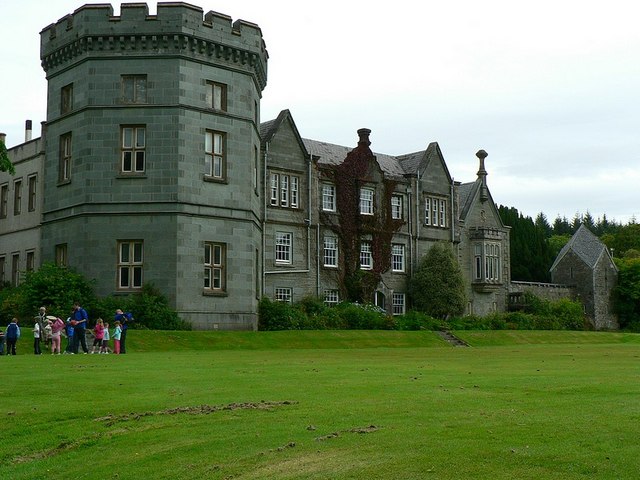


Kilmory Castle combines an earlier house with nineteenth-century castellated additions and a continuing role at the centre of local government.
Quick facts
- Date
- Central block about 1820; front about 1830; rear extensions dated 1863
- Architect / designer
- Designers not identified in the current designation
- Type
- Castellated country house adapted for civic administration
- Designation
- Listed building, Category B (LB11039)
- OS grid reference
- NR 86883 86730
Architecture and continuing use
A three-storey central block sits behind a two-storey front with crenellated parapets and three towers. An ogee-arched entrance and mock portcullis lead into the courtyard; rear additions dated 1863 continue the gabled, turreted composition.
Its story
The house was the Campbell seat before passing through marriage to Sir John Powlett Orde in 1826 and being enlarged for him. Later conversion brought yacht-club and hotel use. It became district-council headquarters in 1975 and the west wing suffered fire damage in 1984.
Why it is included
It connects estate architecture with twentieth- and twenty-first-century public administration, while its layered fabric prevents the misleading idea of a single building campaign.
What to notice
- The three differently shaped entrance-front towers.
- Crenellation, gablets and mullioned windows.
- The 1863 dated chimney among the rear ranges.
Reading the surroundings
This is a working civic building, not an unrestricted visitor attraction. Use public or signed routes, respect staff areas and events, and check arrangements before visiting the grounds or interior.
Timeline
- About 1820 The central block incorporated parts of an earlier castle.
- 1826–about 1830 Sir John Powlett Orde acquired and enlarged the estate house.
- 1975 The building became district-council headquarters.
- 1984 Fire damaged the west wing.
What we know — and what remains uncertain
The designation records several campaigns but does not name their architects. Access to council rooms and gardens depends on current operational arrangements.
Sources & further reading
- Historic Environment Scotland: Kilmory Castle, LB11039 — Current designation status, official mapped location, date, fabric and significance.
- Argyll and Bute Council: Council Chambers, Kilmory — Current official identification of Kilmory Castle as the council-chamber location.
- Argyll and Bute Council: Lochgilphead Registration Office — Current confirmation of council headquarters and ceremony-room use.
- Trove search: Kilmory Castle Lochgilphead — National collection search for site records, surveys and archive material.
Location
OS grid reference NR 86883 86730 · Location confidence: High for the current national designation point; public text separately states access, component-identity and current-use uncertainty. · Select the marker to open its satellite view in Google Maps. On desktop, drag Pegman (the yellow figure) onto a blue road. On mobile, turn on the Street View layer and tap a blue road. Other photo markers may be user-contributed.
Suggest a marker correction
Suggest a more accurate position
The teal marker is the current published position. The orange marker starts slightly to its right so both remain visible; this is only a visual starting position. Tap the correct place on the map or drag the orange marker. Sending this form creates a private review entry only; it does not move the published marker.
Check this area in Google Maps Choose the Satellite layer there if useful.
Map: © OpenStreetMap contributors. You can also enter checked coordinates below.