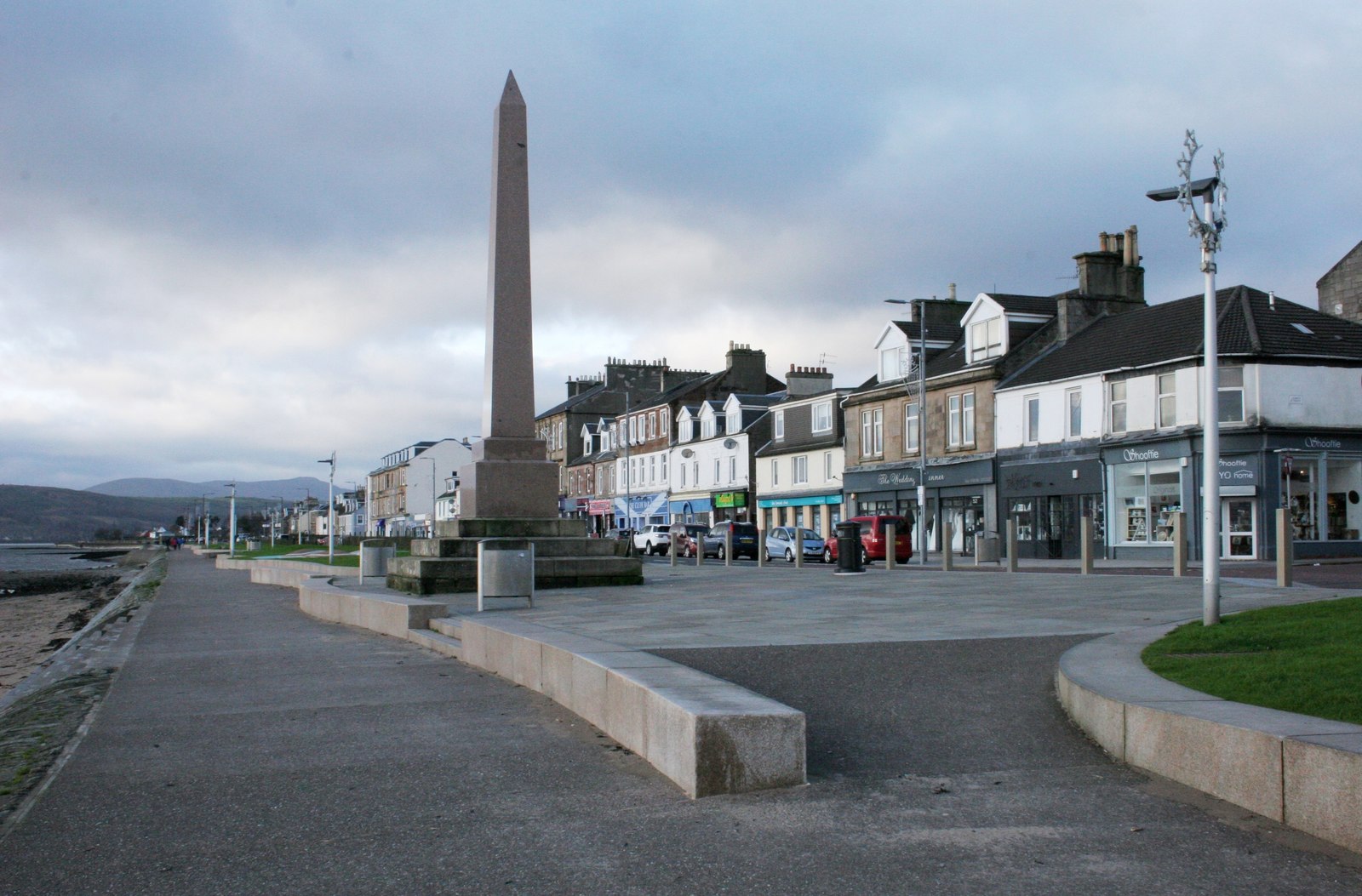
A waterfront obelisk commemorates Henry Bell and the steamship connection that helped shape the seaside town.


Quick facts
Date: 1872
Architect: Designer not identified in the HES designation
Designation: Category B listed building, LB34743
Address: West Clyde Street waterfront, Helensburgh, Argyll and Bute
OS grid reference: NS 29381 82323
Architecture and history
The tall stone obelisk stands on a stepped base beside West Clyde Street. Its prominent waterfront position links the memorial to the river that made Bell’s achievement possible. HES dates it to 1872: it is a later commemoration, built sixty years after the Comet’s first passenger service.
HES identifies the material as red sandstone. The obelisk is a tapering, four-sided shaft with a pointed top. Its stepped base raises the inscription above the pavement; the text commemorates Bell’s application of steam power to navigation.
Bell, the Comet and Helensburgh
Historic Environment Scotland’s account records the Comet’s construction at John Wood and Sons’ Port Glasgow yard in 1812, with an engine by John Robertson and a boiler by David Napier. A passenger service between Port Glasgow and Helensburgh began on 15 August that year.
Henry and Margaret Bell’s hotel and baths were part of Helensburgh’s development as a resort; Henry also became the burgh’s first provost. The monument brings these civic and maritime associations together. It is distinct from the Comet-related flywheel and anvil in the town and from Bell’s other memorial at Bowling.
What to notice
- The tapering sandstone shaft and stepped base.
- The inscription, distinct from the town’s other Comet-related objects.
A curious detail
Bell named the Comet after the Great Comet of 1811, visible to the naked eye for many months. The vessel’s name commemorated a recent astronomical event.
Location and Photos
The obelisk can be viewed from the public waterfront. The nearby pier has its own access restrictions; the memorial is a separate site.
Sources & further reading
- Historic Environment Scotland: LB34743 — 1872 red-sandstone obelisk, inscription and catalogue location.
- HES: Henry Bell, Helensburgh and the Comet, 15 December 2023 — Shipbuilding and service chronology, Bell’s civic and resort roles, and naming after the Great Comet of 1811.
- Destination Helensburgh: Henry Bell — Local context for Bell and the town’s commemorative landmarks.
- Helensburgh’s Hinterland architectural trail, 2016 — Research lead: stop 3; facts checked independently against the sources above.
Illustration rights
Richard Sutcliffe, 29 December 2018: original item and credit; CC BY-SA 2.0. Full compositions retained. No text or illustrations from either architectural guide are reproduced here.
Location
OS grid reference NS 29381 82323 · Location confidence: HES national-grid point converted from OSGB36 to WGS84; building location, not an entrance or statutory boundary. · Select the marker to open its satellite view in Google Maps. On desktop, drag Pegman (the yellow figure) onto a blue road. On mobile, turn on the Street View layer and tap a blue road. Other photo markers may be user-contributed.
Suggest a marker correction
Suggest a more accurate position
The teal marker is the current published position. The orange marker starts slightly to its right so both remain visible; this is only a visual starting position. Tap the correct place on the map or drag the orange marker. Sending this form creates a private review entry only; it does not move the published marker.
Check this area in Google Maps Choose the Satellite layer there if useful.
Map: © OpenStreetMap contributors. You can also enter checked coordinates below.