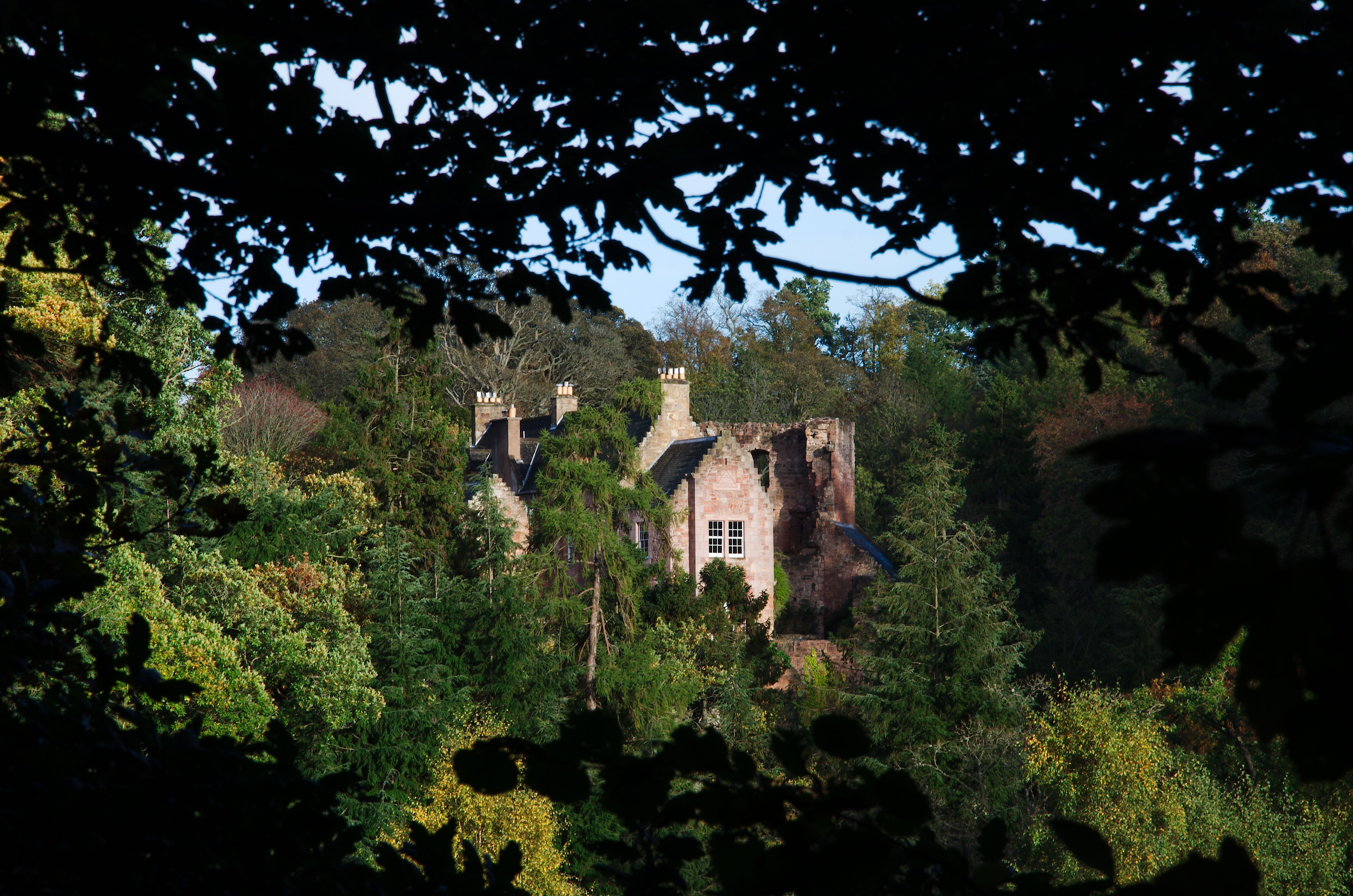
Hawthornden Castle through autumn woodland. Magnus Hagdorn, 27 October 2013. Image source · CC BY-SA 2.0.

In brief
A seventeenth-century house and earlier tower stand above the North Esk, closely associated with the poet William Drummond.
Quick facts
- Date
- Fifteenth-century tower remains; house largely 1638; nineteenth-century alterations
- Authorship / patronage
- William Drummond, patron of the 1638 rebuilding; individual designer not established
- Designation
- Listed building, Category A (LB13023)
- OS grid reference
- NT 28620 63677
Architecture and history
HES describes a house built in 1638 around a triangular courtyard, incorporating or adjoining an earlier fifteenth-century tower. Pink sandstone rubble, dressed surrounds, crowstepped gables and a round corner tower give it a varied outline above the gorge. Attic and stair alterations belong to the nineteenth century.
The northwest range was built in 1638, while the northeast range restored an earlier building. The old tower closes the third side of the triangular courtyard above the river, combining new seventeenth-century accommodation with retained medieval fabric.
William Drummond and the glen
William Drummond of Hawthornden (1585–1649) was a Scottish poet. He inherited the estate in 1610 and rebuilt the house by 1638. The designed-landscape account connects his poetry with walks and groves in the wooded river setting, although the precise extent of his landscaping is uncertain.
What to notice
- The triangular courtyard.
- The earlier tower beside the house.
- Crowsteps, round tower and varied openings.
A curious detail
A circular stone wellhead stands in the triangular courtyard facing the glen, bringing a water-supply feature into the domestic enclosure.
Location and Photos
The active Category A listing includes associated walls, gatepiers, outbuilding, fountainhead and caves. Its former scheduling, SM1205, was removed on 4 December 2018 in the dual-designation review; the castle remains protected by listing. Respect private grounds and avoid entering the caves.
A landscape in art
The accompanying historic painting by Alexander Nasmyth belongs to the early nineteenth-century appreciation of the glen. It is an artistic composition, distinct from the dated photograph of the house.
Sources & further reading
- HES — Hawthornden Castle and associated structures (LB13023) — 1638 new/restored ranges, triangular courtyard, earlier tower and courtyard wellhead.
- HES — Hawthornden Castle and caves, former scheduling (SM1205) — Scheduling removed on 4 December 2018 under the dual-designation review; current protection continues through listing.
- HES — Roslin Glen and Hawthornden Castle designed landscape (GDL00327) — Historic landscape, William Drummond’s poetry and early walks, Romantic art and ancient woodland.
Explore Roslin
The Roslin Place entry connects the village, chapel, castles and industrial glen.


Location
OS grid reference NT 28620 63677 · Location confidence: High — official HES mapped National Grid Reference transformed from OSGB36 to WGS84; catalogue point, not a boundary · Select the marker to open its satellite view in Google Maps. On desktop, drag Pegman (the yellow figure) onto a blue road. On mobile, turn on the Street View layer and tap a blue road. Other photo markers may be user-contributed.
Suggest a marker correction
Suggest a more accurate position
The teal marker is the current published position. The orange marker starts slightly to its right so both remain visible; this is only a visual starting position. Tap the correct place on the map or drag the orange marker. Sending this form creates a private review entry only; it does not move the published marker.
Check this area in Google Maps Choose the Satellite layer there if useful.
Map: © OpenStreetMap contributors. You can also enter checked coordinates below.