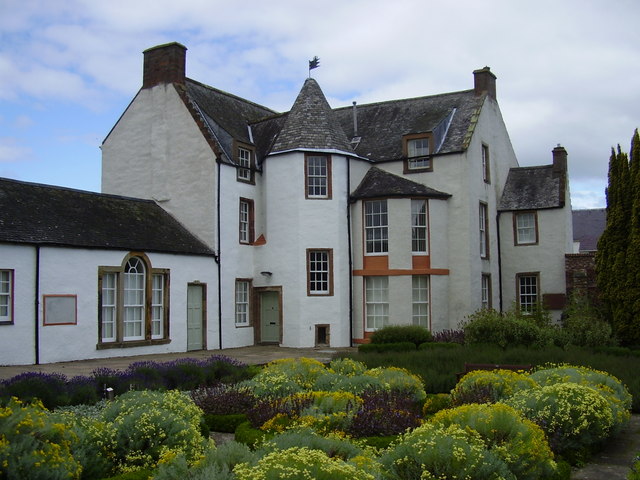
Image: Haddington House by james denham, sourced from Wikimedia Commons and licensed under CC BY-SA 2.0.

A seventeenth-century house on Sidegate with a dated 1680 porch and later additions, restored in 1970 and now used as offices.
Quick facts
- Date
- 17th century; porch dated 1680; restored 1970
- Architect / designer
- Built for Alexander Maitland; restored for the Lamp of Lothian
- Type
- Historic town house and garden
- Designation
- Listed building, Category A (LB34388)
- OS grid reference
- NT 51740 73720
Architecture and alterations
Haddington House is a three-storey, harled L-plan building with crowstepped gables and a slated roof. Behind the house is an octagonal turret stair. The stone entrance steps, balustrade and columned porch face Sidegate; the porch carries the initials of Alexander Maitland and Katherine Cunninghame. The surviving interior includes a first-floor chimneypiece with pilasters and a painted overmantel.
The entrance porch was added in 1680, when the main doorway was moved from the turret stair to Sidegate. An eighteenth-century lower wing and a Regency-period bowed addition near the stair turret record later changes to the house.
The house and the Lamp of Lothian
Built for Alexander Maitland on the site of a medieval house, Haddington House was restored in 1970 by the Lamp of Lothian Trust, founded three years earlier by Elizabeth, Duchess of Hamilton. The house was the first major restoration in a programme that later extended to the mill, cottages and granary at Poldrate.
The Trust has since refurbished parts of Haddington House as flexible office suites, retaining the historic building in use. The adjoining St Mary’s Pleasance garden, between the churchyard and the house, is maintained for public enjoyment by the separate Haddington Garden Trust. The Lamp’s current information provides details of the offices and garden.
What to notice
- Crowstepped gables and varied roofline.
- The entrance porch dated 1680.
- Relationship between the old house, later wing and garden.
Visiting
St Mary’s Pleasance is maintained by Haddington Garden Trust for public enjoyment. Haddington House itself contains working offices; access to its interiors is not generally available as part of a public visit.
Timeline
- 17th century A substantial town house was built for Alexander Maitland.
- 1680 The dated entrance porch marked an important domestic improvement.
- 1970 Lamp of Lothian restoration adapted the historic house for continuing use.
- 2026 Office suites operate beside a community-managed garden.
What we know — and what remains uncertain
The earliest fabric is not documented by a single construction date, and later domestic phases overlap within the surviving house.
Sources & further reading
- Historic Environment Scotland: Haddington House, LB34388 — Designation status, mapped location, date, fabric and architectural or archaeological interest.
- Lamp of Lothian: Haddington House — Current office and garden use, community stewardship and concise restoration history.
- Paterson Architects: Haddington House — Professional conservation context for the historic house and later alterations.
- Lamp of Lothian Trust: Our History — Founding in 1967, restoration of Haddington House and later adaptation of Poldrate buildings.
Location
OS grid reference NT 51740 73720 · Location confidence: High: the national designation supplies an official mapped National Grid Reference; the independent source confirms the Place relationship, history or current identity. · Select the marker to open its satellite view in Google Maps. On desktop, drag Pegman (the yellow figure) onto a blue road. On mobile, turn on the Street View layer and tap a blue road. Other photo markers may be user-contributed.
Suggest a marker correction
Suggest a more accurate position
The teal marker is the current published position. The orange marker starts slightly to its right so both remain visible; this is only a visual starting position. Tap the correct place on the map or drag the orange marker. Sending this form creates a private review entry only; it does not move the published marker.
Check this area in Google Maps Choose the Satellite layer there if useful.
Map: © OpenStreetMap contributors. You can also enter checked coordinates below.