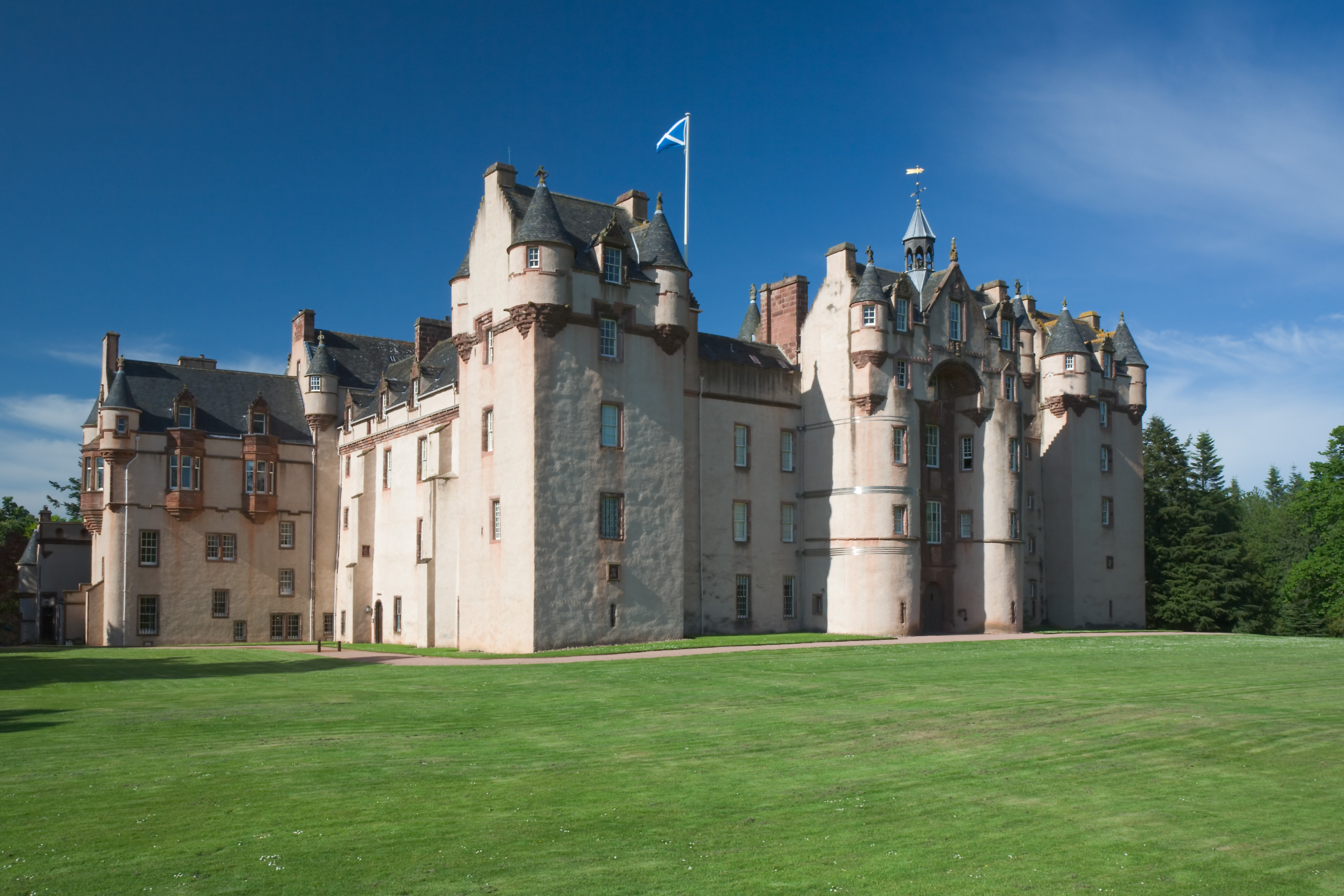
Photograph: Ikiwaner, 1 June 2007. Wikimedia Commons source. Licensed under CC BY-SA 3.0. No modifications.

In brief
Fyvie Castle is an extraordinary accumulation of medieval, Renaissance and later country-house architecture. Its five principal towers and richly varied interiors record the ambitions of successive Preston, Meldrum, Seton, Gordon and Leith owners, while its loch, gardens and woods preserve a nationally important designed landscape.
Quick facts
- Place
- Fyvie, Aberdeenshire
- Building type
- Evolved tower house and country house
- Date
- Medieval origins; major work from about 1400 to 1603; remodelling in 1777–93, 1890 and 1899–1920
- Later architects
- John Bryce; A. Marshall Mackenzie
- Designation
- Category A listed building, LB9615; the surrounding designed landscape is separately included in the Inventory as GDL00184
A castle built in chapters
Fyvie does not read as the work of a single moment. Its irregular, roughly L-shaped mass grew around earlier fabric over many centuries. The south range incorporates work associated with the Preston and Meldrum families, including the Preston Tower of about 1400 and the later fifteenth- or sixteenth-century Meldrum Tower. At the centre, the paired turrets and high, sculptural roofline of the Seton Tower announce the ambitious rebuilding undertaken for Alexander Seton, later Earl of Dunfermline, around 1599.
The west range followed in the early seventeenth century and contains the celebrated great wheel stair. General William Gordon reshaped parts of the house in 1777–93, while the Leith family employed John Bryce and A. Marshall Mackenzie for substantial later work. The result is picturesque, but not accidental: each campaign responds to the earlier castle while asserting a new phase of ownership.
Royal stronghold, noble house
The site has a much longer history than the surviving elevations alone suggest. Fyvie was a royal stronghold in the medieval period, visited by Scottish kings and occupied by Edward I of England in 1296. It later passed through the Preston, Meldrum and Seton families. Alexander Seton acquired Fyvie in 1596 and transformed it into a courtly Renaissance residence. Gordon and Leith ownership brought further remodelling, collecting and estate improvement.
Inside, vaulted rooms, carved stonework, painted decoration, timberwork and elaborate plaster ceilings preserve this layered story. The charter room and late-seventeenth-century plasterwork associated with Robert Whyte are among the details that make the interiors nationally exceptional.
The designed landscape
The castle’s architectural effect depends on its setting. The loch, parkland, woods, drives and walled garden were shaped principally in the late eighteenth, early nineteenth and later nineteenth centuries, with further conservation from the late twentieth century. Historic Environment Scotland assesses the landscape as outstanding for its artistic, horticultural, architectural and archaeological interest. The walled garden also contributes to the conservation of historic Scottish fruit cultivars.
Why it matters
Fyvie is one of Scotland’s clearest demonstrations of a medieval tower house becoming a great country residence without losing the evidence of its earlier lives. The close relationship between its towers, interiors, collections and designed landscape gives the place exceptional historical depth.
What to notice
- The dense skyline of turrets, bartizans, chimneys and crow-stepped gables.
- The contrasting character of the Preston, Meldrum, Seton, Gordon and Leith towers.
- The monumental wheel stair in the west range.
- Renaissance carved detail around the Seton work.
- The way long views across lawn and water turn the accumulated building into a composed landscape feature.
Current access
Fyvie Castle is cared for by the National Trust for Scotland. The castle, shop and tearoom have seasonal opening arrangements, while the grounds, lochside walks and walled garden generally have longer access. Level access is available to the castle entrance, tearoom and principal garden areas, with Blue Badge parking arrangements near the building; many interior routes involve stairs and narrow passages. Check the Trust’s current visitor and accessibility information before travelling.
Timeline
- Medieval period — Royal stronghold above the River Ythan.
- About 1400 — Preston Tower.
- 15th–16th centuries — Meldrum work and further enlargement.
- 1596–1603 — Alexander Seton acquires Fyvie and undertakes major Renaissance rebuilding.
- 1777–93 — Gordon remodelling and the Gordon Tower phase.
- 1890 — Leith Tower work by John Bryce.
- 1899–1920 — Alterations associated with A. Marshall Mackenzie.
- Present — Castle, collections, gardens and estate cared for by the National Trust for Scotland.
What remains uncertain
The precise extent and form of the earliest royal and medieval buildings are obscured by later construction. Dates assigned to individual phases should therefore be read as the best interpretation of surviving fabric and documentary evidence rather than as a complete building account.
Sources and further reading
Explore Fyvie
See the Fyvie place page for the wider setting and future records.
OS grid reference NJ 76390 39306 · Location confidence: High — statutory designation coordinates checked against the current visitor address · Select the marker to open its satellite view in Google Maps. On desktop, drag Pegman (the yellow figure) onto a blue road. On mobile, turn on the Street View layer and tap a blue road. Other photo markers may be user-contributed. The teal marker is the current published position. The orange marker starts slightly to its right so both remain visible; this is only a visual starting position. Tap the correct place on the map or drag the orange marker. Sending this form creates a private review entry only; it does not move the published marker. Check this area in Google Maps Choose the Satellite layer there if useful. Map: © OpenStreetMap contributors. You can also enter checked coordinates below.Location
Suggest a marker correction
Suggest a more accurate position