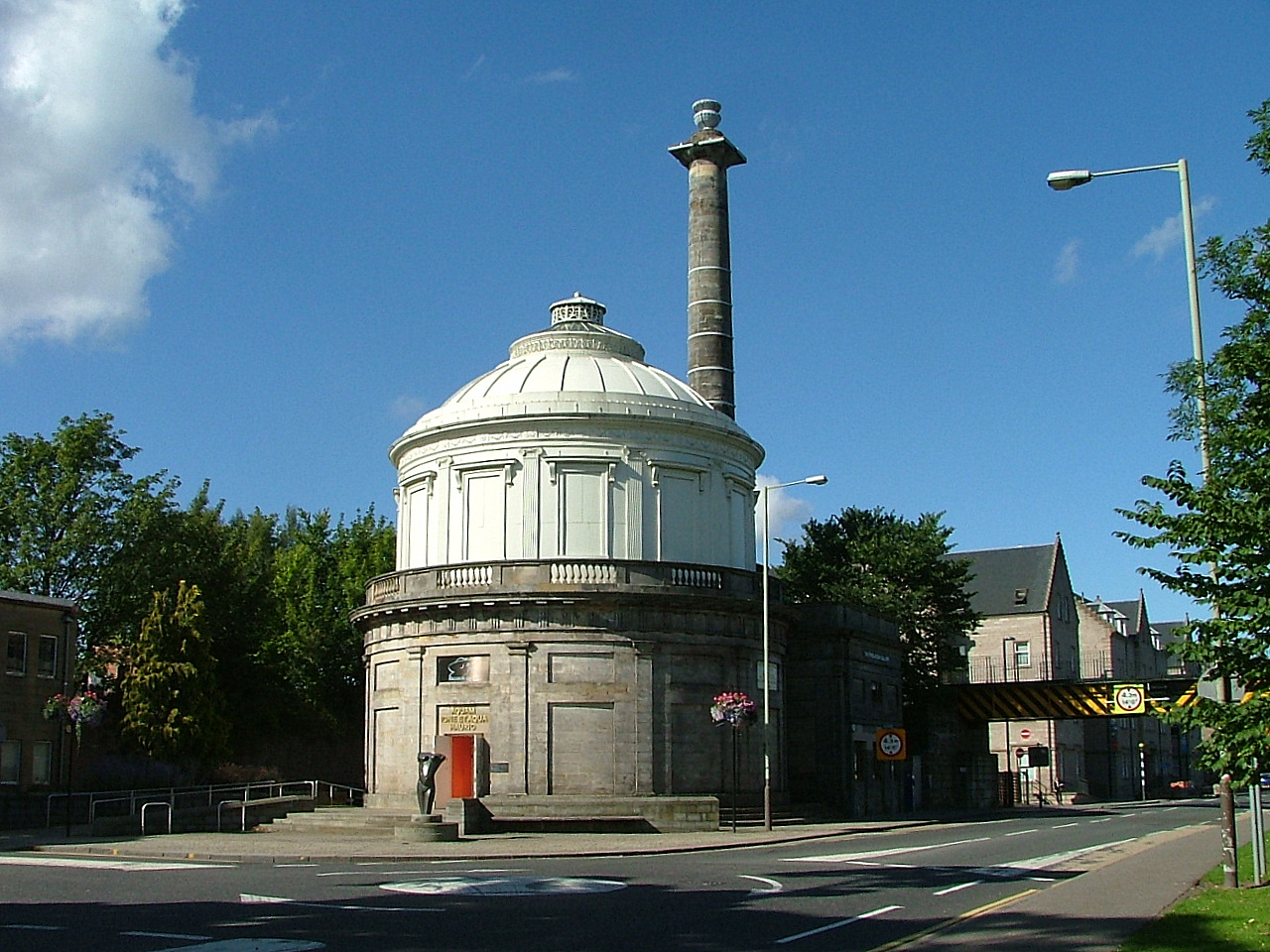
Perth’s former waterworks turns an early cast-iron cistern into a domed Neo-Classical landmark, combining municipal engineering, civic display and later cultural reuse at the southern approach to the city centre.
Quick facts
- Date
- Built 1832; restored 1973; converted to an art gallery in 1992; dome reconstructed 2003
- Designer
- Adam Anderson
- Type
- Steam-powered waterworks with engine house, elevated cast-iron tank and domed rotunda
- Designation
- Listed building, Category A (LB39341)
- OS grid reference
- NO 12038 23137
Architecture
The waterworks is composed as a civic monument rather than a plainly utilitarian plant. Its circular lower stage is built in ashlar and divided by Roman-Doric pilasters, with blind panelled recesses between them. Above, a balustrade conceals the change to an extraordinary elevated cistern assembled from large painted cast-iron plates. Fluted Ionic pilasters, blind consoled windows and a swagged frieze incorporating Perth’s burgh arms disguise the tank as refined classical architecture.
A ribbed dome rises over the cistern and is crowned by a low cupola with a decorated drum. The adjoining former engine house is a single-storey, flat-roofed range with triglyph-decorated Doric pilasters and a panelled parapet. Its tall chimney is treated as a monumental column and finished with a Roman urn; the present urn is a replica, the original having been destroyed by lightning in 1871.
The Latin inscription above the rotunda door, Aquam Igne Et Aqua Haurio, is commonly translated as “I draw water by fire and water”. It compresses the working principle into a civic motto: steam power lifted filtered river water into the high-level tank.
Clean water by steam power
Adam Anderson, rector of Perth Academy, designed the works in 1832. Filtered water was drawn from beds on Moncreiffe Island in the River Tay, carried beneath the river and pumped by steam engine into the rotunda’s cistern. Historic Environment Scotland records a capacity of 146,000 gallons, sufficient to supply almost all of Perth’s commercial and domestic demand at the time.
The system became redundant after a new municipal waterworks opened in 1965. Its survival is exceptional: Historic Environment Scotland identifies it as the earliest known large-scale cast-iron building in Scotland and notes that it may be the earliest of its kind anywhere, while stopping short of presenting that wider claim as proven.
From utility to culture
James Morris and Robert Steedman restored the building in 1973 for a tourist-information centre. A further conversion in 1992 created the Fergusson Gallery for works by the Scottish Colourist John Duncan Fergusson and for temporary exhibitions. The dome was reconstructed in 2003 during a major conservation project supported by the Heritage Lottery Fund, Historic Scotland and Perth and Kinross Council.
The gallery has since closed to general visitors and the public Fergusson displays have moved to Perth Art Gallery. In August 2026 Culture Perth & Kinross reported that the J. D. Fergusson archive was still housed in the former gallery while a digitisation project approached completion, before transfer to a permanent collections store. That collection work is not public access to the building.
Why it matters
The Category A building joins technological innovation to an unusually ambitious city image. The engineering apparatus is not hidden behind a conventional façade: the tank itself becomes the upper architectural order, and the chimney, dome and cupola form a silhouette visible from several approaches. Its corner position at Marshall Place and Tay Street also marks an important entrance to central Perth.
Successive tourist and gallery uses demonstrate how a specialised industrial building can acquire new public meanings without erasing its original function. The rotunda is therefore significant both as water-engineering fabric and as a long-lived city landmark.
What to notice
- The change from the ashlar Roman-Doric lower stage to the painted cast-iron Ionic tank above.
- The burgh arms, swags and blind windows that transform a cistern into civic architecture.
- The Latin inscription connecting water supply with steam power.
- The relationship between rotunda, engine-house range and column-like chimney.
- The dome and cupola as parts of the city skyline rather than merely a roof over machinery.
Visiting and access
The former Fergusson Gallery is not currently advertised as a public attraction. View the exterior from public pavements on Tay Street and Marshall Place; do not infer entry from its former gallery use or from collection work inside. The relocated public displays can be visited at Perth Art Gallery, subject to that venue’s current opening arrangements.
Timeline
- 1832 Adam Anderson’s steam-powered waterworks is completed.
- 1871 Lightning destroys the original urn above the engine-house chimney.
- 1965 A new city waterworks makes the old plant redundant.
- 1973 James Morris and Robert Steedman restore it as a tourist-information centre.
- 1992 The building opens as the Fergusson Gallery.
- 2003 The dome is reconstructed during a major conservation project.
- 2026 The former gallery is closed to general visitors; archive digitisation and relocation work continues.
What is certain — and what is not
The design, capacity, water-supply process and later conversions are documented by Historic Environment Scotland. Its standing as the earliest identified large-scale cast-iron building in Scotland is explicit; the possibility that it was the first in the world remains a cautious assessment, not a settled fact. The August 2026 operator report confirms temporary archive work but does not establish the building’s long-term use after the collection moves.
Sources & further reading
- Historic Environment Scotland: Tay Street, former Perth Water Works, LB39341 — statutory identity, architecture, water-engineering history, later conversion and significance.
- Culture Perth & Kinross: Photographing Fergusson — digitising the J. D. Fergusson archive — August 2026 account of archive work in the former gallery before relocation.
Former Perth Water Works. Photograph: Dave Fergusson, 2 September 2010. CC BY-SA 2.0.
