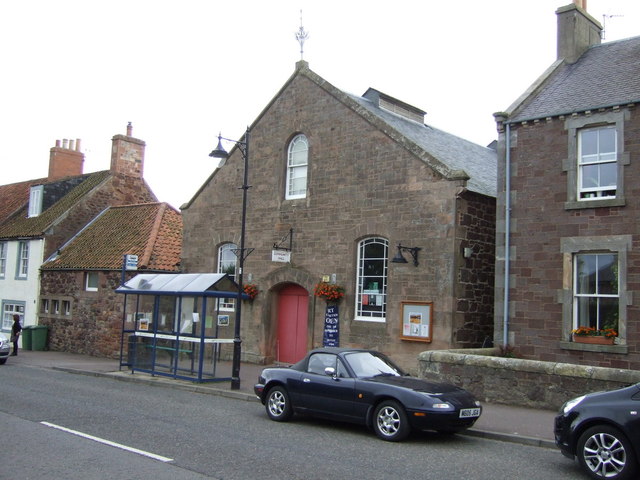
East Linton Community Hall. JThomas, 21 September 2013. Image source · CC BY-SA 2.0.

In brief
Opened in 1875 as a volunteer drill hall, this gabled building became East Linton’s community hall and was extended in 2000.
Quick facts
- Date
- 1874–1875; refurbished 2000
- Authorship / patronage
- Built for No. 5 Haddington Rifle Volunteers; architect not established
- Designation
- No statutory listing identified for this hall; conservation-area context
- OS grid reference
- NT 590 774
- Building stone
- Traprain freestone
Architecture
The volunteers trained indoors beneath a steep slate roof. Traprain freestone was used for the hall, which the Earl of Haddington opened in January 1875.
From rifle volunteers to village association
The hall’s own history dates the foundation stone to 27 June 1874 and its opening, for the No. 5 Haddington Rifle Volunteers, to 6 January 1875. The East Linton & District Community Association was established in 1962, when the building took its present name. A major refurbishment and extension was completed in 2000 with support from the Millennium Commission. The hall is now managed for community activities and hire.
Recruiting in East Linton
During the First World War the drill hall served as a recruiting station. Local research also places the 1/10th (Cyclist) Battalion at East Linton in connection with coastal defence at North Berwick. Dunpender Community Council records the volunteers’ banner in the hall.
What to notice
Tall windows with rounded heads flank the entrance beneath the broad High Street gable. The hall also used space beyond this frontage. The listing for the adjoining No. 71 identifies its former workshop as the drill hall’s cloakrooms.
Location and Photos
For bookings and current access arrangements use the Community Hall’s own website. Its rooms are in active use and are not a freely accessible museum.
Sources & further reading
- East Linton Community Hall — About Us — Foundation stone, opening, rifle volunteers, 1962 community association and 2000 refurbishment. Traprain freestone, construction cost, fundraising and opening by the Earl of Haddington.
- HES — 71 High Street, LB26671 — Adjoining listed property and historic workshop/drill-hall cloakroom connection; not a listing of the hall.
- East Linton Community Hall — Conditions of Let — Current association management and hall uses.
- East Linton Heritage — War Memorial History — Recruitment at the drill hall and the cyclist battalion stationed in the village.
Explore East Linton
The East Linton Place entry connects the village, river crossing, civic buildings and agricultural landscape.
Location
OS grid reference NT 590 774 · Location confidence: Approximate — photographed building location from Geograph/Wikimedia Commons; NGR rounded to 100 m · Select the marker to open its satellite view in Google Maps. On desktop, drag Pegman (the yellow figure) onto a blue road. On mobile, turn on the Street View layer and tap a blue road. Other photo markers may be user-contributed.
Suggest a marker correction
Suggest a more accurate position
The teal marker is the current published position. The orange marker starts slightly to its right so both remain visible; this is only a visual starting position. Tap the correct place on the map or drag the orange marker. Sending this form creates a private review entry only; it does not move the published marker.
Check this area in Google Maps Choose the Satellite layer there if useful.
Map: © OpenStreetMap contributors. You can also enter checked coordinates below.