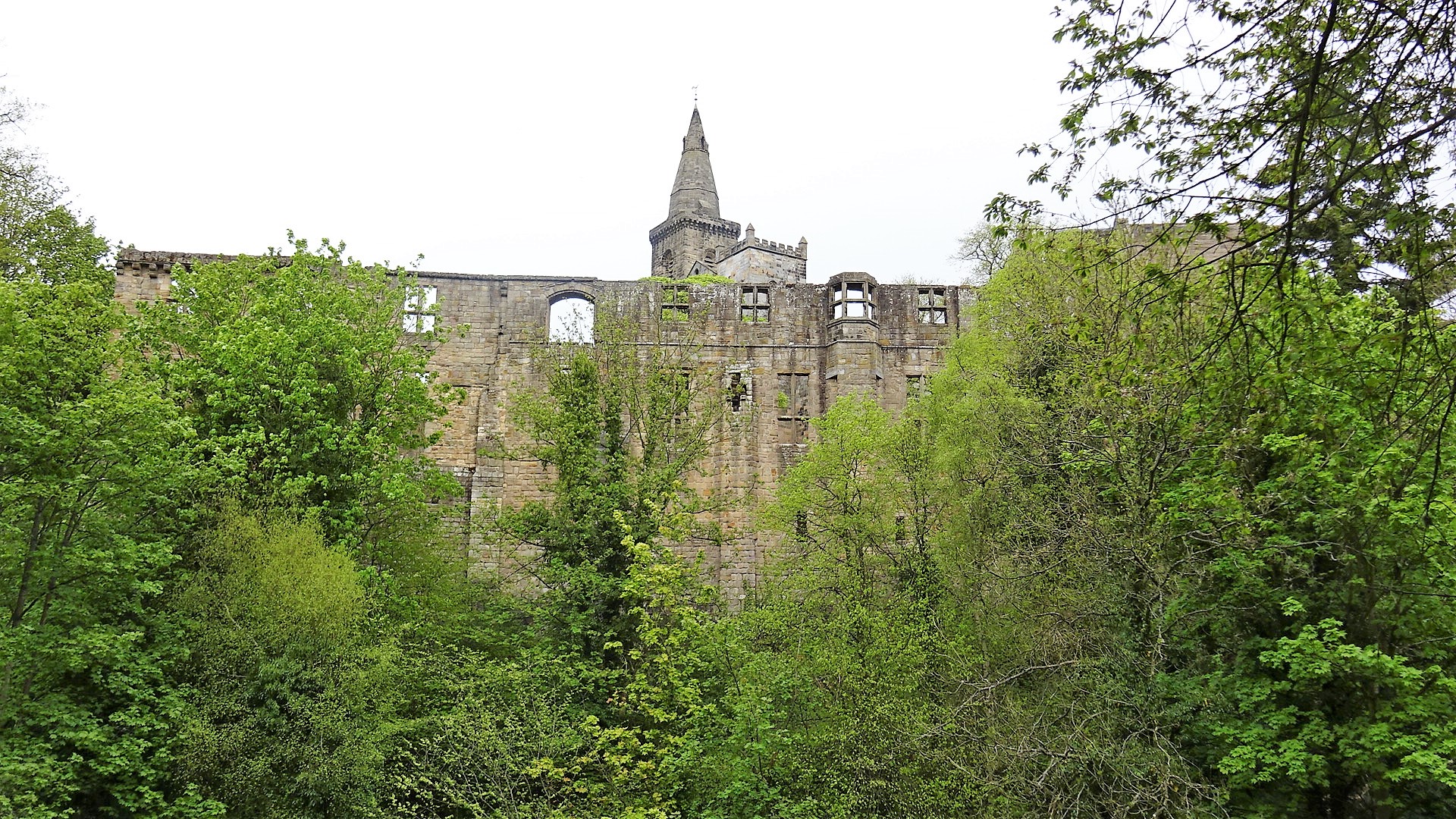
Image: Ruined ranges of Dunfermline Palace and the abbey tower rising above trees in Pittencrieff Park by Rosser1954, licensed under CC BY-SA 4.0.

Scotland’s first Benedictine monastery developed into a royal mausoleum and palace. Its Romanesque nave, William Burn’s nineteenth-century parish church, medieval ruins and buried archaeology form one complex, but they carry three distinct statutory designations.
Quick facts
- Date
- Monastery established around 1070; abbey church begun 1128 and consecrated 1150; major monastic and palace phases from the 13th to 16th centuries; New Abbey Church 1818–1821
- Architect / designer
- Successive medieval masons; New Abbey Church by William Burn, with alterations by R. Rowand Anderson in 1905
- Type
- Abbey, royal mausoleum, palace, burial ground and active parish church
- Designation
- Category A abbey nave and memorials (LB25960); Category A New Abbey Parish Church (LB25961); scheduled monastic, palace and archaeological complex (SM90116)
- OS grid reference
- NT 08900 87200 (point for the wider scheduled complex)
A church of two halves
The roofed medieval nave and the nineteenth-century parish church meet along the line of the lost medieval crossing. The seven-bay Romanesque nave was begun after David I raised the monastery to abbey status in 1128. Massive circular piers, some cut with spiral and chevron patterns, carry round arches above groin-vaulted aisles. The west towers were substantially rebuilt around 1400; the south tower was rebuilt by William Stark in 1811, while the prominent flying buttresses belong to seventeenth-century work and later repair.
East of the nave, William Burn’s church of 1818–1821 occupies the site of the medieval choir and transepts. It is a cruciform, aisled Perpendicular Gothic Revival building in sandstone ashlar, with a central crossing tower, traceried windows, crenellated parapets and stair vestibules designed to join the surviving medieval work. R. Rowand Anderson’s 1905 alterations include the Gothic pulpit and baldacchino above Robert the Bruce’s tomb in the choir.
Monastery, royal burial place and palace
Queen Margaret established a religious house dedicated to the Holy Trinity around 1070. Excavation has identified an early church with nave, west tower and eastern apse beneath the later abbey. David I’s enlargement, consecrated in 1150, established Dunfermline as Scotland’s first Benedictine abbey and one of the kingdom’s principal churches.
The abbey became the principal royal burial place of the Canmore dynasty. Malcolm III, Margaret, David I and Robert I are among the monarchs associated with burials here. Margaret’s shrine chapel survives as low masonry east of the present church, while Robert the Bruce’s remains lie beneath the nineteenth-century choir, marked by an 1889 brass set in a porphyry slab.
South of the church, the remains of refectory, dormitory, latrines, kitchen and gatehouse show the scale of the monastic precinct. The guest-house range was enlarged around 1500 for James IV, remodelled for James V and adapted around 1589 as a palace for Anne of Denmark. Further scheduled archaeology includes graveyards, watercourses and mills along the Tower Burn. These industrial remains are part of the abbey’s economy, not a separate story.
Reformation and continuing worship
After the Reformation in 1560, the medieval nave continued as Dunfermline’s parish church while the abandoned east end collapsed. The present church replaced that lost eastern arm in the early nineteenth century. The result is neither a single medieval survival nor a later reconstruction: it is a layered ensemble in which medieval fabric, royal archaeology, nineteenth-century worship and modern conservation remain active together.
Why it matters
Dunfermline combines Scotland’s earliest Benedictine foundation, its most important medieval royal mausoleum, a major Stewart palace and an active parish church. Its setting above Pittencrieff Glen also preserves the relationship between monastery, royal residence, burgh, water supply and mills. Few sites make the interaction of religion, kingship, town formation and working infrastructure so legible.
What to notice
- The scale and varied carving of the Romanesque piers and round arches in the medieval nave.
- The deliberate transition from the nave into Burn’s Perpendicular Gothic Revival church.
- The crossing tower’s open stone lettering naming King Robert the Bruce.
- Robert the Bruce’s tomb marker, the seventeenth-century magistrates’ pew and the nineteenth-century monuments in the parish church.
- The full-height refectory and palace walls seen from Pittencrieff Glen, where the steep slope explains both their dramatic appearance and the monastic waterworks below.
Current access
The abbey nave, grounds and working Abbey Church are open to visitors, and admission is free, although booking is recommended and donations are welcomed. Historic Environment Scotland currently lists daily opening from 10am to 4.30pm from April through September. From October through March it lists Tuesday–Saturday, 10am–4pm, with Sunday and Monday closed; last entry is earlier than closing. Church services, funerals, weddings and events may alter access, including access to Robert the Bruce’s tomb. The congregation currently holds Sunday worship at 10.30am and Wednesday prayers at 12.15pm.
The palace ruins are currently closed for conservation work. This record therefore does not imply access to the palace ranges even though they remain visually important from the glen and surrounding public routes.
The approach to the nave crosses tarmac paths through the graveyard, followed by three steep stone steps. Visitors requiring level entry to the nave should contact the site in advance. The church is mainly level and has an accessible entrance at the north-east door. There are no visitor toilets on the site; adapted and Changing Places facilities are available at Carnegie Library about 100 metres away. There is no visitor car park or dedicated accessible bay, though drop-off near the entrance is possible. Current arrangements should be checked before a special journey.
Timeline
- c.1070 Queen Margaret established a monastery dedicated to the Holy Trinity.
- 1128–1150 David I raised it to abbey status and the great Romanesque church was built and consecrated.
- 13th–14th centuries The royal mausoleum, conventual ranges and refectory developed; Robert I was buried here in 1329.
- c.1500–late 16th century The guest house was enlarged and remodelled as a royal palace for the Stewart court.
- 1560 onwards The nave continued as the burgh parish church after the Reformation while the eastern church fell into ruin.
- 1818–1821 William Burn’s New Abbey Church was constructed over the medieval choir and transepts.
- 1845–1848 William Nixon and Robert Matheson restored the medieval nave.
- 1889 Robert the Bruce’s present brass tomb marker was installed.
- 1905 R. Rowand Anderson altered the parish church and added the pulpit and baldacchino.
- Present The nave and church remain visitor-accessible and in active use; the palace is closed for conservation.
What remains uncertain
The designation records distinguish visible buildings from extensive buried archaeology, including early churches and royal burials. Much of that evidence cannot be read from the surface, and some traditional identifications have changed as excavation and documentary study have advanced. This page therefore follows the current statutory descriptions and does not use the visitor map point as a substitute for the legal designation plans.
Sources & further reading
- Historic Environment Scotland: Dunfermline Abbey nave and memorials, LB25960 — Category A status, Romanesque fabric, later alterations and relationship to the parish church.
- Historic Environment Scotland: New Abbey Parish Church, LB25961 — Category A status, William Burn’s design, later work and principal fittings.
- Historic Environment Scotland: Dunfermline Abbey, SM90116 — Scheduled area, archaeology, monastic and palace development, mills, burials and national importance.
- Historic Environment Scotland: plan your visit — Current opening, palace closure, access route and facilities.
- Dunfermline Abbey congregation: visit — Current church opening, worship and contact information.
Location
OS grid reference NT 08900 87200 · Location confidence: High for the monument complex: the scheduled record supplies the grid reference; a point cannot represent the full legal boundary. · Select the marker to open its satellite view in Google Maps. On desktop, drag Pegman (the yellow figure) onto a blue road. On mobile, turn on the Street View layer and tap a blue road. Other photo markers may be user-contributed.
Suggest a marker correction
Suggest a more accurate position
The teal marker is the current published position. The orange marker starts slightly to its right so both remain visible; this is only a visual starting position. Tap the correct place on the map or drag the orange marker. Sending this form creates a private review entry only; it does not move the published marker.
Check this area in Google Maps Choose the Satellite layer there if useful.
Map: © OpenStreetMap contributors. You can also enter checked coordinates below.