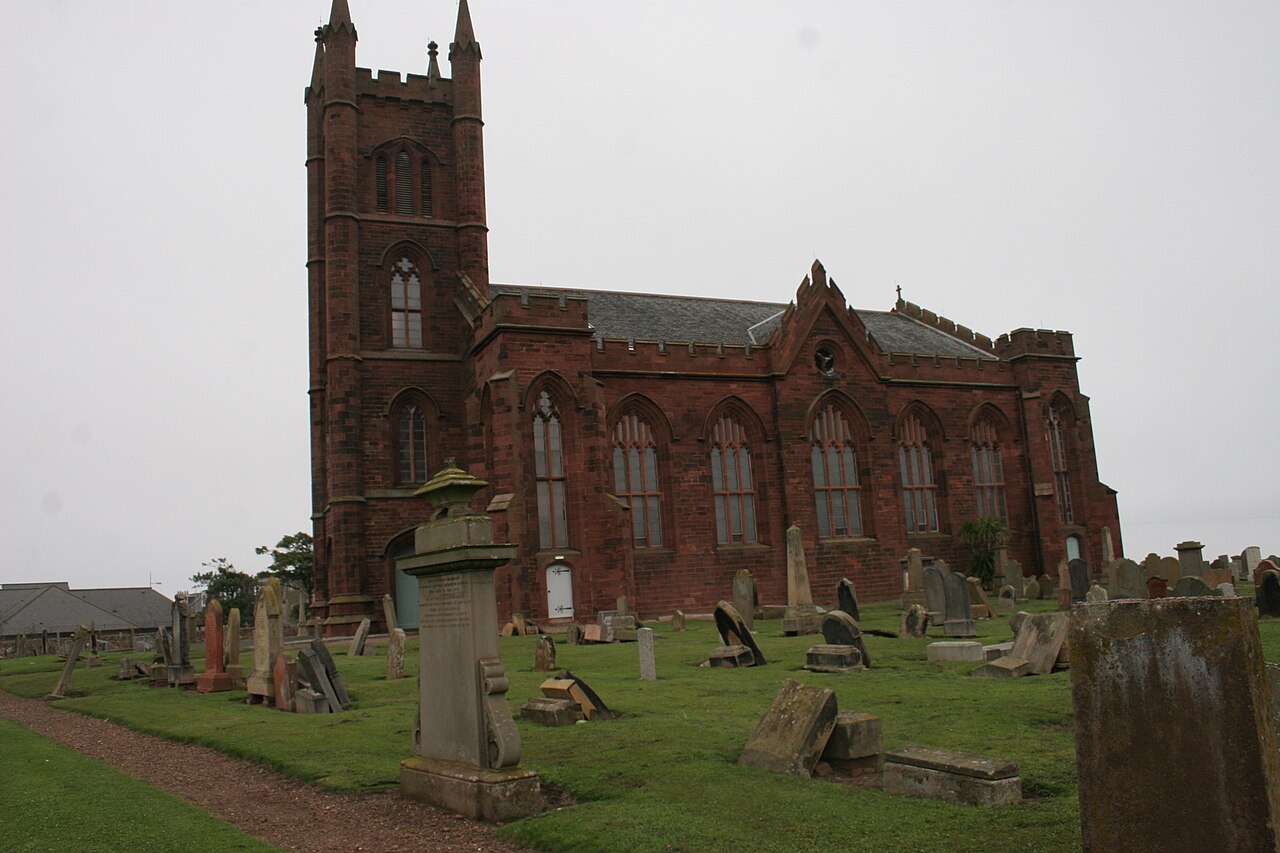
Image: Dunbar Parish Church by Richard Sutcliffe, sourced from Wikimedia Commons and licensed under CC BY-SA 2.0.

A monumental early Gothic Revival church combines Gillespie Graham’s castellated exterior with a reconstructed modern interior and older memorial.
Quick facts
- Date
- 1818–21; apse and internal work 1897; restored after fire 1987–90
- Architect / designer
- James Gillespie Graham; W and J Hay; Campbell and Arnott
- Type
- Perpendicular Gothic Revival parish church and graveyard
- Designation
- Listed building, Category A (LB24842)
- OS grid reference
- NT 68183 78581
Architecture, archaeology and continuing use
Four corner towers and a tall western tower frame an aisled sandstone church with traceried windows and crenellated parapets. The later apse, exposed roof and modern fittings surround the great early-seventeenth-century Home monument.
Its story
James Gillespie Graham designed the church between 1818 and 1821. W and J Hay remodelled the east end in 1897; after a destructive 1987 fire, Campbell and Arnott reconstructed the interior while conserving historic monuments and introducing new glass and furnishings.
Why it is included
The Category A church links nationally important Gothic Revival design with continuing worship, major fire recovery and memorial art from an earlier parish building.
What to notice
- Four-towered outline and central western tower.
- Traceried apse and crenellated parapets.
- Renaissance monument to George Home when the church is open.
Reading the surroundings
This is an active church and burial place. Attend advertised services or seasonal opening, respect worship and graves, and follow guidance for the reconstructed interior.
Timeline
- 1818–21 James Gillespie Graham’s new parish church was constructed.
- 1897 W and J Hay added the apse and reshaped the interior.
- 1987 Fire devastated the worship space while major masonry survived.
- 1990 Campbell and Arnott completed the reconstructed interior.
What we know — and what remains uncertain
Opening outside services is seasonal and any published visitor timetable should be checked before travel.
Sources & further reading
- Historic Environment Scotland: Dunbar Parish Church, LB24842 — Designation status, mapped location, date, fabric and architectural or archaeological interest.
- Scotland’s Churches Trust: Dunbar Parish Church — Independent architectural summary, fire and reconstruction history, worship and seasonal opening information.
- National Records of Scotland: Dunbar kirk session — Independent congregational history, including the medieval collegiate foundation and later parish union.
Location
OS grid reference NT 68183 78581 · Location confidence: High: the national designation supplies an official mapped National Grid Reference; the independent source confirms the Place relationship, history or current identity. · Select the marker to open its satellite view in Google Maps. On desktop, drag Pegman (the yellow figure) onto a blue road. On mobile, turn on the Street View layer and tap a blue road. Other photo markers may be user-contributed.
Suggest a marker correction
Suggest a more accurate position
The teal marker is the current published position. The orange marker starts slightly to its right so both remain visible; this is only a visual starting position. Tap the correct place on the map or drag the orange marker. Sending this form creates a private review entry only; it does not move the published marker.
Check this area in Google Maps Choose the Satellite layer there if useful.
Map: © OpenStreetMap contributors. You can also enter checked coordinates below.