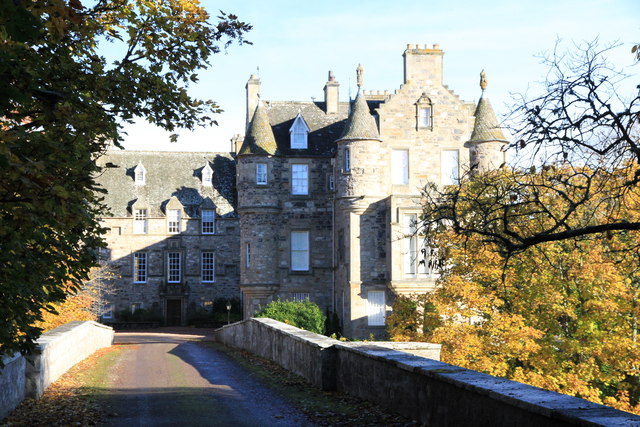
Image: Cullen House by Alan Hodgson, 1 November 2012, sourced from Wikimedia Commons and licensed under CC BY-SA 2.0.
.jpg)
.jpg#file)
Towers, turrets and crowstepped ranges record centuries of architectural change at the historic seat of the Seafield family.
Quick facts
- Date
- 1602 tower house with earlier fabric and major 17th–19th-century additions
- Architect / designer
- Successive estate architects; principal surviving mid-19th-century work by David Bryce
- Type
- Extended Z-plan mansion divided into private residences
- Designation
- Listed building, Category A (LB2219)
- OS grid reference
- NJ 50657 66316
Architecture, archaeology and continuing use
The large mansion combines two- to four-storey rubble and harled ranges around an extended Z-plan. Earlier doorways, dormerheads, angle turrets and seventeenth-century courtyard work sit beside the more emphatic Scottish Baronial remodelling completed by David Bryce.
Its story
A tower house rose on the site in 1600–02 and was repeatedly enlarged by the Findlater and Seafield family. Bryce reshaped major elevations in 1858–59. After sale in 1981, Douglas Forrest converted the mansion into thirteen homes; fire damaged the south ranges in 1987 before restoration.
Why it is included
Category A listing reflects the exceptional accumulated fabric, the quality of the Bryce work and the house’s central role in the history and relocation of Cullen.
What to notice
- Crowsteps, turrets and dormerheads across ranges of different dates.
- The elaborate courtyard doorpieces.
- Contrasts between small-paned early windows and Bryce’s larger openings.
Reading the surroundings
Cullen House is a private residential complex and is not open to visitors. The private grounds advertise limited pedestrian hours; follow entrance notices and keep to permitted roads.
Timeline
- 1600–02 The principal early tower house was constructed on an older site.
- 1858–59 David Bryce carried out the dominant Scottish Baronial remodelling.
- 1982–84 Douglas Forrest divided the mansion into thirteen separate homes.
- June 1987 Fire severely damaged the south and south-west portions before restoration.
What we know — and what remains uncertain
Earlier work by several prominent architects may survive beneath later alterations, but its extent is not securely established.
Sources & further reading
- Historic Environment Scotland: Cullen House, LB2219 — Designation status, mapped location, date, fabric and architectural or archaeological interest.
- Discover Cullen: Cullen House and Cullen Auld Kirk — Present residential use, restricted grounds access and public viewing guidance.
Location
OS grid reference NJ 50657 66316 · Location confidence: High: the national designation supplies an official mapped National Grid Reference; an additional source confirms the Place relationship, history or current identity. · Select the marker to open its satellite view in Google Maps. On desktop, drag Pegman (the yellow figure) onto a blue road. On mobile, turn on the Street View layer and tap a blue road. Other photo markers may be user-contributed.
Suggest a marker correction
Suggest a more accurate position
The teal marker is the current published position. The orange marker starts slightly to its right so both remain visible; this is only a visual starting position. Tap the correct place on the map or drag the orange marker. Sending this form creates a private review entry only; it does not move the published marker.
Check this area in Google Maps Choose the Satellite layer there if useful.
Map: © OpenStreetMap contributors. You can also enter checked coordinates below.