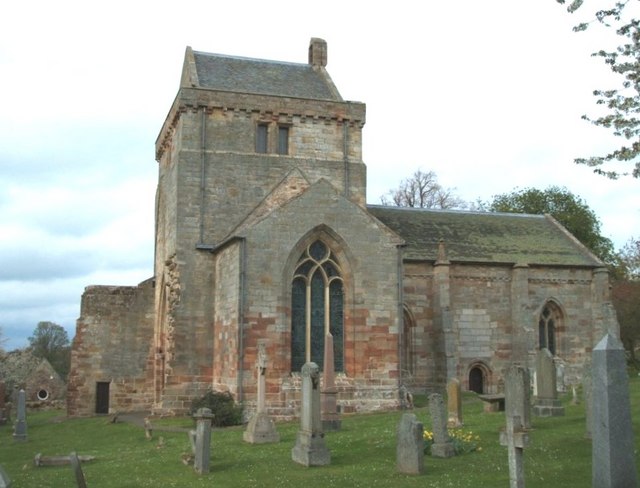
Image: Crichton Collegiate Church by Derek Ferris, sourced from Wikimedia Commons and licensed under CC BY-SA 2.0.

A missing nave leaves a powerful T-plan church whose central tower, vaulting and carved detail preserve a fifteenth-century collegiate foundation.
Quick facts
- Date
- 1449; restored 1898 and about 1998
- Architect / designer
- Medieval masons; Hardy and Wight; later Benjamin Tindall
- Type
- T-plan medieval collegiate church with central tower
- Designation
- Listed building, Category A (LB753)
- OS grid reference
- NT 38082 61614
Architecture and continuing use
Ashlar walls form choir and transepts around a square central tower. The blocked nave arch and surviving roof raggle make the lost western arm legible. Pointed barrel vaults, carved corbels, stair turret, armorial detail and later stained glass create a dense sequence from medieval fabric to Victorian restoration.
Its story
William Crichton founded a college of priests in 1449 and built the church beside his castle. It became a parish church in 1641, despite its remote position for some worshippers. Hardy and Wight restored the building in 1898, and further conservation followed around 1998. A trust now manages the site.
Why it is included
Category A listing recognises an outstanding collegiate church whose medieval fabric, restorations and relationship with Crichton Castle have national importance.
What to notice
- The blocked western arch and outline of the lost nave roof.
- The square tower rising above the crossing.
- Carved faces, corbels and stained glass within the surviving arms.
Reading the surroundings
Use the trust’s published Sunday opening or arrange a visit. Respect services, events and burials; some steps limit access and the building may close outside the advertised season.
Timeline
- 1449 William Crichton established the collegiate foundation and its church.
- 1641 The building became the parish church for the district.
- 1898 Hardy and Wight carried out a major restoration.
- 2026 The trust offers seasonal Sunday visiting and occasional services.
What we know — and what remains uncertain
Seasonal hours and event access can change. The trust’s current page should be checked before travelling.
Sources & further reading
- Historic Environment Scotland: Crichton Collegiate Church, LB753 — Current designation status, official mapped location, date, fabric and architectural or archaeological interest.
- Trove designation: LB753 — Parallel national record identity and archival context.
- Crichton Collegiate Church Trust: visitor information — Current seasonal opening hours, facilities, contact and travel guidance.
Location
OS grid reference NT 38082 61614 · Location confidence: High: the current national designation supplies an exact mapped National Grid Reference; public text separately states access and current-use uncertainty. · Select the marker to open its satellite view in Google Maps. On desktop, drag Pegman (the yellow figure) onto a blue road. On mobile, turn on the Street View layer and tap a blue road. Other photo markers may be user-contributed.
Suggest a marker correction
Suggest a more accurate position
The teal marker is the current published position. The orange marker starts slightly to its right so both remain visible; this is only a visual starting position. Tap the correct place on the map or drag the orange marker. Sending this form creates a private review entry only; it does not move the published marker.
Check this area in Google Maps Choose the Satellite layer there if useful.
Map: © OpenStreetMap contributors. You can also enter checked coordinates below.