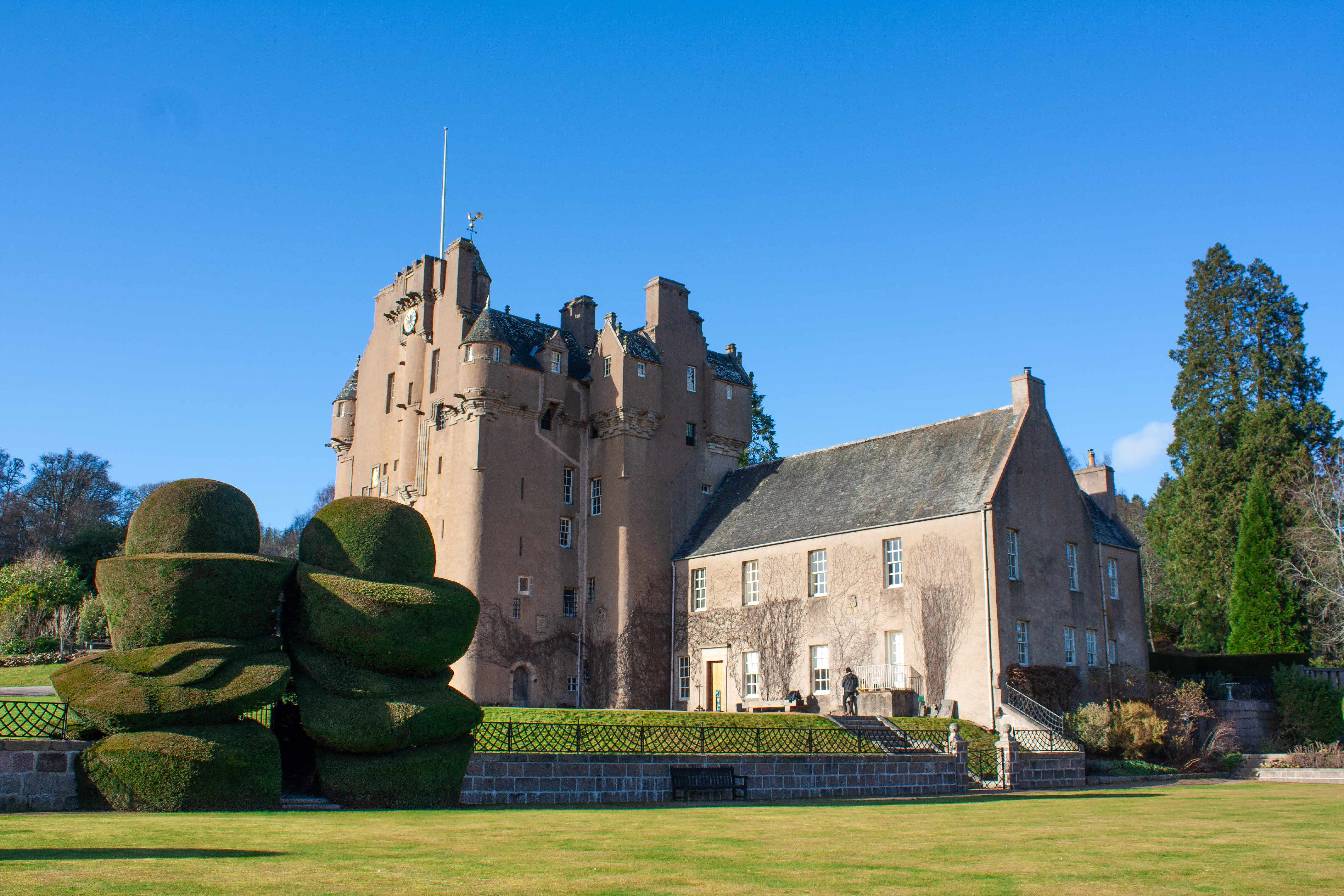
Photograph: Lucas Kendall, 22 February 2025. Wikimedia Commons source. Licensed under CC BY-SA 2.0. No modifications.

In brief
Crathes Castle is a compact, turreted late-sixteenth-century tower house celebrated for its sculptural skyline, painted ceilings and exceptionally close relationship with its formal gardens. Early-eighteenth- and nineteenth-century additions show how the Burnett family adapted the house while preserving its distinctive Renaissance character.
Quick facts
- Place
- Crathes, near Banchory, Aberdeenshire
- Building type
- Modified L-plan tower house
- Date
- Dated panels of 1553 and 1596; early-eighteenth-century east wing; additions of 1894
- Patron
- Built for Alexander Burnett; architect or master mason not securely recorded
- Designation
- Category A listed building, LB3262; the garden and designed landscape are separately included in the Inventory as GDL00119
A Renaissance tower house
Crathes rises through four principal storeys above a vaulted basement. Its modified L-plan gathers rooms around a projecting stair tower at the re-entrant angle, while corbelled turrets, angle rounds, crow-stepped gables and tall chimneys produce an animated roofline. Dated panels of 1553 and 1596 mark the long construction history, which culminated in the form of a defensible residence transformed by comfort and display.
The exterior’s pale harled walling and warm stone dressings make the silhouette unusually legible. Inside, the sequence of small chambers, turnpike stairs, oak panelling and surviving painted ceilings retains the close-grained atmosphere of a Scottish tower house rather than that of a later symmetrical mansion.
The Burnetts of Leys
Robert the Bruce granted land in the district to the Burnett family in 1323. Alexander Burnett began the castle that became their principal seat, and the family remained closely associated with Crathes for more than three and a half centuries. An east wing was added in the early eighteenth century and further additions followed in 1894, allowing the house to meet changing domestic expectations while keeping the sixteenth-century tower at its core.
Castle and garden
Crathes is especially important because its building and landscape can be read together. The garden has roots in the sixteenth century and was developed into a series of strongly defined compartments, with ancient yew hedges, topiary, walls, borders and long axes. Much of its modern character owes to the work of Sybil, Lady Burnett, while the surrounding woodland, park and walks extend the architectural experience into the wider estate.
Historic Environment Scotland assesses the designed landscape as outstanding as a work of art and for its horticultural and architectural value. The separate designation reflects the garden’s national importance in its own right.
Why it matters
Crathes combines the vertical drama and intimate rooms of a late Renaissance tower house with one of Scotland’s best-known formal gardens. Its exceptional preservation allows visitors to understand architecture, family history and landscape design as a single evolving composition.
What to notice
- The projecting stair tower and clustered corbelled turrets.
- The balance between defensive imagery and carefully staged domestic display.
- Painted ceilings and other decorative survivals inside.
- The contrast between the castle’s irregular skyline and the geometric order of the garden.
- Views framed by yew hedges, walls and garden compartments.
Current access
Crathes Castle, garden and estate are cared for by the National Trust for Scotland. Opening arrangements vary seasonally. The ticket area, accessible toilet, shop, café and much of the garden have level or step-free access. The castle’s ground floor can be accessed by wheelchair, but upper floors are reached only by stairs, including narrow spiral stairs. A designated parking area is available near the café and closer castle parking can be arranged. Check current visitor and accessibility information before travelling.
Timeline
- 1323 — Robert the Bruce grants nearby land to the Burnett family.
- 1553 — Date recorded on the castle, marking an early phase of construction.
- 1596 — Further dated work associated with completion of the late-sixteenth-century residence.
- Early 18th century — East wing added; the garden continues to develop.
- 1894 — Further architectural additions.
- 20th century — The formal garden is reshaped and enriched, notably under Sybil, Lady Burnett.
- Present — Castle, garden and estate cared for by the National Trust for Scotland.
What remains uncertain
The dated panels identify important moments, but they do not by themselves explain every construction phase, and the architect or master mason responsible for the principal sixteenth-century work is not securely documented. Later restoration and adaptation also require careful distinction from original fabric.
Sources and further reading
Explore Crathes
See the Crathes place page for the wider setting and future records.
OS grid reference NO 73413 96801 · Location confidence: High — statutory designation coordinates checked against the current visitor address · Select the marker to open its satellite view in Google Maps. On desktop, drag Pegman (the yellow figure) onto a blue road. On mobile, turn on the Street View layer and tap a blue road. Other photo markers may be user-contributed. The teal marker is the current published position. The orange marker starts slightly to its right so both remain visible; this is only a visual starting position. Tap the correct place on the map or drag the orange marker. Sending this form creates a private review entry only; it does not move the published marker. Check this area in Google Maps Choose the Satellite layer there if useful. Map: © OpenStreetMap contributors. You can also enter checked coordinates below.Location
Suggest a marker correction
Suggest a more accurate position